
Abu Ghosh (A-9347)
Permit/License Number
A-9347
Excavation Report
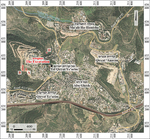
In September–October 2022, a trial excavation was conducted in the western area of Abu Ghosh (Permit No. A-9347; map ref. 209340–842/634108–501; Fig. 1), prior to building a new neighborhood. The excavation, on behalf of the Israel Antiquities Authority and funded by the Ministry of Housing, was directed by S. Gendler (metal detector), with the assistance of E. Aviv (area supervision), N. Nahama (administration), D. Ben-Ayoun (preliminary inspection), E. Marco (photogrammetry), Y. Zelinger and Y. Shalev (scientific consultation), and A. Eirikh-Rose from the IAA Yehuda District.
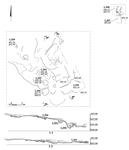
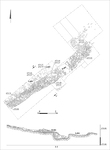
Three excavation areas (A, B, D) were opened on the slopes surrounding the western part of Abu Ghosh, west of Tel Qiryat Ye‘arim (Fig. 1). A building, a winepress and a burial cave were excavated in Area A, a quarry, rock-cuttings (winepress?), a hewn installation, a lime kiln and a subterranean space were uncovered in Area B, and a terrace wall was exposed in Area D.
A previous survey in the area recorded flint items dating to the Lower Paleolithic period, Byzantine-period burial caves and roads, and an installation and agricultural terraces that were not dated (Greenwald and Barda 2012). Excavations in the surrounding area found remains of a settlement and graves from the Neolithic period (Khalaily and Barzilai 2007; Khalaily and Marder 2003) and various remains dating from the Roman to the Ottoman periods (Zilberbod 2007a; Zilberbod 2007b; ‘Adawi 2016).
Area A (map ref. 209340/635108)
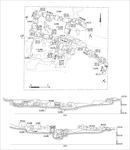
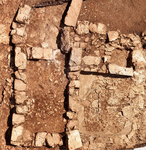
Building and Winepress (Figs. 2, 3). A rectangular building was exposed, comprising a single room (3.0 × 4.2 m) whose walls (W101A, W107, W112, W116) were dry-built of one row of large roughly hewn stones, preserved mostly for one course. The walls were founded directly on the bedrock, whilst the lower part of W107 was quarried to a depth of 0.2 m. The entrance into the building (width 1.2 m) was in W116, and two flat stones (0.5 × 1.2 m) that probably served as a threshold were found in it. The building’s floor (L125) was laid directly on the bedrock and was made of yellowish-red packed earth mixed with small stones.
Two parallel walls (W101B, W123), 1.6 m apart, extend eastward from the building, delineating a corridor or anteroom. The two walls (width 0.4 m, preserved height 0.4 m) were built of a single row of stones on virgin soil, along a northwest–southeast axis, W123 differing from the other walls of the building as it was mostly constructed of small fieldstones. While W101B abuts W101A, the relation of W123 to the building is not entirely certain, as it is not clear if the westernmost stone belongs to the wall, or if it collapsed from W107. The building style of W123, and the different orientation of the two walls from that of the building’s walls, suggests that the two walls may post-date the building. Another wall (W122; width 0.47 m, height 0.5 m), oriented northeast–southwest, abuts the eastern end of W123 and was only partially exposed. These walls may have been built at a later phase and have marked the boundaries of the building’s courtyard.
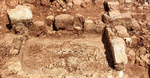
A hewn and built winepress, including a rectangular treading floor (L102; 2.5 × 3.0 m, maximum depth 0.8 m) and an irregularly shaped collecting vat to its east (L115; diam. 1.0 m, maximum depth 0.5 m), was uncovered next to and south of the building. The treading floor (L102) was hewn out of the rock and plastered (Fig. 4), the remains of plaster (L129) visible on the bottom and sides of the floor. The building’s southern wall (W107) delineated the treading floor on the north. Two plastered niches, an eastern one (L119; 0.18 × 0.34 × 0.37 m) and a western one (L120; 0.27 × 0.31 × 0.39 m), were built at the center of W107, facing the treading floor. The eastern side of the treading floor (W106) was built of roughly hewn fieldstones. It seems that the treading floor was originally delineated on the south and west by no longer extant walls. A channel (L128; length 0.35 m, width 8 cm) hewn in the eastern side of the treading floor below W106, led from it to Collecting Vat 115.
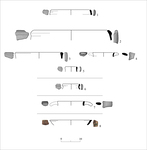
Numerous pottery sherds from various periods were found in earth fills on the surface north and west of the building and in the winepress complex (L103, L113), in an earth accumulation inside the building (L104), in the cleaning of W107 and in an earth accumulation (L124) in the corner of W122 and W123. The pottery finds include bowls (Fig. 5:1), kraters (Fig. 5:2, 3), a cooking pot (Fig. 5:4) and a jar (Fig. 5:5), all dated to Iron IIB, an Early Roman jar (Fig. 5:6), a Late Roman cooking pot (Fig. 5:7), and an Abbasid-period glazed bowl (Fig. 5:8). Since the pottery sherds were not found in situ, they cannot date the remains.
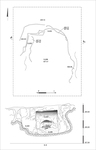
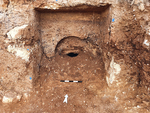
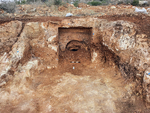
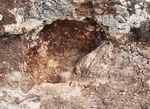
Burial Cave (Figs. 6–8). A cave quarried into a north-facing bedrock step was uncovered 15 m southwest of the building and wine press. The cave entrance was cleaned (L131), but the cave itself was not excavated. A courtyard (L130; 1.8 × 2.7 m, max. height of walls 1.95 m) was hewn in front of the cave, and a bench (L133; length 1.4 m, width 0.35 m, height 0.4 m) was apparently hewn adjacent to its western side. Four stepped frames were cut around the entrance to the cave: the outer frame is square (height 1.8 m, width 1.5 m, depth 0.9 m), the second arched (height 1.2 m, width 1 m, depth 0.15 m), the third square (width 0.65 m, depth 0.2 m; height unknown, since the entrance was not fully excavated) and the fourth frame is also arched (width 0.5 m, depth 0.45 m; height unknown, since the entrance was not fully excavated). No datable finds were discovered here, but the style indicates a Roman-period date for the cave.
Area B (map ref. 209273/635131)
Quarry (L201; 4.7 × 4.8 m; depth 0.2 m; Fig. 9). Stone-quarrying marks and severance channels were identified in the quarry. The size of the quarry is not known, but additional quarrying marks (L207) c. 11 m to the northeast indicate that it was not fully exposed and that it extended to the northeast.
Rock Cuttings (Fig. 9). A number of rock cuttings were discovered west of and adjacent to the quarry, probably a winepress comprising a treading floor (L204), a settling pit or sump (L203) and a collecting vat (L205). Treading Floor 204 (1.0 × 1.2 m) is shallow, cut into a southward-sloping rock and leading to the sump (L203; diam. 1 m, max. depth 0.7 m), with an irregular collecting vat (L205; 1.40 m × 1.56 m, max. depth 1.22 m) hewn to its south. A hewn basin (L209; diam. 0.4 m, max. depth 0.2 m) was uncovered 8 m northwest of the treading floor.
Installation (L208; Fig. 9). A shallow pit hewn into the rock (diam. 1.25 m, max. depth 0.36 m) was uncovered northeast of the quarry. Only its southern part was excavated, and its full extent is therefore not known. Two large elongated stones (0.12–0.18 × 0.44–0.65 m), placed parallel to each other and 0.22 m apart, were found at the center of the pit. Burnt earth or clay-like material was found between and around the stones, perhaps the remains of a tabun.
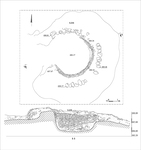
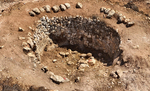
Lime Kiln (L211; Figs. 10, 11). A circular kiln (diam. 10 m) was found about 20 m south of the quarry; it was not excavated, but vegetation and collapse were removed from the surface. The firing chamber (diam. 4.7 m, max. depth 1.85 m), dug into the ground and lined with small and medium-sized fieldstones comprised the main remains of the kiln. A wall built of a line of large fieldstones on the surface, surrounded the firing chamber on the north, south and east, a single course of which survived. The wall probably served to support a vaulted superstructure. A stoking channel led to the western side of the firing chamber. Much lime was visible on the ground surface.
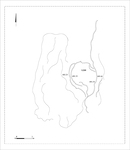
Underground Space (L210; Figs. 12, 13). A natural underground space (width 1.7 m, max. height 1.1 m) was found about 60 m north of the quarry. The opening was cleaned but the space itself was not excavated.
Area D (map ref. 209842/635501)
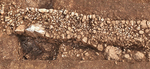
Terrace Wall (W401; exposed length 13 m, width 1 m, max. height 0.6 m; Figs. 14, 15). A wide double-faced wall with a northeast–southwest orientation was exposed on the northern bank of Nahal Yitla. The wall, extant for three courses, was built directly on the bedrock of two parallel lines of large and medium-sized stones and a fill of small and reddish-brown earth between them. It seems to be a terrace wall, since its construction is similar to terrace walls known in the area until recent times.
The finds uncovered shed light on the daily life and activities of the local inhabitants in the past. The excavation adds information regarding the agricultural hinterland of the ancient settlements at Abu Ghosh, Tel Qiryat Ye‘arim and Ḥorbat ‘Eres.
References
‘Adawi Z. 2016. Abu Ghosh. HA–ESI 128. https://doi.org/10.69704/jhaesi.116.2004.24913
Greenwald R. and Barda L. 2012. Abu Ghosh (North), Survey. HA–ESI 124. https://doi.org/10.69704/jhaesi.116.2004.1973
Khalaily H. and Marder O. 2003. The Neolithic Site of Abu Ghosh: The 1995 Excavations (IAA Reports 19). Jerusalem. https://doi.org/10.2307/j.ctt1fzhdmm
Khalaily H. and Barzilai O. 2007. Abu Ghosh. HA–ESI 119. https://doi.org/10.69704/jhaesi.116.2004.671
Zilberbod I. 2007a. Abu Ghosh (A). HA–ESI 119. https://doi.org/10.69704/jhaesi.116.2004.560
Zilberbod I. 2007b. Abu Ghosh (B). HA–ESI 119. https://doi.org/10.69704/jhaesi.116.2004.559
Keywords
Agricultural hinterland, Tel Qiryat Ye‘arim, Ḥorbat ‘Eres, winepress, burial cave, lime kiln, quarry, rock cuttings, Installations
Publication Date
14/05/2026
Report Type
Final Report