
Jerusalem, the Old City, the Archaeological Park (A-9477)
Permit/License Number
A-9477
Excavation Report
During 2019–2023, five excavation seasons were conducted in the Old City of Jerusalem next to the southwestern corner of the Temple Mount, within the Davidson Center, Jerusalem Archaeological Park (Permits Nos. A-8466, A-8650, A-8931, A-9204, A-9477; map ref. 222307–35/631414–37). The excavation was part of the project to conserve the archaeological remains and set up new paths for visitors within the site, and it was undertaken on behalf of the Israel Antiquities Authority and funded by the Ministry of Tourism and the Elad Association. The excavation was directed by Y. Baruch (2019–2023 seasons), along with M. Hagbi (2019, 2020 seasons), O. Bejarano (2020 season), N. Rom (2021–2023 seasons), H. Machline (2021 season) and A. Zilberstein (2022 season), with the assistance of V. Essman (surveying), A. Wiegmann (photogrammetry), S. Halevi (field photography and photogrammetry), O. Zakaim (3D models and graphic design), S. Terem, H. Machline and D. Sandhous (pottery), Y. Levi (numismatics), Y. Gorin-Rosen and M. Zindel (glass), L. Perry-Gal (zooarchaeology), M. Shor and Y. Asscher (construction materials analyses; analytical laboratory), U. Basson (GPR), Y. Vaknin (on-site conservation) and J. Regev and E. Boaretto (dating examinations). Hundreds of youth, soldiers, premilitary-program students, volunteers and a team of excavation workman under the direction of N. Mizrahi took part in the excavations. Special thanks go to Kobi Gur-Arieh, Eli Sharir and Uria Dasberg of the Elad Association, and to Y. Shalev, N. Sapir and A. Re‘em of the IAA Jerusalem Region for their help and support.
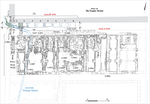
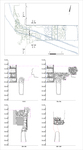
The excavation was carried out in two areas (A, B; Fig. 1). Area A was opened south of the Temple Mount precinct, and the excavation here focused on ten rooms along the northern wall of an Umayyad-period building, most of which had been previously exposed (Ben-Dov 1971: Fig. 1: Building II). The excavation allowed the re-examination of some architectural aspects of Building II, and specifically its specific construction methods, including the extensive reuse of stones and architectural elements (spolia). The excavation of the building identified the remains of four strata: the Early Roman period (Stratum 4; first century CE until the destruction of 70 CE), the Late Roman period (Stratum 3; second–fourth centuries CE), the Late Roman–Early Byzantine periods (Stratum 2; fourth–fifth centuries CE), and the Umayyad period (Stratum 1; early eighth century CE).
The excavation of Area B was located in a strip along the foundations of the southern wall of the Temple Mount precinct, from its southwestern corner eastward for about 32 m, exposing a row of built cells (1–8), dated to the first half of the first century CE. These cells were partly investigated by the British PEF Survey (Wilson and Warren 1871:96–101), and about a century later by the Mazar archaeological expedition (Mazar 1971). The present excavation was carried out below the level of the first-century CE stepped stone street that was uncovered in the past. Since the Stepped Street is one of the highlights for visitors in the archaeological park today, the excavation in Area B was carried out in an underground tunnel below the street to prevent damaging it. Prior to the excavation, complex engineering works were carried out to support and stabilize the overlying ground surface, including drilling, foundation piles, and constructing a stable ceiling. The excavation was carried out horizontally—inward from the section surface —to a depth of c. 1.5 m and a height of c. 1 m, creating a relatively flattish level that could then be excavated vertically. In the first excavation season in 2019—before the cells were uncovered—the roof of a monumental Herodian-period drainage channel was dismantled next to the southwestern corner of the Temple Mount precinct.
Area A
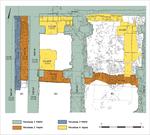
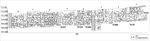
At the outset of the excavation, much vegetation was uprooted, and spoil-heaps and garden soil overlying the whole area after the previous expedition's excavations had concluded were removed. Ten rooms (Rooms II1–II10; Fig. 2) along the northern site of Building II were excavated, uncovering four occupation strata (4–1).
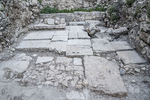
Stratum 4—Early Roman Period (first century down to the destruction in 70 CE). Segments of a street laid in the first century CE were uncovered within the area of Rooms II1–II9 (Fig. 3). This area was exposed in the previous excavations and defined as an open area (estimated width c. 7 m; Mazar 1971:4). The street is almost level with a slight north–south slope. Curb stones were uncovered on the northern edge of the street, and a bordering wall (width 0.8 m; Fig. 3) was built to their north. Thresholds of entrances leading to rooms below the Stepped Street, similar to the cells uncovered in Area B (see below), were set in some of the wall-stones. In Rooms II5 and II6, about 7 m south of the street’s northern wall, the top of a massive wall, understood in the previous excavations as the street’s southern retaining wall (Mazar 1971), was re-exposed. The street was paved with large limestone slabs, mostly Meleke stone, of various sizes (average thickness c. 0.3 m), smoothed on their upper surface and roughly dressed on the underside. Some slabs are missing, presumably uprooted and removed for secondary use. The slabs were carefully laid on a solid bedding of various-sized stones bonded with grayish mortar. A fissure was exposed along the entire length of the southern side of the street, and the adjacent paving stones were slightly sunk, the reasons for the fissure not yet clarified.
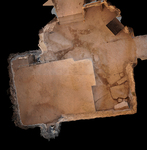
At the western end of the street, in Rooms II1 and II2, an exceptionally large paving slab was uncovered (L1075; 0.40 × 2.75 × 3.84 m; estimated weight c. 5.5 tons; Fig. 4). In Room II5, four large, rough rectangular slabs (L1182) were exposed, laid over a bedding of large, rough stones, unlike the other street pavers; these stones were laid at a slightly higher level than the street surface.
A street curb-stone in which an arched drainage opening was set, was found in Room II6. The opening apparently drained run-off water from the street to a drainage channel uncovered in Room II9. The channel’s poor state of preservation allowed partial excavation, uncovering earth accumulations containing many fragments of glass vessels dated to the fourth–fifth centuries CE; however, there is no doubt that this is an earlier drainage channel connected to the street.
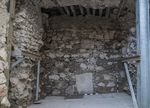
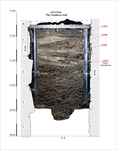
Stratum 3—Late Roman Period (second–fourth centuries CE). In Room II1, a massive wide wall, oriented north–south (W1111; estimated width c. 1.1 m, exposed length c. 3 m; Figs. 3, 5) was discovered, and a thick layer of earth and stones fill (thickness 1.3 m; Fig. 6) abutted it on the east. Wall 1111 and the fill layers were set directly on the Stratum 4 street, and sealed below the foundations of the later Strata 2 and 1 buildings, the wall continuing south beyond the excavation boundaries. The wall was constructed of stone fragments cemented with bonding material of small stones, earth and mortar, and also containing pottery sherds, the latest dating to the early second century CE. A few large Herodian-period stones and a fragment of a column segment from the collapsed piles of the destroyed Temple Mount, were incorporated in the base of the wall, and were carefully laid directly on the paving slabs of the Stratum 4 street.
Pottery sherds, coins and other small finds were found in the core of W1111 and in the fills, the latest finds dating to the first half of the second century CE, and the earlier finds to Iron Age IIB–C, the Hellenistic and Hasmonean periods, and the end of the Second Temple Period; a Tyrian shekel dating to 26–27 CE was found in the core of the wall. A black stone seal with a winged figure and an ancient Hebrew inscription on both sides of the figure, was found within the fills (Vukosavović et al. 2024).
Stratum 2—Late Roman–Early Byzantine Periods (fourth–fifth centuries CE). The Stratum 2 building remains include two walls (W1102, W1110) forming the corner of a partly exposed building. The walls, constructed of medium-sized and small fieldstones bonded with light mortar, were set directly over and sealing the Stratum 3 fills. Wall 1110 was adjacent to and east of Stratum 3 W1111, and W1102 was uncovered in Rooms II1 and II2, its probable eastern extension (W1164) uncovered in Room II3. The upper part of the wall was plastered with grayish hydraulic plaster; particularly marked in Room II2. The preliminary examination of the finds from the core of W1110 permits cautiously suggesting that the walls were part of a fourth–fifth century CE building.
Stratum 1—Umayyad Period (beginning eighth century CE). Part of a wall (W1056; see Fig. 2) that served as the foundation of one of Building II’s walls (W202), was dismantled in the excavation. The wall was built of various-sized stones bonded with strong, dark gray mortar, whose dismantlement required mechanical ‘congo’ equipment. The wall was built over the Stratum 3 fills, and adjacent to Stratum 2 W1110 and Stratum 3 W1111 on the east (Fig. 7).
Building II and the adjacent building were previously dated to the Umayyad period (Ben-Dov 1971). Doubts regarding this date for these buildings, or at least some of them, were raised over the years (e.g., Baruch and Reich 2002). These buildings were intensively restored, and some of the walls were reconstructed without documentation, rendering an architectural analysis very difficult. Nonetheless, the excavation exposed a sequence of adjacent walls (Fig. 7), built successively in Strata 3, 2 and 1, thus contributes to the understanding of the building phases prior to Building II, possibly to the attempts to date Building II.
Area B
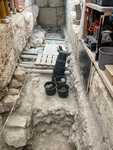
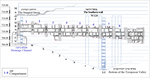
The excavation was carried out in an underground tunnel (length c. 32 m, average height c. 3.5 m) along the foundations of the southern wall of the Temple Mount precinct. A row of eight rectangular cells was uncovered (1–8; average cell size c. 2.5 × 3.4 m; Fig. 8), adjacent to the southern face of the six foundation courses of the precinct wall (Courses Q–V; Warren 1884: Pl. XXVII). The excavation began next to the southwestern corner of the Temple Mount precinct, and exposed a few stones from the precinct’s corner, built of large stones laid in headers and stretchers technique; the southeastern corner of the precinct was built in a similar technique (Baruch and Reich 2023:387–391). The excavated segment of the wall’s foundation courses was constructed of various-sized building stones (length 1.0–6.3 m), mostly whitish-beige in color, and occasionally light pinkish. The long corner stones were entirely dressed, while the other stones were only dressed along the margins.
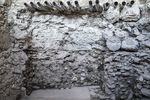
A shared long wall of all the cells (W122; Fig. 9) was built parallel to the fortification wall, about 2.5 m to its south, integrated with the cross walls that delineated the cells. The integrated wall structure provided strength and stability to the cell construction. The cross walls (width c. 0.8 m) incorporated building stones in secondary use together with stone fragments, the source of which was probably in adjacent houses and buildings that were intentionally and completely dismantled when the area was cleared of its occupants, prior to the project of extending the Temple Mount precinct, initiated during Herod’s lifetime. The cells were all deliberately filled with earth and gravel (Fig. 10), the fill layers loose, whilst some packed earth deposits were documented in a few intermittent places. A stone layer covering the bedrock was exposed at the bottom of Cells 1 and 2, possibly also extant in the other cells. It seems that all the cells were built on bedrock, although this assumption was only demonstrated in the excavation in Cell 1, as to its east the rock descends sharply to the east, down to the Tyropoeon valley floor (see Fig. 8). It seems that the row of built cells had a role in the preparation of the area by the engineers prior to its construction and the building of the roads leading to it (Baruch et al. 2024).
Numerous varied finds were discovered in the fill of the cells: pottery sherds, stone and glass vessels, metal objects, coins, animal bones and much organic material. The preliminary analysis of the finds suggests that the cells were constructed over a long period, starting with Herod’s reign, through the first quarter of the first century CE, and perhaps even later.
During the first excavation season in 2019, before the cells were uncovered, a restricted area extending from the southwestern corner of the Temple Mount precinct southward was excavated. The previous excavations of this area uncovered the walls of a cell (Hagbi and Uziel 2015: W102, W14044, W14045) built next to the southwestern corner of the Temple Mount precinct, and row of cells extended from it to the north along the western fortification wall, similar to the cells uncovered along the southern wall. Wall 14045 (width c. 1.3 m), abutting the southwestern corner of the Temple Mount precinct on the west, was partially dismantled during the excavation. Wall 14044, with a curving contour, was built over the vaulted ceiling of a monumental Herodian-period drainage channel (Shukrun and Reich 2011; Reich and Shukrun 2012). A segment of the channel’s ceiling was dismantled in the present excavation (Fig. 11) to allow an undisturbed view from the channel to the full height of the southwestern corner of the Temple Mount precinct above it, thus enhancing the experience of the visit in the drainage channel itself.
This short report describes the main finds from the excavation seasons of 2019–2023. To date, building remains from four periods were uncovered (Strata 4–1), as well as artifacts with no stratigraphic context from the end of the Iron Age and the end of the Hellenistic period. The remains of the buildings, the pottery assemblages and the other finds indicate the changes took place in this area between the end of the Second Temple period and the end of the Byzantine or Umayyad periods, after which building in this area of the city ceased.
References
Baruch Y., Rom N., Zeilberstein A., Machline H. and Reich R. 2024. The Southern Wall of the Jerusalem Temple Mount and the Road System Leading to its Gates. In O. Peleg-Barkat, Y. Zelinger, Y. Gadot and Y. Shalev eds. New Studies in the Archaeology of Jerusalem and its Region: Collected Papers XVII. Jerusalem. Pp. 53–74 (Hebrew; English Summary, p. 133*).
Ben-Dov M. 1971. The Omayyad Structures Near the Temple Mount (Preliminary Report). Eretz Israel 10:35–40 (Hebrew).
Hagbi M. and Uziel J. 2015. Jerusalem, the Old City, the Western Wall Foundations. HA–ESI 127. https://doi.org/10.69704/jhaesi.116.2004.15729
Mazar B. 1971. The Excavations in the Old City of Jerusalem near the Temple Mount—Second Preliminary Report, 1969–70 Seasons. Eretz Israel 10:1–34 (Hebrew).
Reich R. and Shukron E. 2012. Excavations Next to Robinson’s Arch 2011—From the Level of the Paved Street to Bedrock. In E. Baruch, A. Levy-Reifer and A. Faust eds. New Studies on Jerusalem 17. Ramat Gan. Pp. 219–238 (Hebrew).
Shukron E. and Reich R. 2011. Jerusalem, Robinson’s Arch. HA–ESI 123.
https://doi.org/10.69704/jhaesi.116.2004.1884
Vukosavović F., Reich R., Rom N. and Baruch Y. 2024. An Iron Age IIB–C Hebrew Stamp Seal with Apotropaic and Prophylactic Properties from the Southwestern Corner of the Temple Mount, Jerusalem. ‘Atiqot 116:125–142. https://doi.org/10.70967/2948-040X.1127
Warren C.1884. Plans, Elevations, Sections: Showing the Results of the Excavations at Jerusalem, 1867–1870. London.
Keywords
Davidson Archaeological Park, Ophel, Temple Mount, Southern Wall of the Temple Mount, Second Temple Period, Roman Period, Byzantine Period, Umayyad Period, Umayyad Building II
Publication Date
18/05/2026
Report Type
Preliminary Report