
Jerusalem, Giv‘ati Parking Lot—2021–2022 (G-3/2021, G-1/2022)
Permit/License Number
G-3/2021, G-1/2022
Excavation Report
During January 2021–December 2022, two excavation seasons were conducted in the Giv‘ati Parking Lot, in the City of David, Jerusalem (Permit Nos. G-3/2021, G-1/2022; map ref. 22235–8/63130–4). The excavations, carried out on behalf of the Israel Antiquities Authority and Tel Aviv University, and funded by the El‘ad Association were directed by Y. Gadot and Y. Shalev, with the assistance of E. Bocher (senior field archaeologists), O. Bejarano (area supervisor and photogrammetry), M. Hacohen (assistant area supervisor), Y. Zelinger (scientific guidance), N. Mizrachi (administration), V. Essman (surveying and drafting), A. Wiegmann and A. Zakaim (photogrammetry), A. Peretz, C. Harati and S. Halevi (Field photography), Y. Vaknin and I. Kelman (conservation), R. Abu Diab (mosaic conservation), D. Sandhaus, L. Freud and A. Berlin (pottery), Y. Wiener and S. Salem (pottery restoration), C. Harosh and I. Lidsky-Reznikov (pottery drawing and scanning), D.T. Ariel (numismatics and amphorae handles), R. Kool (numismatics), D. Langgut and Y. Hockima (archaeobotany), L. Sapir Hen and A. Spiciarich (zooarchaeology), D. Gazit (studio photography), H. Kupershmidt, I. Reznitsky, I. Naor and A. Grinstein (objects conservation and metal laboratory), A. Van-Zuiden and M. Shor (plaster analysis), Y. Regev and E. Boaretto (C14). Workers of the El‘ad Association participated in the excavation, along with students from premilitary programs and girls’ high schools, as well as groups of volunteers from Volunteering for Israel.
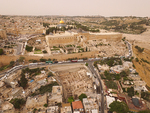
The Giv‘ati Parking Lot is located on the northwestern spur of the City of David, on the slope that descends westwards to the Tyropoeon Valley (Fig. 1). A large number of excavations were conducted at the site in the past, and a stratigraphic sequence dated from the Iron Age IIA to the Early Islamic period that continued into the Mamluk and Ottoman periods was uncovered (Shalom et al. 2021, and see there for further references; Ben-Ami 2020b; 2020c; Shalev et al. 2020; 2022a; 2022b).
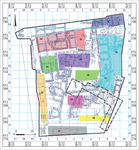
The excavation focused on three areas (65, 70 and 75; Fig. 2). In the eastern (70) and southern (65) parts of the site remains from the Iron Age, Hellenistic, Roman, Byzantine and Early Islamic periods were discovered. The aim of the excavation in Area 65 was to lower the level of the area and the sections around so as to create a stepped section that will allow optimal preservation of the remains and adequate representation of all the periods at the site.
Area 65—the Hellenistic, Late Roman, Byzantine and Early Islamic Periods. There are three squares oriented east–west in this area, in which an earthen fill from the late Hellenistic period was previously found. Into the Hellenistic fill building foundations and installations from the Late Roman, Byzantine and Early Islamic (Abbasid) periods were dug (Shukron and Reich 2005; Ben-Ami and Tchekhanovets 2008; 2010; 2013).
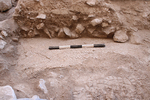
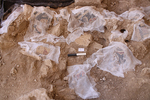
The current excavation uncovered the southern portion of a large building dating to the end of the Byzantine–beginning of the Early Islamic period (the sixth–eighth centuries CE; Phase 65/IV). The northern part of this structure had been previously exposed in earlier excavations (Shukron and Reich 2005; Ben-Ami 2013:43–49). The current excavation exposed two large rooms, an eastern and a western one, divided by a wide ashlar wall (W6554). In the Eastern Room a segment of a white mosaic floor was uncovered in situ (L6577; Fig. 3), abutting W6554 from the east. While this specific section of the floor consisted solely of white tesserae, numerous segments of mosaic recovered from the building’s debris (Fig. 4), as well as from an Early Islamic period pit (below) and previous excavations in the northern portion of the structure, indicate that the building originally featured polychrome mosaics decorated with floral and geometric patterns.
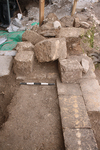
In the Western Room segments of a pavement (L6643, Fig. 5) made of large, smoothed stone slabs were exposed. The paving is poorly preserved; however, similar segments were found in the northern part of the building during past excavation seasons. It is possible that this paved area served as a courtyard or an anteroom providing access to the structure from the street that was previously identified to its west. At the western edge of the excavated area, a small drainage channel was exposed. The channel was cut on its eastern side by an Early-Islamic pit (L6615), but it continues west beneath the street’s paving.
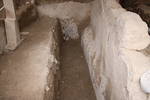
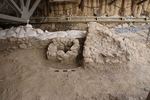
During the Early Islamic period (Phase 65/III–II) the Byzantine period building was destroyed, probably deliberately, and some of its walls were used in the construction of a new building. The mosaic floor in the eastern room was dismantled and thrown to a refuse pit. Additional refuse pits were found throughout the area containing fragments of tile, mortar and stucco, tesserae and fragments of hewn stone—most of which belonged to the destroyed building. The foundations of W6554, that divided the eastern and western rooms in the Byzantine period building, were coated with a thick layer of plaster and served as the western wall of a large cistern (L6600; Fig. 6), which, in turn, cuts the Byzantine Floor 6577, and therefore postdates it. The cistern was eventually filled with earth, yielding finds no later than the Early Islamic period. In the western part of the area there are two stone-lined pits (W6520, L6539; Fig. 7). Pit 6520 is bell-like, widening as it deepens, and beside it there is a layer of fieldstones, suggesting that the pit and a fieldstones layer may have been contemporary. Pit 6539 was discovered underneath this fieldstones layer and was sealed by it. The sealed pit, together with the wall remnants and floors exposed in the eastern part of the area indicate that the Early-Islamic period building had at least two construction phases. This observation was demonstrated in the past in other buildings of this period at the site (Ben-Ami 2020a:3–4).
Area 70—The Iron Age, and the Hellenistic, Early Roman and Late Roman periods. In this area there are six squares arranged in two parallel rows oriented north–south, and a wide east–west trench (width c. 30 m, min. depth 8 m) which had previously been uncovered but not excavated to its full depth. The trench has been identified as a moat that was quarried at the end of the ninth–beginning of the eighth century BCE (Gadot et al. 2023). The southern scarp of the trench was quarried as a vertical cliff (exposed depth 5 m). During the Iron Age and Hellenistic periods broad walls were built abutting the southern face of the moat (Shalev et al. 2019:53–60).
The northern scarp of the trench, however, was quarried in wide steps (height of each step c. 3 m). On the tread of the second step, a rock-cut installation was found (Fig. 8). This installation contains five shallow channels: one longitudinal channel from which three channels branch southward, and one southwestward. While the exact function and date of this installation remains unclear, it seems to postdate the original quarrying of the moat. In the two easternmost southward-reaching channels, an earth fill which was sealed by a thick layer of crushed limestone was uncovered. Pottery fragments from this fill are dated to the Iron Age IIA/IIB transition (Shalev et al. 2023).
Adjacent to the rock step to the west, a wall of large fieldstones was constructed along the slope to fill the natural cavities and cracks in the bedrock. West of this fieldstone wall and above the bedrock several segments of yellowish tamped earth floor were found. These floor segments are similar to floors that were previously found in a Hellenistic-period building in Area 10 (Shalom et al. 2021). Sparse pottery dating to the 3rd–2nd centuries BCE was recovered from this floor.
Throughout the area, the moat and earlier remains were covered by earthen fills (min. depth 5 m). In the eastern squares, the fills mostly slope from northeast to southwest, indicating that they were poured into the squares from the top of the northern cliff. However, the fills in the western squares were poured from east to west. Similar fills were previously documented elsewhere at the site, especially in Area 70. These fills were dated to the late Hellenistic period, perhaps during the Hasmonean period (end of second century BCE; Ben-Ami and Tchekhanovets 2015; Vukosavović et al. 2022). On these fills were built walls and installations from the Early and Late Roman periods (Shalom et al. 2021).
Area 75—The Iron Age and the Early Roman, Late Roman and Byzantine Periods. In area 75 a rock-cut installation was uncovered on the tread of a bedrock step, bearing a striking resemblance to the one found in Area 70 (Fig. 9). The installation consists of a single longitudinal channel from which eight secondary channels branch northwards beyond the excavation boundaries. Three of these channels had been exposed in the past (Ben-Ami and Tchekhanovets pers. comm.). The middle channel is of special interest since it does not connect to the vertical channel but instead originates in the center of the bedrock. Since no clear sealing layer was found directly above these channels, the installation was dated to the Iron Age on the basis of its similarity to an installation from Area 70.
To the west of the channel installation, slightly above the bedrock, the external face of a plastered square installation was visible in the section. Although not fully excavated, as the plaster square lies outside of the excavation boundaries, its shape and the quality of the plaster align with the numerous Early-Roman installations that were previously found at the site. A Late-Roman wall and a number of walls from the Byzantine period were also uncovered. The walls were part of a building previously uncovered along the northern boundary of the excavation area (Ben-Ami and Tchekhanovets 2013). These walls are fairly wide, and their foundations dug deep into the ground, reaching the bedrock and cutting through earlier fills that must have covered the moat prior to the Roman period.
References
Ben-Ami D. 2013. Jerusalem: Excavations in the Tyropoeon Valley (Giv‘ati Parking Lot) I (IAA Reports 52). Jerusalem. https://doi.org/10.2307/j.ctt1fzhdtq
Ben-Ami D. 2020a. Introduction. In D. Ben-Ami and Y. Tchekhanovets. Jerusalem: Excavations in the Tyropoeon Valley (Giv‘ati Parking Lot) II: The Byzantine and Early Islamic Periods (IAA Reports 66/1). Jerusalem. Pp. 1–4. https://doi.org/10.2307/j.ctv1fkgc5q.5
Ben-Ami D. 2020b. Strata IV–I: The Early Islamic Period; Stratigraphy and Architecture. In D. Ben-Ami and Y. Tchekhanovets. Jerusalem: Excavations in the Tyropoeon Valley (Giv‘ati Parking Lot) II: The Byzantine and Early Islamic Periods (IAA Reports 66/2). Jerusalem. Pp. 271–373. https://doi.org/10.2307/j.ctv1fkgc67
Ben-Ami D. 2020c. Stratum V: The Byzantine Period; Stratigraphy and Architecture. In D. Ben-Ami and Y. Tchekhanovets. Jerusalem: Excavations in the Tyropoeon Valley (Giv‘ati Parking Lot) II: The Byzantine and Early Islamic Periods (IAA Reports 66/1). Jerusalem. Pp. 5–69. https://doi.org/10.2307/j.ctv1fkgc5q.6
Ben-Ami D. and Tchekhanovets Y. 2008. Jerusalem, Giv‘ati Parking Lot. HA-ESI 120. https://doi.org/10.69704/jhaesi.116.2004.873
Ben-Ami D. and Tchekhanovets Y. 2010. Jerusalem, Giv‘ati Parking Lot. HA–ESI 122. https://doi.org/10.69704/jhaesi.116.2004.1377
Ben-Ami D. and Tchekhanovets Y. 2013. Jerusalem, Giv‘ati Parking Lot. HA–ESI 125. https://doi.org/10.69704/jhaesi.116.2004.5432
Ben-Ami D. and Tchekhanovets Y. 2015. “… and they also that were in the city of David in Jerusalem, who had made themselves a tower” (1 Macc., 14.36). The Seleucid Fortification System at the Giv‘ati Parking Lot, City of David. In G.D. Stiebel, O. Peleg-Barkat, D. Ben-Ami and Y. Gadot eds. New Studies in the Archaeology of Jerusalem and its Region. Collected Papers IX. Jerusalem. Pp. 313–322 (Hebrew).
Gadot Y., Bocher E., Freud L. and Shalev Y. 2023. An Early Iron Age Moat in Jerusalem between the Ophel and the Southeastern Ridge/City of David. Tel Aviv 50/2:147–170. https://doi.org/10.1080/03344355.2023.2246811
Shalev Y., Gellman D., Bocher E., Freud L., Porat N. and Gadot Y. 2019. The Fortifications along the Western Slope of the City of David: A New Perspective. In O. Peleg-Barkat, Y. Zelinger, J. Uziel and Y. Gadot eds. New Studies in the Archaeology of Jerusalem and Its Region: Collected Papers XIII. Jerusalem. Pp. 51–70 (Hebrew).
Shalev Y., Shalom N., Bocher E. and Gadot Y. 2020. New Evidence on the Location and Nature of Iron Age, Persian and Early Hellenistic Period Jerusalem. Tel Aviv 47:149–172. https://doi.org/10.1080/03344355.2020.1707451
Shalev Y., Avisar R., Freud L., Koch I., Bocher E., Shalom N. and Gadot Y. 2022a. “And he had prepared for him a great chamber” (Nehemiah 13: 5): Examining Jerusalem’s Elite in the Terminal Phases of the Iron Age through Building 100 in the Giv’ati Parking Lot Excavations. In Y. Gadot, Y. Zelinger, O. Peleg-Barkat and Y. Shalev eds. New Studies in the Archaeology of Jerusalem and Its Region: Collected Papers XV. Jerusalem. Pp. 89–106 (Hebrew).
Shalev Y., Gadot Y., Bocher E., Bejarano O., Gellman D., Sindel M., Zalut Har-Tuv R., Machline H., Roth H. and Shalom N. 2022b. The Giv‘ati Parking Lot Excavations: Four Years of the Renewed Excavations (2017–2020). Qadmoniot 164:24–35 (Hebrew).
Shalev Y., Bocher E., Gellman D., Bejarano O., Freud L. and Gadot Y. 2023. News from the Excavations Under the Givati Parking Lot: The Unique Canal Facilities and the Question of Jerusalem’s Growth in the Ninth Century BCE. In Y. Shalev, O. Peleg-Barkat, Y. Zelinger and Y. Gadot eds. New Studies in the Archaeology of Jerusalem and Its Region: Collected Papers XVI. Jerusalem. Pp. 63–85 (Hebrew).
Shalom N., Gadot Y., Bocher E., Machline H. and Shalev Y. 2021. Jerusalem, Giv‘ati Parking Lot 2017–2018. HA–ESI 133. https://doi.org/10.69704/jhaesi.116.2004.26089
Shukron E. and Reich R. 2005. Jerusalem, City of David, the Giv‘ati Car Park. HA–ESI 117. https://doi.org/10.69704/jhaesi.116.2004.250
Vukosavović F., Cohen-Weinberger A., Gadot Y., Bocher E., Bejarano O. and Shalev Y. 2022. Hellenistic Roof Tiles in Jerusalem. Journal of Hellenistic Pottery and Material Culture 6:45–63.
Keywords
City of David, Iron Age, Hellenistic Period, Roman Period, Byzantine Period, Early Islamic Period
Publication Date
19/05/2026
Report Type
Preliminary Report