
Gan Yavne, Survey (S-787/2017)
Permit/License Number
S-787/2017
Excavation Report
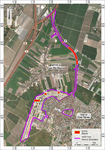
In August 2017, a development survey was conducted at Gan Yavne (Permit No. S-787/2017; map ref. 171176–2790/632822–6427; Fig. 1), prior to construction. The survey, on behalf of the Israel Antiquities Authority and funded by Arim Urban Development Company Ltd., was directed by A. Dayan (field photography), with the assistance of Y. Elisha, Y. Arbel, C. Ben-Ari, I. Jonish and Y. Mermelstein (survey, aerial photography), M. Mullokandov, A. Acksman and Y. Sitton (survey), A. Dagot (GPS) and P. Gendelman (pottery identification).
The survey area encompassed two archaeological sites: Gan Ha-Darom (Dayan et al. 2020, see map with additional sites in the vicinity) and Ḥorbat Meshullam. The site of Gan Ha-Darom extends over a low hill, and remains of an extensive settlement, installations and pottery dating from the Roman to Ottoman periods have been found here (Barda and Zbenovich 2005). At Ḥorbat Meshullam, a Byzantine-period installation was previously exposed (Kanias 2006). Several previous excavations, most exposing remains from the Byzantine period, were conducted to the south of the surveyed area (Ben-Ari 2012, see there additional excavation).
Seven find-spots with ancient remains (Fig. 1:1–7) were identified in the survey, described here from north to south.
1. About 300 m north of the Gan Ha-Darom site, the top of a few stones was visible on the surface, as well as small pottery body sherds dated to the Byzantine–Umayyad periods.
2. The remains of a tabun and numerous pottery sherds dating mostly to the Byzantine period, and including jars and a casserole, and a few sherds dating to the Late Roman–Early Byzantine periods were found on the surface north of the Gan Ha-Darom site.
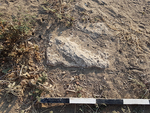
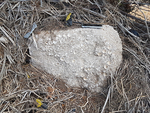
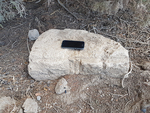
3. Kurkar stones, some hewn and whose tops were visible on the surface, were identified at the Gan Ha-Darom site (Fig. 2), possibly the remains of a building. Building remains found at the edge of an earthen path included two hewn beach rocks, one large dressed stone (0.1 × 0.5 × 0.6 m; Fig. 3), the other medium-sized (0.2 × 0.3 m), and a large hewn kurkar stone (0.3 × 0.5 m; Fig. 4).
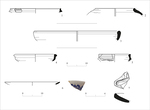
4. Scattered pottery sherds, probably dating to the Byzantine period, and the top of a kurkar stone visible on the surface, were found northeast of Ḥorbat Meshullam. A krater sherd from the Early Islamic period (Fig. 5:3), and a nineteenth–twentieth century porcelain bowl (Fig. 5:6) were also retrieved.
5. About 150 m north of Ḥorbat Meshullam, a concentration of Byzantine-period pottery sherds was found. In the area north of the site, a few scattered pottery sherds, included Late Roman–Byzantine-period body sherds, an Early-Islamic-period jar rim, and two Ottoman-period bowls: a simple bowl (Fig. 5:4) dated to the seventeenth–nineteenth centuries CE, and a Gaza Ware bowl (Fig. 5:5) dated to the eighteenth–nineteenth centuries CE.
6. Part of a broken installation coated with hydraulic plaster, and many scattered stones that were probably part of another installation, damaged by modern agricultural activity, were found in the northern area of Ḥorbat Meshullam. Additional finds included many Roman–Byzantine-period pottery sherds, including a LRC bowl (Fig. 5:1), a Gaza Ware jar (Fig. 5:2), and an Ottoman-period wheelmade open lamp nozzle (Fig. 5:7). Many Byzantine-period sherds were found in the area of the ruin.
7. Scattered sherds, including many body sherds that probably date to the Roman–Byzantine periods, were found about 70 m south of Ḥorbat Meshullam.
References
Barda L. and Zbenovich V. 2005. Gedera Map, Survey. HA–ESI 117. https://doi.org/10.69704/jhaesi.116.2004.228
Ben-Ari C. 2012. Gan Yavne, Barqa. HA–ESI124. https://doi.org/10.69704/jhaesi.116.2004.2038
Dayan A., Barkan D., Nadav-Ziv L., Golan D., Mermelstein M. and Tamir A. 2020. Gan Ha-Darom. HA–ESI 132. https://doi.org/10.69704/jhaesi.116.2004.25874
Kanias T. 2006. Horbat Meshullam. HA–ESI 118. https://doi.org/10.69704/jhaesi.116.2004.286
Keywords
Ḥorbat Meshullam, plastered installation, Roman period, Byzantine period, Early Islamic period, Ottoman period
Publication Date
20/05/2026
Report Type
Final Report