
Permit/License Number
A-8544
Excavation Report
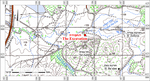
During June 2019, an excavation was conducted on the northern part of Tel Ẓafit (Permit No. A-8544; map ref. 185696/623759; Fig. 1), prior to building a wall. The excavation, on behalf of the Israel Antiquities Authority and funded by the Israel Nature and Parks Authority, was directed by S. Talis (field photography), with the assistance of Y. Alamor (administration), E. Aladjem (surveying, field photography and photogrammetry), I. Azoulay (plans), Y. Bukengolts (pottery restoration), D. Gazit (studio photography), I. Lidsky-Reznikov (finds drawing), A. Fraiberg (digital recording) and I.D. Peters (analytical laboratory).
Since 1996, excavations of the Tel exposed archaeological remains in the upper and lower cities that date between the Early Bronze Age and the Ottoman period (Maeir 2017). The site is identified as Philistine Gat, one of the largest cities in Philistia in the tenth century BCE (c. 500 dunam), which was destroyed by King Ḥaza’el of Aram-Damascus during the second half of the ninth century BCE (Maeir 2017:216; Maeir 2021). Remains from the Iron Age I and II were found near the present excavation area, and they include a city wall, the eastern part of a gate and the western part of a ceremonial building (Area D, Stratum D3; Dagan, Eniukhina and Maeir 2018:28; Maeir 2021). Additionally, excavations uncovered residential and public buildings and craft production areas dating to the Iron Age IIA, when the Philistine city reached its zenith (Area A, Stratum A3; Maeir 2017:217–218).
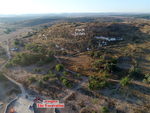
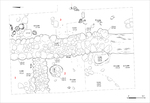
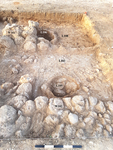
The excavation area (4 × 6 m; Figs. 2, 3) was opened in the lower city of Tel Ẓafit, about 50 m south of Area D, which was excavated from 2008 until today (Maeir 2012; Maeir 2021). The excavation exposed part of a building with two architectural phases dated to the ninth century BCE. The date of the building corresponds to Strata D3 and A3, which were previously uncovered.
The excavated building has at least two rooms (1 and 2) and an outdoor activity area (3). The rooms were bounded by two walls (W101 and W102) that were founded on clayey soil and built of fieldstones, which were preserved to a height of three courses; Wall 101 is especially wide. The two phases are discernible by the raising of the floor levels. Room 1 was partially excavated, and only the surface layer (L100) was exposed.
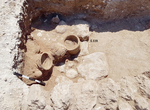
The Early Phase. In Room 2, a tamped-earth floor (L109) was uncovered. A pit (L111), bordered by several small fieldstones, was dug into the floor, and an earthen fill was uncovered in it. Pottery sherds from the ninth century BCE were found on Floor 109 and in Pit 111. A tamped-earth floor (L110) was also found in the outdoor activity area – Compound 3; it was founded on sterile clayey soil (L112) and abuts the base of W101. A surface paved with flat stone slabs was exposed on the floor, upon which lay intact vessels dated to the ninth century BCE, including bowls, a cooking pot, a juglet, a jug and a stand (Fig. 4).
The Late Phase. In this phase, the tamped-earth floors were raised by about 0.3–0.6 m on both sides of W101: in Room 2 (L103, L108) and in Compound 3 (L104). Two ṭabuns (L105, L106; Fig. 5) were dug into the floor in Room 2; the bottom of Ṭabun 105 was paved with hewn stones. A pile of collapsed fired mud bricks was uncovered on Floor 108. Examination in the analytical laboratory found that the ṭabun wall was exposed to a maximum temperature of 500˚c; therefore, the collapsed mud bricks likely did not originate from the ṭabuns. Some pottery vessels and numerous fragments were found on Floor 104 in Compound 3, including bowls, juglets and a colander dating to the ninth century BCE.
The Pottery Assemblage. Bowls, kraters, a cooking pot, jars, jugs, juglets, a handle, a colander and a stand were found in the excavation. Similar vessels are known from the area of Philistia in the ninth century BCE, including Stratum A3 in Area A of Tel Ẓafit (Shai and Maeir 2012).
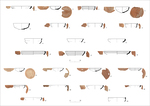
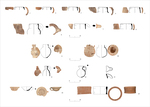
Bowls are the most common vessels in the assemblage; approximately half of them are burnished and red-slipped. The following types were discovered: shallow bowls carinated mid-body (Fig. 6:1, 2; Shai and Maeir 2012: Pl. 14.2:14); medium and small bowls with a carinated lower body and a straight upper body (Fig. 6:3–8; Shai and Maeir 2012: Pls. 14.2:8–12, 14.6:1), including a bowl (No. 8) with an everted rim (Shai and Maeir 2012: Pl. 14.6:2); sharply carinated bowls with an everted rim (Fig. 6:9, 10; Shai and Maeir 2012: Pls. 14.9:1–2, 14.11:1); rounded bowls with a simple, occasionally inverted, rim (Fig. 6:11–13; Shai and Maeir 2012: Pls. 14.2:2, 14.17:3); rounded bowls with a ledge rim (Fig. 6:14–19; Shai and Maeir 2012: Pls. 14.2:15, 14.14:4–5, 14.15:2, 14.16:3); and rounded bowls with a rim that is inverted, folded out and sometimes thickened on the interior and exterior (Fig. 6:20–24; Shai and Maeir 2012: Pl. 14.13:5).
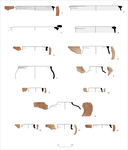
The kraters include two types. The first has a thickened rim, sometimes internally and externally, which is out-folded (Fig. 7:1–4; Shai and Maeir 2012: Pl. 14.11:10). The second has a closed body, a narrow opening and a thickened everted rim or a ledge rim thickened internally and externally (Fig. 7:5, 6; Shai and Maeir 2012: Pl. 14.6:6).
The cooking pot is open and slightly squat, with a grooved rim thickened on the interior (Fig. 7:7; Shai and Maeir 2012: Pl. 14.5:3).
Only rim fragments of jars were found, and they were divided into three main types. The first type features a long straight neck (Fig. 7:8, 9) or a short, inverted neck (Fig. 7:10, 11); it is similar to Types SJ2 and SJ3 at Tel Ẓafit (Shai and Maeir 2012:332, Pls. 14.5:9, 14.11:12). The second type has no neck at all, and the rim is thickened and everted (Fig. 7:12, 13); it is similar to Tel Ẓafit Type SJ1 (Shai and Maeir 2012:329, Pls. 14.9:10, 14.11:11). The third type has a wide opening and a thickened out-curving rim (Fig. 7:14); it is similar to Tel Ẓafit Type SJ10, which has a barrel-shaped body (Shai and Maeir 2012:334, Pl. 14.5:8).
Most of the jugs have a wide neck and a globular body (Fig. 8:1–9). Some have a ridge at the base of the rim (Fig. 8:1–6; Shai and Maeir 2012: Pls. 14.4:7–9, 14.8.2, 14.13:8), while others have a rim that is rounded on the exterior (Fig. 8:7, 8; Shai and Maeir 2012: Pl. 14.3:3) or thickened on the interior (Fig. 8:9; Shai and Maeir 2012: Pls. 14.1:4, 14.15:7). The jugs are similar to Tel Ẓafit Types JG1–3 (Shai and Maeir 2012:334–335). An unusual jug was also discovered and characterized by a globular body, rounded base and two handles descending to the shoulder (Fig. 8:10). It is similar to Tel Ẓafit Type JG8 (Shai and Maeir 2012:338–339, Pls. 14.8:3, 14.9:6).
The juglets comprise two types. The first has an elongated narrow body, a narrow neck and a rim slightly thickened internally and externally and everted (Fig. 8:11; Shai and Maeir 2012: Pls. 14.3:4, 14.5.2, 14.7:7–8). The second has a globular body, everted neck and a simple thin rim (Fig. 8:12; Shai and Maeir 2012:329, Pl. 14.7:4).
The handle that was found bears an incised potter’s mark (Fig. 8:13). This is a rare find, and only one other example was discovered in Stratum A3 at Tel Ẓafit (Shai and Maeir 2012: Pl. 14.19:7). The incision is reminiscent of the letter T, but it presumably is an X mark that was common in the south during this time span. This mark is known on handles of cooking pots from Tel Be’er Sheva‘, with most of them found in Stratum III and a few in Stratum IV (Singer-Avitz 2016:992, Figs. 13.1:1–3, 13.14:1–2).
The colander (Fig. 8:14) was found on Floor 104 in the late construction phase. This type is very common at Tel Ẓafit, Stratum A3 (Shai and Maeir 2012: Pls. 14.4:2, 14.7:2, 14.10:4).
The stand (Fig. 8:15) was found on Floor 110 in the early phase. The stand has one thickened rim and one rim with several grooves. Two types of stands, which differ slightly from the one in the present excavation, were found at Tel Ẓafit, Stratum A3 (Shai and Maeir 2012:328).
The excavation exposed part of a building dated to the ninth century BCE, which is contemporaneous with buildings previously discovered in the adjacent Area D (Dagan, Eniukhina and Maeir 2018; Maeir 2021). The width of W101 indicates that this was a large building that differs from nearby previously discovered buildings. This may have been a public building next to the city gate. The function of the building is unclear, but future excavations may shed light on the matter.
References
Dagan A., Eniukhina M. and Maeir A.M. 2018. Excavations in Area D of the Lower City: Philistine Cultic Remains and Other Finds. NEA 81/1:23–28. https://doi.org/10.5615/neareastarch.81.1.0028
Maeir A.M. 2012. Tell es-Safi/Gath I: The 1996–2005 Seasons. Wiesbaden.
Maeir A.M. 2017. The Tell es-Safi/Gath Archaeological Project: Overview. NEA 80/4:212–223. https://doi.org/10.5615/neareastarch.80.4.0212
Maeir A. 2021. Tel Ẕafit—2019. HA–ESI 133. https://doi.org/10.69704/jhaesi.116.2004.26006
Shai I. and Maeir A.M. 2012. The Late Iron Age IIA Pottery Assemblage from Stratum A3. In A.M. Maeir ed. Tell es-Safi/Gath I: The 1996–2005 Seasons. Wiesbaden. Pp. 313–363.
Singer-Avitz L. 2016. Potmarks. In Z. Herzog and L. Singer-Avitz eds. Beer-Sheba III, II: The Early Iron IIA Enclosed Settlement and The Late Iron IIA–Iron IIB Cities. Winona Lake. Pp. 992–1019.
Keywords
Philistine Gath, Iron Age, architectural remains, public building, tabun, complete pottery vessels, potter’s mark
Publication Date
19/11/2026
Link to Excavation Repository
Report Type
Final Report
Included in
Classical Archaeology and Art History Commons, History of Art, Architecture, and Archaeology Commons