
Permit/License Number
Z-57/2023
Excavation Report
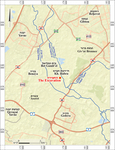
During May–June 2023, an educational-community excavation was conducted at Khirbat Ḥabra (License No. Z-57/2023; map ref. 178628–40/638860–9; Fig. 1). The excavation, on behalf of the Israel Antiquities Authority and funded by the Sorek-Lachish Drainage and Streams Authority and the Brenner Regional Council, was directed by R. Shnabel and Y. Amitzur, with the assistance of D. Barkan and D. Citron (supervision), S. Emmanuilov and I. Jonish (surveying, field photography and photogrammetry), Y. Amrani, Z. Lotan and T. Uriel (administration), A. Peretz (photography), G. Stern (education), I. Taxel (pottery), L. Perry-Gal (archaeozoology) and A. Lester (metal artifacts) as well as students from the Brenner Regional Council, soldiers from the Maghar and Tel Nof ordnance bases and community volunteers. Special thanks are due to D. Shidelov, the head of the Brenner Regional Council, and S. Yifrah from the Sorek-Lachish Drainage and Streams Authority.
Khirbat Ḥabra is located on a small hill between Naḥal Soreq and Naḥal Gamli’el, approximately 3.5 km southeast of Tel Yavne (Fig. 1). The site was surveyed several times over the years, and the pottery, marble artifacts and other finds discovered indicate the settlement was occupied since the Hellenistic period at the latest and until the Mamluk period (Schwabe 1944–1945; Ilan 1991:267–268; Fischer, Taxel and Amit 2008; British Mandate Archive, File no. ATQ 458). An excavation in 2022 discovered architectural remains and pottery kilns dated likely to the Persian and Hellenistic periods in addition to finds from the Persian–Early Islamic and Mamluk periods (Radashkovsky 2025 and see therein).
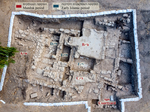
Eight squares were opened in the present excavation (c. 200 sq m; Area A; Fig. 2; this is Area S1 in Radashkovsky’s excavation). Two occupation strata were uncovered, dating to the Early Islamic (Stratum II) and Mamluk (Stratum I) periods. Remains of a building were uncovered in each stratum, although distinguishing the strata was difficult since the builders of the later structure utilized the walls of the earlier one. The function of the buildings is unclear. Pottery and glass dated to the Hellenistic (third–first centuries BCE) and Byzantine (fourth–sixth centuries CE) periods was also found not in association with the exposed architectural remains.
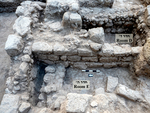
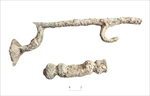
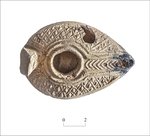
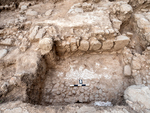
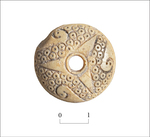
Stratum II—The Early Islamic Period (Seventh–Thirteenth Centuries CE). Excavations uncovered the remains of a building with at least three rooms (D–F). Most walls were constructed of a single row of large ashlars, preserved to a height of three courses. However, a few walls were constructed of fieldstones and are preserved to a height of four–five courses. The northern and southern boundaries of Rooms D and E (2 × 4 m, 1 × 3 m, respectively; Fig. 3) are delineated by a shared wall, and a wall of ashlars and fieldstones separated the rooms. In the southern part of these rooms, a step ascends to a higher level. The pottery from Rooms D–F dates predominantly to the Early Islamic period, but sherds from the Byzantine and Crusader periods were also found. Modeled copper objects that served as feet to support vessels and furniture (Fig. 4; Ayala Lester, pers. comm.) were also found in Room D. In the southern side of Room E, in a fill above a single stone course, an intact oil lamp dating to the Early Islamic period was found (Fig. 5). Only the southern part of Room F (4 × 4 m; Fig. 6) was excavated, and a thin plaster floor, which extends further north, was found. Decorated bone buttons (Fig. 7), a miniature oil lamp and a ceramic rattle were also found in the building.
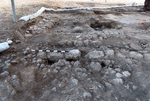
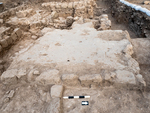
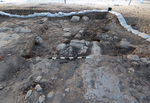
Stratum I—The Mamluk Period (Thirteenth–Fifteenth Centuries CE). The foundations of a building with three rooms (A–C) and a courtyard were uncovered. The building is delineated by wide walls that were built of two rows of hewn stones, with a fill of small stones between them. The walls were visible on the surface and were only preserved to a height of one course. In Room A, a floor of medium-sized fieldstones was discovered (4 × 5 m; Fig. 8), abutting the southern and western walls. In Rooms B and C, thin plaster floors were uncovered (3.5 × 4.0 m, 2.0 × 3.5 m, respectively; Figs. 9, 10). The floors were laid on a fill of earth and stones deposited over the earlier walls. Additional plaster floors, which are at a lower elevation than the center of Room B, were identified to the east and south of this room. The eastern floor is divided into two parts by a short and low internal wall. In Room C, part of the plaster floor was destroyed, so it was not possible to determine the room’s original dimensions.
A tamped-earth floor was exposed in the courtyard (Fig. 10), and on it were two ṭabuns and a refuse pit, indicating that this was an external courtyard. Numerous fragments of grinding tools, pottery and glass vessels, a fragment of a glass bracelet, metal utensils and animal bones of primarily draft animals, such as camels and donkeys (Lee Perry-Gal, pers. comm.), were discovered in the courtyard.
Earth fills in the rooms and courtyard contained Mamluk-period pottery sherds, which date the final use of the building.
The excavation at Khirbat Ḥabra uncovered settlement remains from the Early Islamic and Mamluk periods. The Hellenistic and Byzantine pottery and glass vessels, which were discovered out of architectural context, indicate human activity also during these periods. The faunal remains and metal objects may indicate the presence of a khan that acted as a way station for travelers passing through major regional settlements, such as Tel Yavne and Tell Qatra.
References
Fischer M., Taxel I. and Amit D. 2008. Rural Settlement in the Vicinity of Yavneh in the Byzantine Period: A Religio-Archaeological Perspective. BASOR 350:7–35. https://doi.org/10.1086/BASOR25609264
Ilan Z. 1991. Ancient Synagogues in Israel. Tel Aviv (Hebrew).
Kaplan J. 1948. Khirbat Ḥabra=Kefar Hebron. Bulletin of the Jewish Palestine Exploration Society 14:91–92 (Hebrew; English abstract, p. II).
Radashkovsky I. 2025. Khirbat H̱abra. HA–ESI 137. https://doi.org/10.69704/jhaesi.116.2004.26634
Schwabe M. 1944–1945. An Inscription on a Column from the Habra Synagogue. Bulletin of the Jewish Palestine Exploration Society 11:31–33 (Hebrew; English abstract, p. II).
Keywords
occupation, building remains, Early Islamic period, Mamluk period, pottery finds, glassware, Hellenistic period, Byzantine period, grinding tools, glass bracelet, coins, metal objects, animal bones
Publication Date
22/11/2026
Report Type
Preliminary Report
Included in
Classical Archaeology and Art History Commons, History of Art, Architecture, and Archaeology Commons