

Permit/License Number
A-9303
Excavation Report
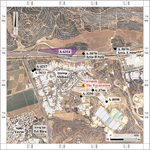
In May 2022, a salvage excavation was conducted in Moshav Aḥihud (Permit No. A-9303; map ref. 216800–50/756950–7000; Fig. 1), prior to private construction. The excavation, undertaken on behalf of the Israel Antiquities Authority, was directed by P.R. Zajac (field photography), with the assistance of Y. Ya‘aqobi (administration), R. Be’eri (scientific guidance), M. Kahan (drafting), E. Dalali-Amos (plan), Y. Gorin-Rosen (glass), H. Tahan-Rosen (pottery drawing), A. Shapiro (location map), G. Cinamon, the Eastern Galilee and Golan district archaeologist, S. Dallasheh, the sub-district archaeologist, and laborers from Kabul.
The excavation was conducted approximately 800 m northeast of Tel Bira, close to the eastern branch of the via maris (Be’eri 2008:39–42) and 8 km east of Tel ‘Akko. Chalcolithic settlement remains, Middle Bronze Age winepresses and numerous architectural remains, agricultural installations, a pottery workshop, caves, kilns, quarries and finds from the Hellenistic to the Ottoman periods were discovered in the vicinity of the excavation area (Cohen 2007 [Fig. 1: A-3250]; Avshalom-Gorni 2009a [Fig. 1: A-3613, A-4217]; Porat and Getzov 2010 [Fig. 1: A-3746]; Tahan-Rozen 2010 [Fig. 1: A-5070]; Spivak 2019 [Fig. 1: A-8098]; Abu Raya, Syon and Jaffe 2022 [Fig. 1: A-6314]).
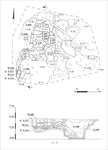
The current excavation was conducted in a residential area in the western part of Moshav Aḥihud, situated partly on a chalk spur, sloping slightly eastward. One square was opened (Fig. 2), exposing the remains of a quarry (L101), a hewn cave (L107) that may have been used for burials and two walls (W109 and W113). The finds date the burial cave to the Middle–Late Roman period (late second–fourth centuries CE) and the walls to the Late Roman–early Byzantine period. The burial cave likely postdates the quarry, as it cuts thorough it.
Quarry 101 (Fig. 3)
In the central part of the excavation area, a quarry hewn into the chalk bedrock was exposed. Four undetached quarry stones (L101; c. 0.4 × 0.6 × 0.8 m) with severance channels (width c. 10 cm) were unearthed. Quarrying activity was also observed in the eastern part of the area, but due to the limited scope of the excavation, it was not further investigated.
Cave 107 (Fig. 3)
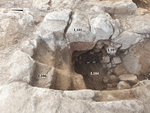
Excavations exposed a hewn staircase (L106) that descended to a small room (L104; c. 1.2 × 1.5 m) that led into a subterranean cavity (L107). The room was partially excavated, while the subterranean cavity remained unexcavated.
The stairs, consisted of five steps hewn into the chalk bedrock, carved unevenly with the eastern treads slightly wider and the lowest poorly preserved. The stairs’ inner string consisted of smoothly quarried bedrock (L108), which also constituted the western wall of the room. At the upper edge of this quarried bedrock wall was a rectangular notch (length c. 0.6 m) of unknown function. The room’s southern end was blocked by a stone collapse (L110). To its east, below the earlier quarry, an arched carved entrance opened into Cave 107, which contained an earthen fill including small and medium-sized stones and pottery sherds; its function remains unknown as it was not excavated. However, the carved entrance is indicative of a burial cave.
Two layers of archaeological accumulation overlaid the stairs. The upper layer comprised a dark brown sediment with small stones and numerous pottery sherds (L103), whereas the lower layer (L104) at the bottom of the steps consisted of a light brown sediment and few pottery sherds. Although bedrock was not reached during the excavation, the lowest layer of sediment may represent the floor level of the small room.
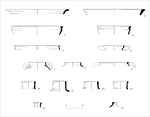
The finds (Fig. 4). The pottery recovered from the two accumulation layers covering the stairs leading to Cave 107 date it to the Middle and Late Roman periods (second–late fourth centuries CE). The finds consist mostly of open vessels, cooking ware and jars.
The open vessels include a large flat-based African Red Slip (ARS) ware plate (Fig. 4:1) corresponding to Hayes’ Form 60 and dated to the mid–late fourth century CE (Hayes 1972:100); two ARS ware base fragments (not illustrated); an open bowl (Fig. 4:2) with a rounded rim corresponding to Kefar Ḥananya Type 1E, dated to the mid-third–early fifth centuries CE (Adan-Bayewitz 1993: Pl. 1E:12) and previously documented at the site (Avshalom-Gorni and Shapiro 2015: Fig. 7:2); and two kraters (Fig. 4:3, 4) with a hooked rim and a deep groove below the rim on the exterior, whose type was previously documented at Aḥihud (Avshalom-Gorni and Shapiro 2015: Fig. 7:6, 7) and dates to the Middle–Late Roman period.
The cooking ware includes a cooking bowl (Fig. 4:5) corresponding to Kefar Ḥananya Type 3B (Adan-Bayewitz 1993:119–124), dated to the early second–late fourth centuries CE and previously identified at Aḥihud (Avshalom-Gorni and Shapiro 2015: Fig. 7:1); a cooking bowl (Fig. 4:6) with parallels from Ḥorbat ‘Uẓa dated to the mid-fourth–early fifth centuries CE (Avshalom-Gorni 2009b: Fig. 2.31:7); a cooking pot (Fig. 4:7) with parallels from Ḥorbat ‘Uẓa dated to the fourth–fifth centuries CE (Avshalom-Gorni 2009b: Fig. 2.33:12); a Kefar Ḥananya Type 4C cooking pot (Fig. 4:8), dated to the early second–mid-fourth centuries CE (Adan-Bayewitz 1993: Pl. 4C); and a cooking pot (Fig. 4:9) featuring a wide everted rim, similar to a type found at Jalame dated to the late fourth century CE (Johnson 1988: Fig. 7-40:597).
The jars include common bag-shaped forms with a high neck and ridged handles (Fig. 4:10–13). Similar high-necked jars dating to the Middle–Late Roman period are attested at Ḥorbat ‘Uẓa (Avshalom-Gorni 2009b: Fig. 2.37), in prior excavations at Aḥihud (Avshalom-Gorni and Shapiro 2015: Fig. 8) and at Sepphoris (Balouka 2013: Pl. 30).
Other finds include a jug fragment (Fig. 4:14) similar to Kefar Ḥananya Type 5B, which dates to the fourth–fifth centuries CE (Adan-Bayewitz 1993: Pl. 5B), and a lid knob (Fig. 4:15).
In addition, the excavation yielded several non-diagnostic bowl fragments, ribbed body sherds and storage jar handles (not illustrated). Some of the bowls and storage jar body sherds were decorated with one or two painted horizontal white stripes. This decoration style is characteristic of jars produced at Shiḥin between the first–fourth centuries CE (Balouka 2013:37–38, Types SJ2, SJ3 and see references therein). Bowls decorated with white bands from excavations at Sepphoris were dated to the second–third centuries CE (Balouka 2013:49, Pl. 24:3–10), although the shape of the vessel here differs.
At least some vessels appear to have been manufactured on-site (Fig. 4:3, 14), as they have a similar shape and fabric to vessels identified as local products in previous excavations at Aḥihud (Avshalom-Gorni and Shapiro 2015).
Although several glass fragments were recovered from the two accumulations above the stairs, only one from L103 could be identified as a folded-inward funnel rim fragment of a Late Roman bottle.
Walls (W109, W113; Fig. 5)
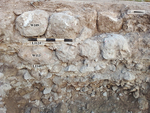
Two walls (exposed length c. 1 m) were discerned in the southwestern section of the excavation area. They were built of medium-sized hewn stones, aligned on a north–south axis and preserved to a height of one course. The upper W109 was built of two rows of stones with a fill of small stones. Both walls rested atop plastered floors (L112, L114). The earlier Floor 114 was set on a bedding of small stones. The relationship between the walls and the burial cave remains unclear.
The walls are dated tentatively to the Late Roman or early Byzantine period based on the pottery that was retrieved while cleaning the eastern face of the walls. The finds included a Cypriot Red Slip ware bowl of Hayes’ Form 9 (Fig. 6:1; Hayes 1972:379–398) dated to the sixth–late seventh centuries CE; a krater with a flat everted rim and a deep groove below the rim (Fig. 6:2); and a high-necked cooking pot featuring a wide mouth (Fig. 6:3) with similar examples at Ḥorbat ‘Uẓa (Avshalom-Gorni 2009b: Fig. 2.33). Alongside the pottery, a fragment of a raised hollow-ring base of a bowl or pitcher dating to the Late Roman period was recovered from a disturbed accumulation east of the walls (L105).
The excavation adds further information to our knowledge regarding smaller sites in the rural hinterland of ‘Akko during the Middle and Late Roman period. Although there are few architectural remains, the pottery confirms the rural character of the site as reported from previous excavations. The Middle–Late Roman pottery assemblage reflects Aḥihud’s connections with other nearby Galilean sites, among them Ḥorbat ‘Uẓa, Sepphoris and Kefar Ḥananya, with whom it shared a common material culture. Some of the pottery was probably produced at the site. Despite Aḥihud’s vicinity to a major maritime outlet (‘Akko) and its location along a busy commercial route connecting ‘Akko to the Sea of Galilee, its residents purchased mostly locally produced goods.
References
Abu Raya R., Syon D. and Jaffe G.B. 2022. Aẖihud (North). HA-ESI 134. https://doi.org/10.69704/jhaesi.116.2004.26134
Adan-Bayewitz D. 1993. Common Pottery in Roman Galilee: A Study of Local Trade. Ramat Gan.
Avshalom-Gorni D. 2009a. Aẖihud. HA-ESI 121. https://doi.org/10.69704/jhaesi.116.2004.1268
Avshalom-Gorni D. 2009b. Strata 9–6: The Late Roman and Byzantine Periods. In N. Getzov, D. Avshalom-Gorni, Y. Gorin-Rosen, E.J. Stern, D. Syon and A. Tatcher eds. Ḥorbat ʻUza: The 1991 Excavations II: The Late Periods (IAA Reports 42). Jerusalem. Pp. 7–104. https://doi.org/10.69704/iaaRepV000.1996.35
Avshalom-Gorni D. and Shapiro A. 2015. A Pottery Workshop at Ahihud and Its Relationship to the Jar Industry in the Northeastern Zevulun Valley and Western Galilee during the Roman Period. ‘Atiqot 83:67–92. https://doi.org/10.70967/2948-040X.1704
Balouka M. 2013. Roman Pottery. In E.M. Meyers and C.L. Meyers eds. The Pottery from Ancient Sepphoris (Duke Sepphoris Excavation Reports I). Winona Lake. Pp. 13–129. https://doi.org/10.5325/j.ctv1bxh4tm.5
Be’eri R. 2008. Tel ‘Akko and the Urbanization of ‘Akko Plain in the First Half of the Second Millennium BCE (2 vols.). Ph.D. diss. University of Haifa. Haifa (Hebrew; English summary, pp. I–XXV).
Cohen M. 2007. Aẖihud. HA-ESI 119. https://doi.org/10.69704/jhaesi.116.2004.512
Johnson B. 1988. The Pottery. In G. Davidson Weinberg ed. Excavations at Jalame: Site of a Glass Factory in Late Roman Palestine. Columbia. Pp. 137–226.
Porat L. and Getzov N. 2010. Aẖihud. HA-ESI 122. https://doi.org/10.69704/jhaesi.116.2004.1414
Spivak P. 2019. Aẖihud. HA-ESI 131. https://doi.org/10.69704/jhaesi.116.2004.25657
Tahan-Rozen H. 2010. Aẖihud. HA-ESI 122. https://doi.org/10.69704/jhaesi.116.2004.1346
Keywords
burial cave, walls, quarry, Middle Roman period, Late Roman period, Byzantine period, agricultural hinterland
Publication Date
09/10/2026
Link to Excavation Repository
Report Type
Final Report

Included in
Classical Archaeology and Art History Commons, History of Art, Architecture, and Archaeology Commons