
Permit/License Number
S-714/2016
Excavation Report
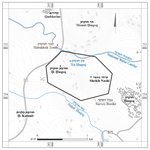
During November 2016 and March–April 2017, an archaeological survey was conducted at Ḥorbat Ḥuqoq and Giv’at Sheikh Nashi (License No. S-714/2016; map ref. 24490–625/75390–490; Fig. 1). The survey, on behalf of the Israel Antiquities Authority and financed by Israel Nature and Parks Authority, was directed by S. Kisilevitz and Y. Alef (field photography), with the assistance of Y. Amitzur, G. Cinamon, Y. Shivtiel and U. Berger (surveyors), A. Kleiner and M. Peleg (aerial photography) and A. Shapiro (GPS and mapping).
The survey was conducted northwest of Kibbutz Ḥuqoq in the eastern Lower Galilee and covered the hills of Ḥorbat Ḥuqoq and Sheikh Nashi. Numerous surveys and excavations were conducted in the area, discovering architectural remains and finds from many periods including the Middle Paleolithic (Permit No. A-8603), the Early Bronze Age IB (Ravani and Kahane 1961; Tepper and Shachar 1987; Fogelson 2003; Tsur 2025), the Iron Age, the Hellenistic and Ottoman periods and the British Mandate, when Kefar Yaquq, an Arab village, was located at the site (Survey of Palestine 1932; Leibner 2009:135–158). Underneath the ruins of the village, the remains of a Jewish settlement from the Roman and Byzantine periods, with a magnificent synagogue at its center (Magness et al. 2018; Magness et al. 2024) was uncovered; it was also a center of pilgrimage during the Medieval period (Mizzi and Magness 2022; Kool 2024). Finds near the site included Miqva’ot, quarries, tombs (Dalali-Amos 2014), unique hewn pressing installations known as ‘Ḥuqoq Installations,’ which may have produced mustard seed oil (Tepper, Der‘in and Tepper 2000:84–86; Stiebel 2018:7), and underground hiding complexes from the Great Revolt and Bar Kokhba Revolt (Shivtiel 2016). The agricultural areas and quarries of the Ḥuqoq population during the Roman and Byzantine periods also extended westward to the area of Ḥorbat Kalanit (Cinamon 2013: Site 10; Berger et al. 2023). The tomb complex of Habakkuk/esh-Sheikh Hasan (Survey of Palestine 1932: Sheet 195–250, 1:10,000), which was a place of prayer and pilgrimage for the Jews of Palestine during Ottoman period and British Mandate, is located slightly to the north of Ḥorbat Ḥuqoq (Ben-Zevi 1938:31); traditions that identify this as the tomb of the prophet Habakkuk are known since the thirteenth century CE (Ha-Parḥi 1897:285; Yaari 1943:80; Yaari 1946:98–103).
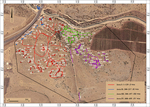
Two hundred and sixty-one find spots were documented in the present survey in four areas (I–IV; Fig. 2; Appendix): (I) Ḥorbat Ḥuqoq and the southern slope of the hill on which it extends (Spots 1–129); (II) the shoulder of Road 65 (Spots 200–217); (III) south of the National Water Carrier and east of ‘En Ḥuqoq (Spots 300–357); and (IV) Giv’at Sheikh Nashi (Spots 400–455). Finds include ancient quarries, ‘Ḥuqoq Installations’, oil presses, bodedot, hewn winepresses, miqva’ot, cisterns, hiding complexes, tombs, cupmarks, game boards, spring house, remains of fortifications, Muslim cemeteries, agricultural terraces and segments of roads. Most of the find spots comprise a single ancient remain, such as a winepress, a quarry or a field wall. Some are associated with an aggregate of remains, such as a cluster of cist tombs, a cluster of cupmarks or various remains associated with each other, such as a miqveh connected with hiding complexes and cisterns.
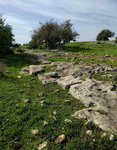
Quarries. Fifty-seven quarries that produced building stones were documented (Fig. 3). Their style is reminiscent of the Roman and Byzantine quarries that were uncovered at Ḥorbat Mishkena (Berger 2013) and Ḥorbat ‘Ammudim (Cinamon and Porat 2015).
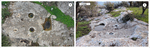
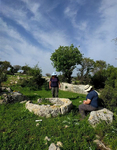
Hewn Pressing Installations. Fourteen ‘Ḥuqoq Installations’ (Fig. 4), two oil presses and three bodedot were documented. The dates and functions of the ‘Ḥuqoq Installations’ are uncertain. In addition to the suggestion that these were installations used by the Jewish settlement to extract mustard seed oil during the Roman and Byzantine periods (Tepper, Der‘in and Tepper 2000:84–86), others suggest they date to the Bronze Age because of their similarity to the Ḥaẓor and Ta‘anakh winepresses (Tsur 2025). The oil press that was found in Spot 400 (Fig. 5) includes a circular stone crushing vat, similar to the one uncovered nearby in Khirbat Wadi Ḥamam that was dated to the Roman period (Leibner 2018:221–235). A bodeda was identified in Spot 105 (Fig. 6), and it is nearly identical to one found in an agricultural complex of a Second Temple Jewish village at Khirbat Ḥammada in the Eshta’ol region (Golani 2011: Site 12).
Hewn Winepresses. Five winepresses were documented (Fig. 7). A pit for screw that was set in the floor of the winepress at Spot 107 (Fig. 7:1) indicates that it was used from the Late Roman period onwards (Ayalon, Frankel and Kloner 2012:30).
Miqva’ot. Four hewn miqva’ot, were documented; these date to the Early Roman period but probably remained in use during the Byzantine period (Magness 2012).
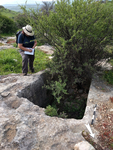
Cisterns and Underground Hiding Complexes. Twelve cisterns hewn into the bedrock were recorded. It seems that some of the cisterns were hewn during the Roman period and were used during the Mamluk and Ottoman periods as well as the British Mandate (Berger and Shivtiel 2024; Magness et al. 2024). At the bottom of five cisterns, there were openings to passages leading to underground hiding complexes with narrow twisting tunnels. Hiding complexes at Ḥorbat Ḥuqoq were probably used by the local Jewish population during the revolts against the Romans, such as the Great Revolt, Bar Kokhba Revolt and Gallus Revolt (Berger and Shivtiel 2024; Shivtiel et al. 2025).
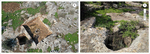
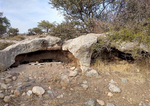
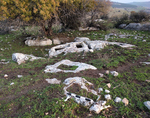
Burial Caves and Tombs. More than 30 hewn burial caves (Figs. 8, 9) and c. 90 hewn cist tombs (Fig. 10) were identified. Some of the burial caves include deep square courtyards that lead to burial chambers with loculi. Such caves are known in the Galilee in Jewish sites such as Mishkena (Berger 2013), Nein (Dalali-Amos 2018) and Ḥorbat ‘Ammudim (Cinamon 2014), where they were used from the Early Roman to the Byzantine periods. Cist tombs similar to those from Ḥuqoq were identified nearby at Wadi Ḥamam, where they were attributed to the Jewish village there and dated to the Late Roman period (Leibner 2018:633).
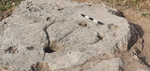
Cupmarks and Hewn Gameboards. About 30 cupmarks and two hewn gameboards (mancala) were recorded in the survey.
Spring House. A building constructed of basalt over a pool and roofed with cement slabs was recorded. The water was transported to the pool via an underground system from ‘Ein Ḥuqoq, a few meters north of the building. The cement slab roof that was placed over the ancient building also covered the spring.
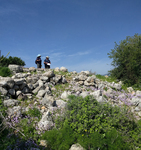
Fortification Remains. Remains of a fortified complex, which includes a wall and round towers (Fig. 11), were recorded on Giv’at Sheikh Nashi. The wall remains were previously identified (Tepper, Der‘in and Tepper 2000:119).
Muslim Cemeteries. Two Muslim cemeteries, which are also known from the British Survey maps (Survey of Palestine 1932), were recorded. They probably were used by the residents of Kefar Yaquq.
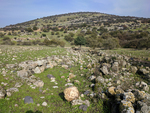
Agricultural Terraces and Roads. Retaining walls of agricultural terraces, boundary walls of adjacent plots and road segments were recorded (Fig. 12). Many of these are visible in aerial photographs taken in the 1940s (Royal Air Force 1946, Palestine Survey Aerial Map 6439:680 DEV 84, 4 [4 April 1946]) and are therefore probably related to Kefar Yaquq. Some of the roads that were surveyed were used since the Mamluk period (Tepper, Der‘in and Tepper 2000:137–140).
References
Ayalon E, Frankel R. and Kloner A. 2012. Wine Production in Eretz Israel in Antiquity: Advancement in Research or a Completely New Approach? Cathedra 145:15–36 (Hebrew).
Ben-Zevi I. 1938 The Jewish Settlement Hukok–Yaqûq. Bulletin of the Jewish Palestine Exploration Society 6:30–33.
Berger U. 2013. H̱orbat Mishkena. HA–ESI 125. https://doi.org/10.69704/jhaesi.116.2004.2289
Berger U. and Shivtiel Y. 2024. Evidence and Indications of Adaptation of the Hiding Complexes at Ḥuqoq in Preparation for the Bar Kokhba Revolt. In A. Goldstein, T. Goldberg, Z. Greenberg and M. Abbasi eds. Tel-Hai Galilee Studies 4. Tel Hai. Pp. 53–67 (Hebrew; English Abstract).
Berger U., Feig N., Bekker-Shamir M., Be’eri R., Shemer M., Porat L. and Finkielsztejn G. 2023. H̱orbat Kalanit. HA–ESI 135. https://doi.org/10.69704/jhaesi.116.2004.26301
Chocron A. 2022. H̱uqoq. HA–ESI 134. https://doi.org/10.69704/jhaesi.116.2004.26170
Cinamon G. 2013. H̱uqoq, Survey. HA-ESI 125. https://doi.org/10.69704/jhaesi.116.2004.5385
Cinamon G. 2014. H̱orbat ‘Ammudim (Southwest). HA–ESI 126. https://doi.org/10.69704/jhaesi.116.2004.10585
Cinamon G. and Porat L. 2015. H̱orbat ‘Ammudim (West). HA–ESI 127. https://doi.org/10.69704/jhaesi.116.2004.20770
Dalali-Amos E. 2014. H̱orbat H̱uqoq. HA–ESI 126. https://doi.org/10.69704/jhaesi.116.2004.12661
Dalali-Amos E. 2018. Nein. HA–ESI 130. https://doi.org/10.69704/jhaesi.116.2004.25398
Fogelson Y. 2003. Ḥuqoq: History, Archaeology and Tradition. Ramat Yishai.
Golani A. 2011. Khirbat H̱ammada. HA–ESI 123. https://doi.org/10.69704/jhaesi.116.2004.1891
Ha-Parḥi A. 1897. Kaftor Va-Ferach. Jerusalem.
Kool R. 2024. A Fifteenth-Century Gold and Silver Coin Hoard at Ḥuqoq/Yaquq. AJN 36:279–352.
Leibner U. 2009. Settlement and History in Hellenistic, Roman and Byzantine Galilee: An Archaeological Survey of the Eastern Galilee (TSAJ 127). Tübingen. https://doi.org/10.1628/978-3-16-151460-9
Leibner U. 2018. Khirbet Wadi Ḥamam: A Roman-Period Village and Synagogue in the Lower Galilee (Qedem Reports 13). Jerusalem.
Magness J. 2012. H̱uqoq—2011. HA–ESI 124.https://doi.org/10.69704/jhaesi.116.2004.1959
Magness J., Kisilevitz S., Grey M., Mizzi D., Burney J., Britt K. and Boustan R. 2018. Bible Stories in the H̱uqoq Synagogue Mosaic Floor: Intermediate Report for the 2011–2017 seasons. Qadmoniot 156:66–83.
Magness J., Mizzi D., Grey M., Burney J., Wells M., Britt K. and Boustan R. 2024. H̱uqoq—2023. HA–ESI 132. https://doi.org/10.69704/jhaesi.116.2004.26541
Mizzi D. and Magness J. 2022. A Late Medieval Synagogue at Ḥuqoq/Yaquq in Galilee? Levant 54/2:257–276. https://doi.org/10.1080/00758914.2022.2093029
Ravani B. and Kahane P.P. 1961. Rock-Cut Tombs at Ḥuqoq. ‘Atiqot (ES) 3:121–147.
Shivtiel Y. 2016. The Hiding Complexes beneath the Synagogue of Ḥuqoq: A Comparative Perspective and a Test Case for Hiding Complexes under Synagogues in the Galilee and the Southern Hebron Highland. In T. Grossmark, H. Goren, M. Abbasi, Y. Zeltenreich and Z. Greenberg Eds. Tel-Hai Galilee Studies 2. Tel Hai. Pp. 175–204 (Hebrew).
Shivtiel Y., Barshad D., Ahipaz N. and Berger U. 2025. Two Coin Hoards from Hiding Complexes in Galilee and the Question of Their Association with the Gallus Revolt. INR 20:225–239.
Stiebel G.D. 2018. ‘Burns Like Fire’—Mustard and Viniculture in Roman Palestine. Tarbiz 86:5–37 (Hebrew; English abstract, p. v).
Tepper Y. and Shachar Y. 1987. Exploration of the Hiding Complexes. In A. Kloner and Y. Tepper eds. The Hiding Complexes in the Judean Shephelah. Tel Aviv. Pp. 49–71 (Hebrew).
Tepper Y., Der‘in G. and Tepper Y. 2000. Naẖal ‘Amud Region: Chapters on the Settlement Outpost. Tel Aviv (Hebrew).
Tsur Y. 2025. H̱orbat H̱uqoq. HA–ESI 137. https://doi.org/10.69704/jhaesi.116.2004.27730
Yaari A. 1943. Letters from the Land of Israel. Tel Aviv (Hebrew).
Yaari A. 1946. Travels to the Land of Israel. Tel Aviv (Hebrew).
Zingboym O. and Badichi T. 2022. H̱orbat H̱uqoq. HA–ESI 134. https://doi.org/10.69704/jhaesi.116.2004.26149
Keywords
Kibbutz Ḥuqoq, ancient quarries, Ḥuqoq Installations, oil presses, bodedot, hewn winepresses, miqva’ot, cisterns, hiding complexes, tombs, cupmarks, game boards, spring house, remains of fortifications, Muslim cemeteries, agricultural terraces, segments of roads
Publication Date
18/11/2026
Report Type
Preliminary Report
Included in
Classical Archaeology and Art History Commons, History of Art, Architecture, and Archaeology Commons