
Lod, Betar Street (A-8834)
Permit/License Number
A-8834
Excavation Report
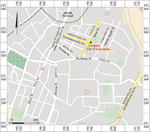
During October 2020 a salvage excavation was conducted at Betar Street, Lod prior to construction (Permit No. A-8834; map ref. 190755–85/651752–84; Fig. 1). The excavation, on behalf of the Israel Antiquities Authority, and funded by Ibrahim ‘Aliwa was directed by S. Krispin, with the assistance of Y. Alamor (administration), Y. Sitton (preliminary inspection), I. Jonish (field photography, surveying and drafting), A. Dagot (GPS/GIS), I. Milevski (scientific guidance and pottery), M. Abu (plans), L. Perry-Gal (archaeozoology), M. Shemer (flint tool), A. ‘Azab, I. Korenfeld and Y. Tepper (consultancy and scientific guidance), D. Gazit (studio photography) and workmen from the area of Nablus.
The excavation was located near the southeastern edge of Tel Lod. Numerous surveys and excavations were conducted on the tel in the past, uncovered a long occupation sequence, from the Pottery Neolithic (c. 8,000 years BP) until modern times (Kaplan 1977; Yannai and Marder 2000; Arbel 2004; Weinberger 2005; Golani 2012; Krispin, Tendler and Jakoel 2022; Krispin and Tendler 2024).
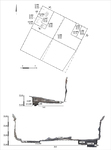
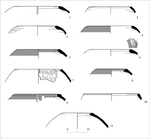
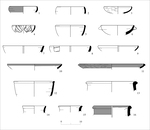
In this excavation four squares were opened (100 sq m; Fig. 2), after a modern fill-layer (L100; thickness c. 2 m) was removed using mechanical equipment. A rim of a hole-mouth jar (Fig. 3:5) and a krater (Fig. 4:12), dated from the Early Bronze Age IB, were found in this fill-layer. Due to time and safety constraints, it was decided to limit the excavation to two restricted points in the northeastern and northwestern corners of the area. There are remains of floors and an installation that were dated, according to the pottery, to the Early Bronze Age IB (3300–3100 BCE) were uncovered. A mixed flint-tools assemblage, dated to the Neolithic, Chalcolithic and Early Bronze Age was also found.
The northeastern corner. A tamped earth floor (L105) was uncovered, and on it (L102) were found Early-Bronze-IB pottery fragments, which included bowls (Fig. 4:5, 10), a hole-mouth jar (Fig. 3:4) jars (Fig. 4:14, 16), flint tools (see below) and animal bones. A probe (L106) dug into the floor uncovered pottery fragments dating to the same period, including hole-mouth jars (Fig. 3:2, 3, 8, 10), a bowl (Fig. 4:3) a jar (Fig. 4:15), flint tools (see below) and animal bones.
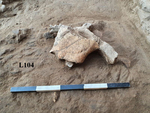
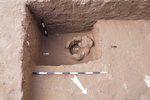
The northwestern corner. A tamped earth floor (L104) was uncovered. Pottery fragments dating to the Early Bronze Age IB, including hole-mouth jars (Fig. 3:1, 6, 7, 9), bowls (Fig. 4:6, 8 , 9, 11) and a krater (Fig. 4:13) were found in the topsoil above the floor and on the floor itself (L101, L103). In the same contexts were also found flint tools (see below) and animal bones, among them a cattle skull vault (Fig. 5). A probe (L107) dug into the floor uncovered an oval installation (L108; Fig. 6), which was built of small fieldstones and built on a tamped earth floor (L109); this installation seems to have served as a hearth. Pottery fragments dating to the Early Bronze Age IB, including a hole-mouth jar (Fig. 3:11) and bowls 4:1, 2, 4, 7) were found around the installation.
The Flint Assemblage
Maayan Shemer
Four hundred and seventy four items were collected (Table 1), of which 250 items came from the northeastern floor (L105) and 224 items came from the northwestern floor (L104). The flint assemblage of Floor 105 also included a single hammerstone. The flint items were well-preserved, their edges sharp and the scar ridges prominent. Approximately 3%–5% of the items are coated with white patina. The raw material displays uniformity wherein 57%–67% of the items are made on brecciated flint typical of the Mishash formation, which has outcrops at the Modi‘in hills about 4 km east of the site. Between 25%–30% of the items in the assemblage are burnt, and c. 7% are made of flint of unknown origin. The range of items collected indicates that the tools were knapped at the site.
Most of the cores were recovered from Floor 105 (Table 2), and they indicate a manufacture of flakes from multiplatform cores or cores with two perpendicular striking platforms that share a reduction surface.
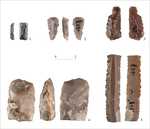
Six of the tools from the assemblage were datable, however they indicated a mixed assemblage (Table 3): two sickle blades (Fig. 7:1, 5); two broken arrowhead-tangs, perhaps the Amuq type (Fig. 7:2, 3); and two broken axes (Fig. 7:4). Sickle blade No. 1 was knapped on a bladelet and has a double truncation, the backing was formed with an abrupt retouch, and the active edge is delicately denticulated—characteristic of Chalcolithic-period sickle blades (Vardi 2011:87–89). Sickle blade No. 5 was formed on Canaanite blade and has a double active edge delicately denticulated—all features that are particularly characteristic of the flint industries of the Early and Intermediate Bronze Ages (Rosen 1997:44–60; Vardi 2011:89–92).
The two arrowheads were shaped so that the proximal or distal end converge, and they may be part of a point or a tang. Arrowhead no. 2 was knapped by semi-abrupt scale-retouch while arrowhead No. 3 displays bi-facial pressure retouching. The shape of the arrowheads hints at a leaf-like outline, which correlates to the Amuq-type arrowhead, but since they are broken it is impossible to determine this with any certainty. The two axes are bi-facial, without polishing marks. These tools are typical of flint industries from the Neolithic and Chalcolithic periods (Rosen 1997:93–98).
The flint assemblage from the excavation is small, but well preserved. The mixed characteristics represented in the datable tools imply activity nearby during the Neolithic and Chalcolithic periods, in addition to activity during the Early Bronze Age, to which the floors and most of the pottery finds were dated. Activity during these periods was identified in the past in excavations next to Tel Lod (Kaplan 1977; Gopher and Blockman 2004; Paz, Rosenberg and Nativ 2005; Masarwa 2011; Segal 2012; Gopher et al. 2017; Spivak 2022).
At least two occupation phases dating to the Early Bronze Age IB were uncovered in the excavation. However, because of the restricted scope of excavation it was not possible to offer an in-depth interpretation of the finds. Nevertheless, the excavation joins the rest of the Lod excavations and may assist in understanding the settlement distribution during the Early Bronze Age.
References
Arbel Y. 2004. Lod. HA-ESI 116. https://doi.org/10.69704/jhaesi.116.2004.25
Golani A. 2012. Lod. HA-ESI 124. https://doi.org/10.69704/jhaesi.116.2004.1938
Gopher A. and Blockman N. 2004. Excavations at Lod (Nevé Yaraq) and the Lodian Culture of the Pottery Neolithic Period. ‘Atiqot 47:1–50. https://doi.org/10.70967/2948-040X.2194
Gopher A., Gophna R., Eyal R. and Paz Y. 2017. Jacob Kaplan’s Excavations of Protohistoric Sites. 1950s–1980s (Tel Aviv University Institute of Archaeology Monograph Series 36) (2 vols.). Winona Lake–Tel Aviv.
Kaplan J. 1977. Neolithic and Chalcolithic Remains at Lod. Eretz-Israel 13:57–75 (Hebrew; English summary, pp. 291*–292*).
Krispin S., Tendler A.S. and Jakoel E. 2022. A New Type of Tomb from Roman Era Lod and the Boundaries of the City Based on the Location of Its Cemeteries. Lod “Diospolis—City of God” 8:49–67 (Hebrew; English summary, p. 51).
Krispin S. and Tendler A.S. 2024. Lod, Nordau Street. HA-ESI 136. https://doi.org/10.69704/jhaesi.116.2004.26513
Masarwa D. 2011. Lod (Northwest). HA-ESI 123. https://doi.org/10.69704/jhaesi.116.2004.1696
Paz Y., Rosenberg, D., and Nativ A. 2005. Excavations at Lod: Neolithic and Chalcolithic Remains and an Egyptian Presence in the Early Bronze Age. Salvage Excavation Report 2:114–158.
Rosen S.A. 1997. Lithics after the Stone Age: A Handbook for Stone Tools from the Levant. Walnut Creek–London–New Delhi.
Segal O. 2012. Lod, Tel. HA-ESI 124. https://doi.org/10.69704/jhaesi.116.2004.1945
Spivak P. 2022. The Flint Assemblage from Tel Lod. ‘Atiqot 108:209–224. https://doi.org/10.70967/2948-040X.1150
Vardi J. 2011. Sickle Blades and Sickles of the Sixth and Fifth Millennia BCE in Light of the Finds from the Chalcolithic Sickle Blade Workshop Site of Beit Eshel. Ph.D. diss. Ben-Gurion University of the Negev. Be’er Sheva‘ (Hebrew; English summary, pp. I–IX).
Weinberger D. 2005. Lod. HA-ESI 117. https://doi.org/10.69704/jhaesi.116.2004.248
Yannai E. and Marder O. 2000. Lod. HA-ESI 112:80–82.
Keywords
Early Bronze Age 1, settlement remains, floors, installation, flint items, Neolithic period, Chalcolithic period
Publication Date
25/05/2026
Report Type
Final Report