
Permit/License Number
A-9055
Excavation Report
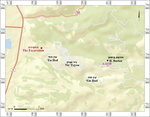
During July 2021, a trial excavation was conducted west of ‘En Hod, within the declared antiquities site, triangulation point Z-363 (Permit No. A-9055; map ref. 198283–309/734302–27; Fig. 1), following the discovery of antiquities in preliminary probes. The excavation, on behalf of the IAA and funded by Mekorot Water Company, was directed by E. Oren, with the assistance of Y. Amrani and Z. Lotan (administration), S. Emmanuilov (photogrammetry and field photography), I. Taxel and P. Gendelman (pottery), A. Cohen-Weinberger (petrography), M. Abu (plans), Y. Tepper (scientific guidance) and L. Talmi and K. Sa‘id from the IAA Haifa District.
The excavation was located in an open area with olive and almond groves, north of Road 7111, leading to the settlements of ‘En Hod and Nir ‘Eẓyon. A prehistoric site was documented at this location in a survey of the Carmel (c. 10 dunam; Olami 1960: Site 29—‘En Hod). The ‘Atlit Map survey recorded next to the excavation area a blocked well and, over it, a square building (Ronen and Olami 1978: Site 93). About 1 km east of the present excavation, remains of a site containing buildings and several large winepresses were uncovered and dated to the Byzantine and Early Islamic periods (Talmi and Katsnelson 2015 [Fig. 1: A-6320]).
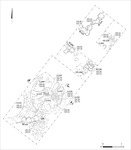
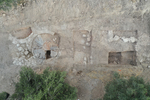
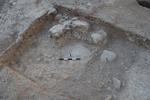
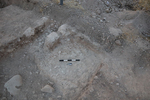
The current excavation (Figs. 2, 3, 4) exposed pottery kilns, remains of walls and a floor and a refuse pit dated to the Roman period (second–third centuries CE).
Pottery Kilns. Two adjacent pottery kilns (L109, L111) were uncovered in the southwestern part of the excavation area; Kiln 111 was only partially exposed as most of it was outside the excavation’s boundaries.
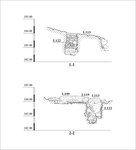
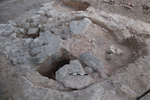
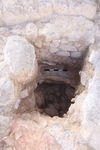
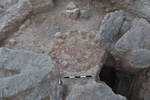
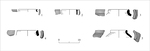
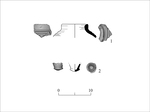
Kiln 109 (ext. diam. 5.4 m; int. diam. 5.3 m; Fig. 5) was dug into the ground and lined with various-sized fieldstones; it was coated with clay internally, probably to insulate the wall and prevent it from degrading due to the high temperature of the firing chamber. In the upper part of the lining, there was a recession formed to support the firing chamber floor (L113). The firing chamber (height 1.2 m; Fig. 6) was fully preserved. A pillar built from bricks and lined with small fieldstones (L119; Fig. 7) was uncovered at its center. The pillar supported brick arches that supported the firing chamber floor and abutted the kiln’s wall; they survived only partially. The floor of Firing Chamber 113 was well preserved. A stoking opening was built in the eastern part of the kiln (L122; 0.45 × 0.65 m) to feed combustion material into the firing chamber and remove the ash. The main pottery finds from the kiln included a cooking pot (Fig. 8:1), a bag-shaped jar with a long neck (Fig. 8:2), Carmel jars (Fig. 8:3) and Phoenician jars (Fig. 8:4, 5), all dated to the second–third centuries CE. Based on this assemblage, the kiln was likely used to produce types of jars typical of the Carmel region.
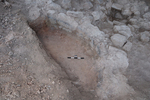
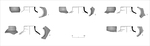
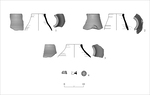
Kiln 111 (Fig. 9) was also dug into the ground and lined with fieldstones coated with clay. It is poorly preserved, and the firing chamber floor did not survive. Pottery sherds, including bag-shaped jars (Fig. 10:1–5) dated to the second–third centuries CE, were found in an earth fill inside the kiln.
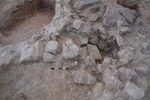
Remains of Walls and Floor. A wall built of large fieldstones and a single ashlar (W124; Fig. 11) was uncovered between the two kilns and to their south; the wall was damaged by modern activity, and its context is unclear. About 3 m northeast of Kiln 109 were remains of two walls (W104, W118; Figs 12, 13) built of large stones. Remnants of a plaster floor (L106) abut the walls from the south, and on the floor, there is a thick layer of pottery sherds, including predominantly Carmel (Fig. 14:1) and Phoenician jars (Fig. 14:2) dated to the second–third centuries CE. The walls and floor may have been part of a building that stored the products of the kiln and was not preserved.
Two walls forming a corner (W114, W125) were uncovered in the northeastern part of the excavation. These were probably part of a building that extended northward outside the excavation boundaries.
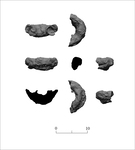
Refuse Pit (L103). In the northeastern part of the area, a probe (depth c. 1 m) uncovered a large refuse pit. At the bottom of the pit, a floor (L126) made of various-sized fieldstones was found. This floor may be the remnant of an earlier building or installation that was converted into a refuse pit. A large quantity of pottery sherds, including Phoenician jars (Fig. 15:1–3) and the base of a Carmel jar (Fig. 15:4), dated to the second–third centuries CE, were collected from the refuse pit. Some of the pottery sherds were misfired and deformed, such as a Carmel-type amphora handle (L103, B1013/02; Fig. 16), indicating that the kiln wasters were thrown into this refuse pit.
Petrography. Some of the ceramic vessels were submitted to petrographic analysis, and the results confirm that the vessels characteristic of the Carmel regions were fired in the kilns. The Carmel and bag-shaped jars were fired at a relatively high temperature. A predominance of quartz and small quantities of minerals, such as feldspar and hornblende, were identified in the Carmel jars. This indicates that they were manufactured from local clay collected from the Carmel coast up to ‘Akko in the north.
However, the Phoenician vessels contain foraminifera (marine unicellular organisms) from the Pliocene. Since the area of ‘En Hod has no such outcrops, the vessels were probably manufactured in Phoenicia from marl collected along the Lebanese coast.
The excavation uncovered imported and locally manufactured vessels that date the kilns and architectural remains to the second and third centuries CE. The paucity of information about sites dating to this time span in the area prevents associating the assemblage with a particular settlement. The closest settlement that was excavated is in Ḥorbat Bustan, about 1 km east of the excavation; however, this settlement was dated to the Byzantine period (Talmi and Katsnelson 2015).
References
Olami Y. 1960. Prehistoric Survey of the Carmel 1949–1958 (Preliminary Report). Mitekufat Haeven 1:3–12 (Hebrew).
Ronen A. and Olami Y. 1978. Map of ‘Atlit (26) (Archaeological Survey of Israel). Jerusalem.
Talmi L. and Katsnelson N. 2015. Ḥorbat Bustan. HA–ESI 127. https://doi.org/10.69704/jhaesi.116.2004.20773
Keywords
‘Ein Hod, Pottery Kilns, Roman period, Carmel-type amphora, Phoenician jars, second and third centuries CE
Publication Date
19/11/2026
Link to Excavation Repository
Report Type
Final Report
Included in
Classical Archaeology and Art History Commons, History of Art, Architecture, and Archaeology Commons