
Legio (A-9683)
Permit/License Number
A-9683
Excavation Report
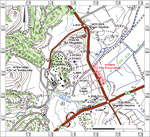
During October 2023–March 2024 a testing excavation was conducted east of Kibbutz Megiddo, along the eastern side of Road 66, north of Megiddo Junction (section 1; Permit No. A-9683; map ref. 217909–8501/719922–21078; Fig 1). The excavation, on behalf of the Israel Antiquities Authority and funded by Netivei Israel National Transport Infrastructure Company was directed by Y. Tepper (testing trenches, field and finds photography) and B. Tzin (testing trenches, field and finds photography), with the assistance of ‘A. Najar, G. Peled, and R. Assis (area supervision and probes), A. Sian Kessler, Z. Turgeman-Yaffe and A. Gabay (area supervision), G. Barav, J. Iskova, R. Arad, T. Lavi, R. Namouz, K. Hako and M. Hasbani (assistance in area supervision and testing trenches), C. Elimelech (assistance in area supervision and sampling), A. Kozlov (assistance in area supervision and metal detector), O.C. Drori, A. Shichman, G. Leyfirer and A. ‘Amara (assistance in area Supervision), Y. Zilpa and Y. Ya‘akobi (administration), H. Hadad and N. Silverberg (testing trenches), N. Mammon, Y. Levi, E. Hoffman and S. Krispin (metal detector), A. Khalatov and A. Elghani Ibrahim (RTK), Y. Widaker and H. Ashkenazi (GIS), D. Gazit (field photography), A. Peretz (field photography and studio photography), S. Emmanuilov (field photography, photogrammetry, drafting and plans), R. Mishayev (drafting and plans), M. Kahan and Y. Gomani (drafting), A. Fahima and A. Eyal (on-site conservation), A. Shapiro (studio photography, maps, pottery sorting, experimental archaeology and petrography), Y. Nikitina (studio photography), T. Harpak and H. Yohanan (floatation and picking), S. Najar (finds registration), E. Dalali-Amos (data entry), E. Stern (pottery sorting), K. Vardi, J. Kang and N. Getzov (flint tools and prehistoric finds), Y. Gorin-Rosen (glass), J. Gosker and Á. Bollók (metal finds), L. Perry-Gal (fauna), T. Meltsen (finds sketching and reconstruction), H. Tahan-Rosen (finds drawing), A. Arbel (experimental archaeology), N. Wieler (geology, seismology and analytical laboratory) and Y. Asscher, M. Shor, and A. Leviant (analytical laboratory). Additional help was rendered by R. Be’eri, M. Asakaly and B. Hana of the IAA north district, E. Ambar-Armon from the education and community department of the IAA, A. Gilo and R. Cohen from the Avnei Derech Association , and G. Tal and A. Linder from Kibbutz Megiddo. Workmen from Kafr Manda, Umm el-Faḥm, ‘Ar‘ara, Shibli, Kabul, Deir Hanna, Nazareth, Shefar‘am and Sha‘ab participated in the excavation, as well as volunteers, students from the University of Ḥaifa and the Technion and archaeologists of the IAA Central and Northern Regions.
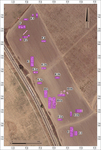
In this excavation four excavation areas were opened (C–F; Fig. 2), and sub-divided into a central area and sub-areas, comprising 140 squares along 800 m on the eastern fringe of el-Manakh hill. The hill and its surroundings were extensively surveyed in the past and finds from a range of periods were found, starting with prehistoric periods near the hill and Tel Megiddo (Tepper 2013). A previous survey of el-Manakh hill identified the full scale legionary base, first established by the Second Triana legion and later, till its abandonment, it was the base of the Sixth Ferrata legion (second–third centuries – beginning of fourth century CE). Six excavation seasons were then conducted by Y. Tepper and M.J. Adams at the legionary base on behalf of the Albright Institute in Jerusalem (Tepper 2007; Tepper 2013; Adams, Tepper and Cohen 2023). In the current excavation in the eastern, lower part of the base, which contained building remains, was uncovered in Areas C–E. In Area F, which is outside and north of the base, a segment of a Roman-period Imperial road was found, and in the same vicinity during past excavations a Chalcolithic-period installation, which was a part of a large site that had been uncovered (see below).
Past excavations of the legionary base suggested that it covered an area of 325 × 485 m (Tepper, Adams and Ernenwein 2023; Fig. 1: G-59/2013; J-23/2023), and during these past excavations of the hill and base uncovered a wide variety of finds. First, a Roman-period military cemetery (Leyfirer et al. 2023 [Fig. 1: A-8895]) as well as a military amphitheater were uncovered north of the base (Fig. 1: J-19/2022, J-23/2023). South of the base and north of Naḥal Qeni were found remains of buildings that were interpreted as a civilian settlement that developed side by side with the base (canabae; Abu Uqsa 2016 [Fig. 1:A-3417, A-3548]). Next remains of buildings, streets and installations extending over a wide area were discovered on a spur south of Naḥal Qeni and identified as Kefar ‘Othnay which is known from historical sources as a village of mixed Jewish-Samaritan population. The village was settled before the legionary base was built, and was abandoned at the end of the Byzantine period, after the base had been abandoned (Tepper 2006 [Fig. 1: A-3411]; Abu ‘Uqsa 2016 [Fig. 1: A-3401]; Tepper and Di Segni 2005). Lastly, an extensive site, which contains remains from the Paleolithic period to the Iron Age, was uncovered north of the base (Tepper 2013; Golani 2025 [Fig. 1:A-8347]).
Area C
In this area thirty four squares were excavated in the central area and in three Sub-Areas (C2a, C2b, C3). Roman-period remains (second–third centuries CE) as well as random finds from the Hellenistic (first century BCE–first century CE) and the Early Byzantine period (fourth century CE) were found in this area.
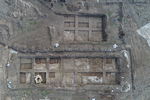
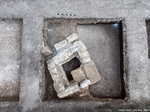
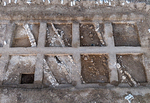
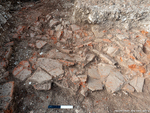
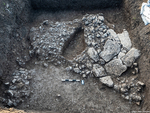
Central Area C (Fig. 3). In a large part of this area a wide square foundation made of light-colored limestone placed on local clay soil was exposed. In the northern part of the area the base of a monument (2 × 2 m; Fig. 4) which was built of a single course of ashlars set on a massive stone foundation was discovered. A number of architectural fragments were found in the collapse layers around its upper portion. East of this monument a segment of a channel oriented northeast–southwest was found. The capstones of the channel were preserved and found at the same level as the street’s infrastructure levels. In the southern section of the area, two superimposed layers of stone were found, curving from southwest to northeast. The stones are mixed with light brown earth. The stone layers are clearly distinguished from their surroundings by curb-like boundary lines of medium and small stones that were laid along their northern and southern edges. These stone layers and their bordering stones appear to form the foundation of a wide wall, probably part of the perimeter wall the legionary base.
Sub-Areas C2a and C2b. These two Sub-Areas were opened on the hill’s slope. The excavation revealed the roadbed (thickness c. 0.5 m) which was composed of crushed limestone, sometimes containing medium and small stones. The finds found within the roadbed date from the Roman period (second–third centuries CE).
Sub-Area C3 (see Fig. 3). This Sub-Area is adjacent to and east of the Central Area C (above). The excavation of this Sub-Area revealed a foundational layer (width c. 6 m) constructed of two layers of stones, similar to the one in the southern part of the central area, except that its’ trajectory curves from southwest to north. Based on the location of this wall foundation on el-Manakh hill, and the orientation of its curve suggests that it served as the foundation of a massive wall that did not survive, most likely, was the base’s fortification wall. Numerous pieces of metal slag and coins were recovered from the upper stone layer. These coins date from the Hellenistic to the end of the Roman–Early Byzantine periods (first century BCE to third–fourth centuries CE). However, only Roman-period pottery (second–third centuries CE) was found in a sounding conducted in the foundation layer and the soil under it. To the east of the wall foundation, nearly sterile brown earth was found, strengthening the assumption that this wall is the foundation of the fortification wall that surrounded the base.
Area D
In Area D fifty two squares were excavated across three Sub-Areas (D1a, D1b, D2). The investigations uncovered building remains dating to the Roman period (second–third centuries CE).
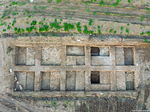
Sub-Area D1a. Excavations in this area revealed a major thoroughfare and monumental structures associated with the Roman legionary base. The street, approximately 11 m wide and oriented northeast–southwest, was identified as the Via Praetoria (Fig. 5). The street was bounded by two limestone walls, while the street's infrastructure (approx. 1 m thick) consisted of three superimposed layers of compacted crushed chalk rock that was laid over local brown clay. A gap in the chalk infrastructure (width c. 2.5 m) in the center of the street was filled with basalt and limestones over the brown clayey soil. The street’s boundary walls were built of basalt stones. The southern boundary wall (width c. 0.6 m) survived to a height of about four courses. North of this boundary wall a curving drainage channel constructed of large stones and covered with stone slabs was uncovered. Most of the northern boundary walls were robbed but were identified by a line of large masonry blocks, architectural fragments, and by the street infrastructure that abuts its foundations.
South of the street, adjacent to the southern boundary wall, a large, leveled area (10 × 25 m; thickness c. 0.5 m) made of alternating layers of light crushed chalk and brown earth was identified as infrastructure for a large open area. Southeast of the street, the foundations of a large ashlar building were found (Fig. 6). It seems that the original plan was in the shape of the letter omega (Ω). The building’s wall (width c. 0.5 m) was built on a flat stone base and survived to a height of two courses. The lower course was upright, and its façade was uniformly shaped along its length, while the upper course was laid horizontally. The stone base and the lower course are oriented at about 30 degrees to southeast, while the upper course is oriented 30 degrees in the opposite direction. In the center of the building was found part of an apse (estimated diam. c. 18 m). The southern part of the building, which was completely uncovered, is c. 4 m long and c. 3 m wide, and its corners are modelled (spurs). To the east of this building a leveled infrastructure layer was found laid over the brown clayey earth. To the west of the building and adjacent to it was found a fragment of a limestone altar. Between the building and the square, an open space paved with limestone (exposure: 6 × 20 m) was uncovered, which extends further east by two rows of pavers (exposed length 12 m, width 1.5 m; see Fig. 6). Lastly, south of the street the finds include numerous tiles, indicating that the building was likely to have been roofed.
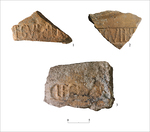
North of the street and adjacent to it alternating infrastructures (15 × 25 m) were found, most likely floors of a building. North of the street was also found another drainage channel, which was cancelled at a later phase and covered with the crushed chalk foundations. Five bases of columns were found approximately 5 m from the street’s northern wall. These supports indicate that a colonnaded wall that ran parallel to the street was here. The abundance of wall/floor tiles and roof tiles fragments indicates that this area was roofed and was most likely a stoa. The most significant finds were roof tiles bearing the stamp of the Sixth Legion Ferrata (the “Ironclad” Legion; LEGVIFER; Fig. 7).
Notably the stone beddings and paving in this area and in areas D2, E and F (below) are undulated. This, in conjunction with the inclination of the exposed building’s wall, indicate a seismic event that occurred at the site after the base was abandoned, which included ground vibrations, landslides or an earthquake; this issue requires further research.
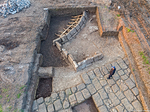
Sub-Area D1b. Excavations in this sub-area continued along the trajectory of the main street that was identified in D1a. Portions of the street’s boundary walls were found, along with a floor foundations made of crushed chalk and small stones that were uncovered next to the northern wall foundations. Along the northern face of the southern wall was uncovered a built drainage channel (length 10 m and more; Fig. 8) that had been partly covered. A similar channel was uncovered outside the street, beside a large assemblage of roof tiles and wall/floor tiles. These two channels were built at a moderate slope towards the northeast, indicating that they were designed to carry runoff and wastewater from the base's center toward its lower-lying peripheral areas. Two other drainage channels oriented northwest–southeast, which probably drained sewage from buildings that were adjacent to the northern side of the main street, were also uncovered. These buildings did not survive. The convergence of these drainage channels indicate that the excavated area was located near the northeastern boundary of the base and the perimeter wall, perhaps also close to the base’s gate complex.
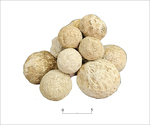
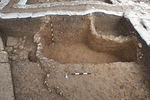
Sub-Area D2. In this sub-area a broad-based foundation was exposed that extended over a large area (10 × 25 m; Fig. 9) that sloped moderately from west to east. Soundings into the foundation identified fills (thickness c. 1 m) of ash, brown soil and crushed limestone, that were deposited in two phases. The fills contained remains of charred wood and olive pits and Roman-period pottery fragments (second–third centuries CE). In the southern part of the area a single southwest–northeast wall built on light brown earth with Roman-period pottery discovered on both sides of it was uncovered. Sling stones and ballistae stones were also found in this area (Fig 10), and this along with meager finds of tiles, supports the assumption that this was a roofless open space.
Area E
In this area twenty six squares were excavated across a central area and four sub-areas (E2a, E2b, E3a, E3b). Similar to the other areas, Roman-period building remains (second-third centuries CE) were found.
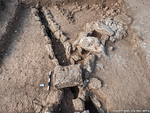
Central Area E. In this Area the northern boundary of the base was found, along with floor foundations. The floor foundation (10 × 15 m; thickness c. 0.3 m) was constructed of crushed limestone mixed with basalt laid directly on the natural basalt bedrock. In the floor foundation was cut a plastered and covered channel (Fig. 11), traversing the foundation in a southwest–northeast direction. Once again, the foundation is undulated, indicating a seismic event (as in Area D above, and Area F below). To the north of the floor earth accumulations were found on the basalt bedrock. The nature of the bedrock didn't show any traces of quarrying or other human intervention, as well as the paucity of finds in this excavation area, support the assumption that this is the northern boundary of the base.
Sub-Areas E2a, E2b, E3a, E3b. In western Sub-Areas E2a and E3a were found two layers of square foundations (max. thickness c. 1 m) made of brown earth, ash and small stones. Once again undulations in the roadbed along with a marl fill in the foundations were uncovered in Sub-Area E3a, possibly indicating a repair following a seismic event (see below). At the bottom of the slope in Sub-Areas E2b and E3b were found poorly preserved meager building remains, which were probably building foundations. The pottery finds from this area date to the Roman period (second–third centuries CE).
Area F
In this area twenty eight squares were excavated across a central area and three sub-areas (F2, F3, F4). Here Roman-period building remains (second–third centuries CE) and Late Chalcolithic installations (mid fourth millennium BCE) were found.
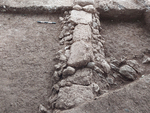
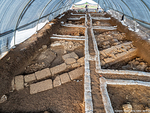
Central Area F. Excavations in this area exposed a monumental construction, probably part of an Imperial Roman road that led from the legionary base north (Legio–Ptolemais road). Two ashlar boundary walls, 11 m apart, flank the road, with the roadbed found between them. The eastern boundary wall is oriented east–west (preserved length 12 m; Fig. 12) and was built on a stone foundation layer and it survived to a height of two courses. The western boundary wall is also oriented east–west and was found in a collapsed pile of ashlars that a range in size. The roadbed (max. thickness 1.2 m; Fig. 13) was constructed of stones and roof tile-fragments. A section perpendicular to the east wall that was cut in the roadbed, uncovered undulations that indicate a seismic event that seemingly caused the walls to lean over (below). East of the eastern boundary wall was discovered a channel, as well as an installation that was dug into the clayey ground next to the wall and lined with a white material mixed with small stones (Fig. 14). The characteristics of the soil inside the installation and outside of it indicate that this installation was used to separate clay in ceramics industry.
In Sub-Area F2. In this Sub-Area was found another segment of the Imperial Roman road with the two parallel boundary walls (recorded length c. 100 m) and piles of collapsed stones next to them.
In Sub-Area F3. In this Area was uncovered an oval installation with a floor of medium- and small-sized stones interspersed with stone slabs (Fig. 15). A section cut into the floor of the installation uncovered pottery fragments and flint tools dating to the Late Chalcolithic period.
In Sub-Area F4. In this Area was found two parallel walls, similar in stone size and construction technique to the boundary walls of the Roman road that were uncovered in the central Area F and in Sub-Area F2. Between the two walls were found layers of stones, tiles and light brown road infrastructure laid on the basalt bedrock. The reconstructed path of the road, spanning approximately 180 m between the three excavated areas and the limits of the excavation, reinforces its identification as a Roman Imperial road paved from the legionary base heading north.
The excavation conducted on the eastern part of the hill of the Roman legionary base at Legio allows us to suggest that the activity in the base extended over a larger area than had been previously assumed (at least 325 × 600 m). The finds support the dating of the legionary base to the second–third centuries and early fourth century CE at the latest. The numerous finds that were collected include coins, metals, pottery vessels, glass and architectural elements. Notably, the tilting walls and undulating ground that were uncovered in a number of the excavation areas, indicate a seismic event, probably at the end of the third–beginning of fourth century, when the Roman army was present at the site, and/or after the base was abandoned. This event, which is still being studied and has not yet yielded clear conclusions, could explain settlement processes in the region surrounding Legio (the vicinity of Megiddo) at the end of the Roman period. It is already clear that the site offers an essential contribution to the study of the Roman military presence in northern Israel on the whole, and the legionary base in particular. The establishment of the base and the processes of its development will become clearer as the processing of the material and study of the finds from the excavation progresses.
References
Adams M.J., Tepper Y. and Cohen S.L. 2023. Legio – 2019. HA-ESI 135. https://doi.org/10.69704/jhaesi.116.2004.26263
Golani A. 2025. Kibbutz Megiddo Junction. HA-ESI 137. https://doi.org/10.69704/jhaesi.116.2004.26625
Leyfirer G., Tabar M., Adams M.J. and Tepper Y. 2023. Legio (North). HA-ESI 135. https://doi.org/10.69704/jhaesi.116.2004.26428
Tepper Y. 2006. Legio, Kefar ‘Otnay. HA-ESI 118. https://doi.org/10.69704/jhaesi.116.2004.363
Tepper Y. 2007. The Roman Legionary Camp at Legio, Israel: Results of an Archaeological Survey and Observations on the Roman Military Presence at the Site. In A.S. Lewin and P. Pellegrini eds. The Late Roman Army in the Near East from Diocletian to the Arab Conquest (Proceedings of a Colloquium Held at Potenza, Acerenza and Matera, Italy, 10–14 May 2005) (BAR Int. S. 717). Oxford. Pp. 57–71.
Tepper Y. 2013. Megiddo – Yoqne‘am–Megiddo Junctions, Survey (Road 66). HA-ESI 125. https://doi.org/10.69704/jhaesi.116.2004.4371
Tepper Y., Adams M.J. and Ernenwein E. 2013. The Principia of the Sixth Legion at Legio/Caparcotani: Ground Penetrating Radar and Excavations in a Legionary Base. ʻAtiqot 111:149–174.
Tepper Y. and Di Segni L. 2006. A Christian Prayer Hall of the Third Century CE at Kefar ‘Othnay (Legio): Excavations at the Megiddo Prison 2005. Jerusalem.
Keywords
el-Manakh hill, Tel Megiddo, Roman legion, Roman legionary base, imperial road, Roman period, installations, Chalcolithic period, seismic event
Publication Date
25/05/2026
Report Type
Preliminary Report