
Kokhav Ha-Yarden (Southeast) (A-8985)
Permit/License Number
A-8985
Excavation Report
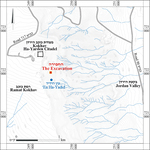
During May–June 2021, a salvage excavation was conducted south of Kokhav Ha-Yarden Citadel (Permit No. A-8985; map ref. 24942–8/72197–200; Fig. 1), prior to the installation of underground electricity infrastructure. The excavation, on behalf of the Israel Antiquities Authority and funded by the Israel Electric Corporation, was directed by H. Mamalya (field photography), with the assistance of Y. Yaakobi (administration), H. Tahan-Rosen (pottery drawing), E. Dalali-Amos (plans), R. Be’eri and E. Stern (pottery consultancy and scientific guidance), B. Hana and Y. Tsur (scientific guidance) and workman from Kafr Yasif and Kabul.
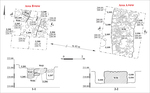
Two excavation areas were opened (A, B; 75 sq m; Fig. 2) on two rock steps (210–220 masl) on the eastern slope of KoKhav ridge in the Lower Galilee, which slopes steeply toward the Jordan Valley. A segment of a wide fortification wall, probably from the Middle Bronze Age II was exposed in Area A, and remains of a building from the Crusader period, constructed over the remains of an earlier, undatable building, were exposed in Area B. The pottery finds included vessels from the Middle Bronze Age II, the Iron Age, and the Persian, Early Islamic, Crusader and Ayyubid periods, which indicate activity in the area during these periods.
The excavation area and site of ‘En Ha-Yadid is found on the escarpment of the Kokhav plateau overlooking the Jordan Valley. The section of the escarpment which is found within the excavation area comprises two main rock strata: the upper one is basalt, of the ‘Cover Basalt’ and ‘Dalwe Basalt’ formations (fissured permeable rocks) and the lower is marl rocks of the ‘Bira Formation’ (fine-grained impermeable rocks). At the contact line between these two rock strata there are numerous springs, the main one being ‘En Ha-Yadid.
The excavation is also about 400 m south of the Crusader fortress of Kokhav Ha-Yarden (Belvoir Castle; Kaukab el-Hawa). The fortress was an important site due to its strategic location on the ridge of the Kokhav plateau. It was surveyed and described during the final decades of the nineteenth century CE when Guérin mentioned it as one of the fortresses built by the Crusaders in the Holy Land and identified its location according to the descriptions by William of Tyre, a historian and archbishop of the twelfth century CE (Guérin 1880:130–132; Conder and Kitchener 1881:126, 137). He adds that this location which is between wadies with natural springs was known to the local inhabitants before the fortress was built (Guérin 1880:130–132; Conder and Kitchener 1881:126, 137). The remains of the Crusader fortress were initially excavated as clearance work, which later became systematic excavations. The architectural finds of Belvoir Castle were attributed to three building phases from the Crusader period (the twelfth–thirteenth centuries CE; Zori 1964a; 1964b; Bed-Dov and Minzker 1966; Bed-Dov and Minzker 1967; Ben-Dov 1968). Surveys that were conducted in the vicinity identified the site of ‘En Ha-Yadid, which was found on the rock benches of the southeastern slope of Ramat Issachar next to the spring of ‘En Ha-Yadid and was dated to the Middle Bronze Age IIa–b, the Late Bronze Age and the Iron Age I–II (fifteenth–eighth centuries BCE; Gal 1980:51; Gal 1991: Site 61).
Lastly, approximately 30 m west of the excavation areas a channel was hewn into the rock (length c. 60 m) to transport water from a small and shallow well in the west eastward to the cultivation terraces on the slope. Parts of the channel were constructed and plastered and were found partly covered and partly open.
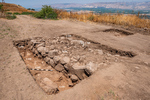
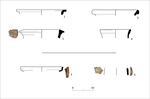
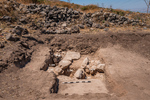
Area A (map ref. 249467-86/721971-86). In this area a massive fortification wall (W50; exposed length 5.2 m, width 2.2 m; Fig. 3) was uncovered, built on packed dark soil (L109) in north–south orientation and constructed of two rows of basalt building-stones, slightly dressed on their external faces, with a core of small fieldstones mixed with a little earth between them. The wall was preserved to a height of two courses. The internal western face (L102, L105, L108), which faces up the slope, was better preserved than the external eastern face (L100, L104), perhaps because of its proximity to a cliff edge on the east. Meagre pottery finds that could not be dated were found on the eastern side of the wall. The pottery that accumulated on the western side of the wall, however, included a cooking pot (Fig. 4:1), a krater (Fig. 4:2) and jars (Fig. 4:3, 4), all dated to the Middle Bronze Age IIb–c; as well as a bowl (Fig. 4:5) and a jug (Fig. 4:6) that are dated to the Crusader and Ayyubid periods (twelfth–thirteenth centuries CE), this then dates the activity within the walled area to these periods.
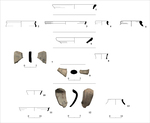
Area B (map ref. 249420-43/721992-2009). This area was opened about 30 m northeast of ‘En Ha-Yadid, on an extensive terrace supported on the east by a massive support-wall that was not excavated. A few east–west walls that divide the area into units that are visible on the surface. One unit was excavated which exposed walls and a floor of two building phases (Fig. 5). The full length of the walls could not be determined because of the limited area of the excavation square. Two short segments of walls (W60, W64), built of medium-sized fieldstones slightly dressed and forming the northeastern corner of a building, were uncovered from the early phase. A floor (L209) composed of well-packed fine-grain soil abuts the walls from the southwest. Pottery fragments include an Iron Age IIa jar (Fig. 6:4; tenth century BCE), a mortar from the Persian period (Fig. 6:6; sixth–fourth centuries BCE) and a Crusader-period bowl (Fig. 6:10; twelfth century CE) which were found in the earth that accumulated over the floor (L205).
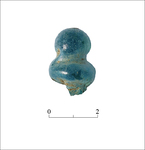
From the later phase a wall (W63; width 1.3 m) was found. This wall was built of two rows of large fieldstones with a core of fine-grain packed earth (L206), of which only one course survives. Wall 63 was partly built over W64 and partly on the bedrock. The rich pottery assemblage that dates to a range of periods was discovered in the core of this wall, which includes a Middle Bronze Age II pithos (Fig. 6:1; first half of the second millennium BCE); cooking pots (Fig. 6:2, 3) and a pithos (Fig. 6:5) from the Iron Age IIa (tenth century BCE); and a Fatimid period jug (Fig. 6:9; eleventh century CE). A base of a glass conical lamp from the Fatimid period (Fig. 7; the seventh–ninth centuries CE) was also found in the core of the wall. Clusters of stones, probably the result of a collapse (L204, L207), were uncovered east of W63, and within them were found pottery fragments that include Early-Islamic-period jars (Fig. 6:7, 8; seventh–ninth centuries CE), and Crusader-period glazed bowl (Fig. 6:11) and cooking pots (Fig. 6:12, 13; twelfth century CE).
The building remains uncovered were in use from the Middle Bronze Age II until the Ayyubid period. The remains in Area B seem to be related to activity around the nearby ‘En Ha-Yadid, and perhaps even to the water channel west of the excavation area.
References
Ben-Dov M. 1968. Kokhav Ha-Yarden. HA 25:6 (Hebrew).
Ben-Dov M. 1973. The Synagogue at Kokhav Ha-Yarden and the Identification of Grofina. Qadmoniot 22:60–62 (Hebrew).
Ben-Dov M. 1993. Belvoir (Kokhav Ha-Yarden). NEAEHL 1. Pp. 182–186.
Ben-Dov M. and Minzker Y. 1966. Kokhav Ha-Yarden. HA 18–19:16 (Hebrew).
Ben-Dov M. and Minzker Y. 1967. Kokhav Ha-Yarden. HA 21:19–20 (Hebrew).
Conder C.R. and Kitchener H.H. 1881. The Survey of Western Palestine I: Galilee. London.
Gal. Z. 1980. Ramat Issachar, Ancient Settlement in a Peripheral Region. Tel Aviv (Hebrew).
Gal Z. 1991. Map of Gazit (46) (The Archaeological Survey of Israel). Jerusalem.
Guérin V. 1880. Description géographique, historique et archéologique de la Palestine III: Galilée I. Paris.
Zori N. 1963. Kokhav Ha-Yarden (Belvoir). HA 8:24–25.
Zori N. 1964. Kokhav Ha-Yarden. HA 9:21.
Keywords
Crusader fortress, Belvoir Castle, Kaukab el-Hawa, Kokhav plateau, ‘En Ha-Yadid, wall, Middle Bronze Age 2
Publication Date
01/06/2026
Report Type
Final Report