
Ma‘ale Amos (North) (06-03-2021)
Permit/License Number
06-03-2021
Excavation Report
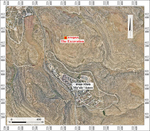
In February–March 2021, a salvage excavation was conducted north of Ma‘ale Amos in southeastern Gush Etzion (Archaeology C.G.A.T. License No. 06-03-2021; map ref. 612342/221662; Fig. 1), prior to development works for a new neighborhood. The excavation, on behalf of the Archaeological Staff Officer of Judea and Samaria and funded by the Gush Etzion Regional Council, was directed by O. Varoner (field photography), with the assistance of A. Miller (administration), Y. Fleitman-Maman (photogrammetry, aerial photography), O. Bejarano (surveying and plans), R. Galili and U. Berger (consultation), H. Shkolnik from the Judea District, and workers from Dhahariya.
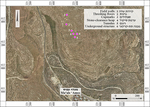
The excavation took place on a large flat-topped hill (750 m asl; Fig. 2). A threshing floor, one of a group of nine documented at the site, was excavated, together with cupmarks, field walls, a subterranean structure, a clearance heap and a stone cairn. In most cases, no finds, or at most worn pottery body sherds, were retrieved. The Herodium Survey Map previously documented a few sites with finds from various periods in the vicinity of the excavation (Hirschfeld 1985: Site Nos. 76–78, 81, 91–99).
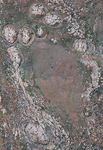
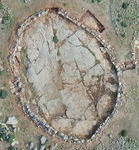
Threshing Floors. A group of nine, various-sized threshing floors (95–175 sq m; Fig. 3:1–9) were recorded, all located around the central surface on the hill. The threshing floors comprised a bare rounded or oval bedrock surface, enclosed within a curved wall. The walls were built of two rows of fieldstones, and preserved for a maximum heigh of two courses (0.7 m). The best-preserved threshing floor (No. 7; c. 175 sq m; Fig. 4) was excavated down to bedrock by removing a sterile earth accumulation layer (max. depth c. 0.5 m). The wall delineating the threshing floor was dismantled in two trial squares opened along it, but no finds were discovered. The threshing floor was a delineated roundish area with accumulated earth above the bedrock (maximum depth 0.5 m), containing very few worn undatable pottery sherds.
Cupmarks (Fig. 5). A flat, smoothed rock-surface south of threshing floor No. 2 was cleaned and four hewn cupmarks were identified (diam. 8–9 cm, depth 9–11 cm).
Field walls. An east–west oriented field wall (length 2.5 m, width 0.5 m) was exposed north of the threshing floors, and another north–south oriented field wall (length 1 m, width 0.5 m) abutted its western end. The walls were built of a single row of fieldstones and preserved for one course.
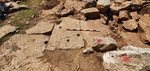
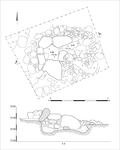
Subterranean structure (Figs. 6, 7). A looted subterranean hewn structure, comprising a narrow rectangular anteroom (L19; max. dimensions 0.7 × 1.5 m) leading to a pentagonal space (L20; length of each side c. 1m), was cleaned and documented. Massive rocks bordered both sides of the anteroom. At the end of the anteroom, there was an entrance in which two stones were placed, perhaps serving as a threshold. The floor of the space was hewn into the bedrock, and an oval depression was hewn in its western part. Walls constructed of three courses of large stones with small-stone fill (height 0.9 m) were built against the rock sides that bordered the space, and massive rocks were placed above them. A particularly large stone slab (0.5 × 0.5 × 1.5 m) that was part of the structure’s ceiling that was apparently constructed from massive stone slabs, was placed in the western part of the space.
Clearance heap. An oval-shaped stone clearance heap (11 × 16 m) was excavated down to bedrock in the eastern part of the area. Worn undatable pottery body sherds were found among the clearance-heap stones.
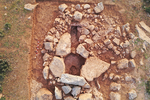
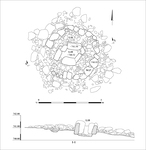
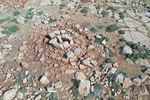
Cairn (Figs. 8, 9). A cairn (max. diam. 4.7 m), facing southwest towards the Judean Desert hills, was uncovered in the southern part of the area. The cairn comprised a burial chamber (L18), surrounded by a fill of small stones (L16), delineated by an external round wall (W17). The burial chamber (1.6 × 1.8 m) was bound by six massive upstanding stones (the largest c. 0.3 × 1.0 × 1.0 m). The chamber was completely looted and contained no finds. Wall 17 was built of partly hewn stones and fieldstones, and preserved for two courses.
Threshing floors similar to the ones documented in the excavation are known throughout the Judean Desert fringes, and in Teqo‘a and Noqdim in the region of Gush Etzion (Y. Aharonovich pers. comm.). The dating of the threshing floors documented in the excavation is not known, but local habitants say that they were in use at least until the mid-twentieth century, and perhaps later. The characteristics of the subterranean structure are similar to those of burial complexes (dolmens) known from Jordan and northern Israel, dated mostly to the Intermediate Bronze Age (Fraser 2018). Cairns and fields of cairns are known from the central Negev, Sinai and Jordan already since the sixth millennium BCE and until the Iron Age (Rosen et al. 2007; Abu-Azizeh et al. 2014; Cohen-Sasson 2017:159). The cairn uncovered in the excavation is of the rounded/filled-in type (Kochavi 1967:125–128; Cohen 1999:281), known throughout the Negev and Sinai, and even at Ramat Ha-Nadiv in northern Israel; it is dated to the Intermediate Bronze Age (Greenberg 1992; Galili 2022:37–39).
The remains uncovered in the excavation are probably associated with two main aspects of human activity: agriculture and burial. It seems that the burial remains date to early periods, while the agricultural activity dates to later times, possible even modern times.
References
Abu-Azizeh W., Tarawneh M., Abudanah F., Twaissi S. and Al-Salameen A. 2014. Variability within Consistency: Cairns and Funerary Practices of the Late Neolithic/Early Chalcolithic in the Al-Thulaythuwat Area, Southern Jordan. Levant 46/2:161–185.
Cohen R. 1999. Ancient Settlement of the Central Negev I: The Chalcolithic Period, the Early Bronze Age and the Middle Bronze Age I (IAA Reports 6). Jerusalem (Hebrew; English summary, pp. 44*–57*).
Cohen-Sasson E. 2017. A Renewed Examination of the Egyptian Mining Operation in Timna Valley: Social Aspects of the Copper Production Organization during the New Kingdom. Ph.D. diss. Ben-Gurion University of the Negev. Be’er Sheva‘ (Hebrew).
Fraser J.A. 2018. Dolmens in the Levant. London–New York.
Galili R. 2022. Landscape Archaeology: Spatial Perspectives, Typology, and Post-Depositional Processes at Cairn Sites in the Negev. Ph.D. diss. Ben-Gurion University of the Negev. Be’er Sheva‘ (Hebrew; English summary).
Greenberg R. 1992. The Ramat Ha-Nadiv Tumulus Field: Preliminary Report. IEJ 42:129–152.
Hirschfeld Y. 1985. Map of Herodium (108/2) (Archaeological Survey of Israel). Jerusalem.
Kochavi M. 1967. Settlement of the Negev in the Middle Bronze (Canaanite) I Age. Ph.D diss. The Hebrew University of Jerusalem. Jerusalem (Hebrew; English summary).
Rosen S.A., Bocquentin F., Avni Y. and Porat N. 2007. Investigations at Ramat Saharonim: A Desert Neolithic Sacred Precinct in the Central Negev. BASOR 346:31–57.
Keywords
Maale Amos, Gush Etzion, Traditional agriculture, granary, Rock-cut cupmarks, Field walls, burial cairn (tumulus), Intermediate Bronze Age, cairns, Judean Desert fringe
Publication Date
01/06/2026
Report Type
Final Report