
Meẓad Tamar (A-9674)
Permit/License Number
A-9674
Excavation Report
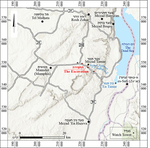
During 2023–2025, three excavation seasons were conducted at The Mezad Tamar Fortress, alongside the conservation of the fortress (Permit No. A-9674; map ref. 223028/548476; Fig. 1). The conservation work was carried out by the IAA Conservation Division, directed by A.S. Sa‘id and A. Inbar. The excavation, on behalf of the Israel Antiquities Authorities and funded by the Israel Land Administration, was directed by D Eisenberg-Degen (field photography and aerial photography), with the assistance of L. W. Davis, Y. Samuel and M. Yehuda (area supervision), N. Lect Ben-Ami (consultation), E. Aladjem (aerial photography and photogrammetry), S. Halevi (multispectral photography), A. Montagu and M. Kahan (surveying and plans), I. Azoulay (plan), R. Shoeff and A. Inbar (architecture), Y. Asscher (analytical lab), T. Erickson-Gini (pottery), Y. Gorin-Rosen (glass), R. Kool (numismatics), L. Perry-Gal and M. Intrator (archaeozoology), and G. Seriy from the Southern Negev District. Students from Ben-Gurion University participated in the excavation, as well as inspectors from the IAA Southern Region and workmen from Kuseifa and the Palestinian Authority.
Mezad Tamar (Qasr el-Juheiniya) is about 12 km west of the Dead Sea, near Highway 25 and the Tamar Quarry, and next to ancient Ma‘ale Tamar. The Mezad Tamar fortress is located next to Nahal Tahmas, which in times of flood supplied a reservoir in the fortress with water through a system of channels. The security of the fortress depended on a line of other fortresses and watchtowers that were erected along an ancient travel route, which connected Zo‘ar to Mamphis and continued north to Tel Malhata (see Fig. 1). Some of the fortresses were built in the Roman period (end of the third–beginning of the fourth century CE) and remained in use during the Byzantine period (mid forth–sixth centuries CE), while others, like Rosh Zohar, ‘En Boqeq and perhaps Mezad Hatrurim were built during the Byzantine period (Magness 2003:129). A building with an estimated date of the end of the Hellenistic period had been found next to Mezad Tamar in the past, therefore, it is possible that some of the fortresses and watchtowers in the area are also dated to the same period (Gichon 1974; 1975; 1976a; 1976b). Mezad Tamar was surveyed a number of times during the first half of the twentieth century (for details, see Gichon 1993:1437) and had been excavated in the past by Gichon on behalf of Tel Aviv University (Gichon 1974; 1975; 1976a; 1976b). Gichon assumed that the fortress was built over a Nabatean-period building, on which its plan was based.
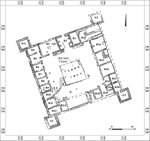
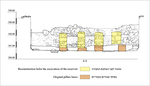
Mezad Tamar is a square building (40 × 40 m, average width of external walls 1.1 m; Figs. 2, 3), with four projecting corner towers (quadroburgus; 6 ×6 m). The fortress has four wings, containing 25 rooms arranged around a courtyard with a water reservoir at its center. Two channels that passed under the western wing (Rooms 9 and 10) carried water from Nahal Tahmas to the reservoir. Only about a third of the reservoir was exposed in Gichon’s excavation, and most of the rooms were not fully excavated.
In the current excavation (3D model) we removed sections and earth fills from Gichon’s excavations, according to the requirement of the conservation team, and completed the excavation of the reservoir rooms in the northern wing (Room 25), the eastern wing (Rooms 22–24) and the southern wing (Room 17), as well as the four corner towers. Rooms that had not been excavated previously in the western and southern wings (11, 12, 13), were uncovered.
The Northern Wing (Room 25) and the Northern Tower. Room 25 is a rectangular room, with a wall that crosses it lengthwise that was uncovered at its center in the past. Parallel to the longitudinal walls of the room, walls built of small fieldstones were previously exposed, forming a kind of elongated cells (c. 0.3 m wide). Gichon assumed that the longitudinal wall along the center of the room served as a base for wooden poles that supported the roofing, and that elongated vessels, such as jars, were stored in the elongated cells, thereby Gichon identified this room as a storeroom (Gichon 1976b). We, however, suggest identifying Room 25 as a stable on the basis of comparison with other stables that were found at Shivta, Rehovot-in-the-Negev and ‘Avdat (Erickson-Gini 2022: Figs. 2, 5, 7). The longitudinal wall at the center may have been a base for troughs, while the narrow elongated cells on both sides of this wall served as feeding troughs. Furthermore, within Room 25 is found the only entrance to the northern tower. The excavation of the tower exposed a large concentration of animal bones, including skulls of horses and a camel, and bones of cattle, pig and sheep/goat. Some limb bones were found in articulation. The horse skulls support the assumption that Room 25 served as a stable.
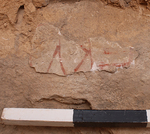
The Eastern Wing (Rooms 22–24) and the Eastern Tower. In room 22 a doorway leading to Room 19a was found. It had been deliberately blocked; within the blocked passage is a stone in secondary use, which carried plaster remains and red inscription (Fig. 4). In the neighboring Rooms 23 and 24, the current excavation identified clear evidence of raised floor levels.
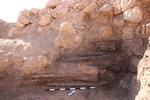
Outside the fortress, in the corner formed by the eastern wall and the eastern tower, a substantial ash accumulation was uncovered, reaching a thickness of approximately 1.3 meters (Fig. 5). This layer was rich in organic material, including twigs and fruit pits, and yielded a small quantity of pottery sherds and coins.
The Western Wing (Room 11). The excavation of Room 11 revealed significant architectural changes to the building, including dismantling and subsequent rebuilding of walls. These changes seems to have led to a reduction in the sizes of the rooms in this wing.
The Southern Wing (Rooms 12, 13 and 17). The excavation of Room 12 found that the southern wall of the fortress was rebuilt at some point, nearly from foundation level. While the excavation of Room 13 identified four activity phases (3D model). In the earliest phase a floor which incorporated some flat stones was exposed at 389.97 asl, about 0.4 m below the second-phase threshold (390.35 asl). A thin layer of ash (height 390.19 asl) was uncovered in the second phase, and above it remains of ephemeral occupation (at 390.28 asl) dating to the third phase. In the latest phase, an Islamic-period burial (at 391.00 asl) was exposed next to the southern wall of the room.
The Water Reservoir (10 × 13 m; 3D model; see Figs. 2, 3). Descent to the reservoir was made by a staircase on its northeastern corner. There were two rows of columns in the reservoir: the southern row had four columns, and the northern row had five. The dimensions of the columns are not uniform, and neither are the distances between them. The first and third columns in both rows and the fifth in the northern row stand on base of hewn stones, which also seems to be what columns themselves were built of. The second and fourth columns in both rows were built of coarse stones and therefore were probably built at a different phase than the other columns.
The reservoir floor (thickness 0.15 m) was constructed of stones and gray plaster, in which two coins were discovered. The floor surface was smoothed and plastered with white plaster. At the junction of the walls and the floor, a sloped plaster fillet (rolka; approx. 0.2 m wide) was installed to reinforce the seams between the walls of the reservoir and the floor. Next to the western wall two stones (0.5 × 0.6 m) were incorporated into the floor, probably deliberately placed below the water flowing from the channels to preserve the plaster by softening the impact of the water on the floor. When discovered, the reservoir was filled with stones from the collapsed columns and with qirton slabs (length of each slab 1.3 m). The latter are probably remnants from the original roofing of the reservoir.
The Finds. The assemblage of pottery, glass and coins in the fortress rooms extends over a long period, from the first to the sixth centuries CE, however most of the finds date to the middle Byzantine period (second half of the fourth–second half of the fifth centuries). Most of the rooms contained mixed assemblages, however it seems that two rooms (Rooms 11 and 22) were deliberately used for refuse disposal. Pottery fragments and coins from the fourth–sixth centuries CE were found in these rooms (Rooms 11 and 22), as well as large quantities of animal bones, some of which were burnt, organic finds and abundant ash. The large quantity of organic remains were found in the fortress, which included date-stones, grain, olive-stones and a grape pip. The largest cluster of date-stones, about 250, was found in the ash layer next to the eastern tower.
Although the present excavation was modest in comparison with the lengthy seasons that were conducted in the past, reexamination of the construction style in conjunction with the assemblage from the fortress’ rooms, and the accumulations exposed outside the structure allows a renewed interpretation of the building phases and its functional evolution. As Gichon identified in his excavations, the fortress underwent several construction phases and structural changes over time, and it is possible that these changes were prompted by the earthquake of 363 CE.
The building style indicates that the rooms in the fortress were roofed with an organic material that was covered with earth. Furthermore, a re-assessment of the layout of Room 25, combined with the discovery of the horse-bones in the adjacent northern tower, strongly suggest that this room functioned as a stable.
The majority of the assemblage dates to the mid-Byzantine period (second half of fourth–second half of fifth centuries CE) and it appears that during this era the use of the fortress reached its peak. The ash layer found adjacent to the eastern tower is most likely from a later phase. This is due to the fact that the ash layer raised the level of the activity surface outside the fortress, potentially compromising its defensive security, and should therefore be dated to a later phase in which the fortress’ function changed from a roadside fortress to a ephemeral living space for a smaller group of people. During this phase it seems is when some of the rooms were repurposed for refuse disposal.
The botanic finds that were identified in Gichon’s excavations (Liphschitz and Waisel 1974) included cedar of Lebanon, common cypress, Jerusalem pine and European olive, and indicate that the fortress was part of an organized Imperial planning and construction network. Furthermore, the garrison stationed at the site received food supplies that, given the large quantity of strainer jugs and the identified fish bones, originated in part from ‘Aqaba, where the Tenth Legion was stationed at that time. The food supplies included grain, olives, grapes and other types of plant-based foods that were likely brought to the site and not cultivated locally.
A future morphological study of the hundreds of date-stones that were recovered may reveal the number of varieties represented and their geographic origin. Likewise, a future analysis of the faunal remains will clarify whether livestock were raised on-site and the extent to which hunting supplemented the garrison’s diet.
References
Erickson-Gini T. 2022. Stables in the Negev: An Overview. In E. Rocca, P. Piraud-Fournet and F. Baratte eds. The "Trough Rooms". Madrid. Pp. 191–201. https://doi.org/10.4000/books.cvz.33790
Gichon M. 1974 Mezad Tamar. HA 48/49:90–91 (Hebrew). https://doi.org/10.1080/00357529.1974.11762985
Gichon M. 1975. Mezad Tamar. HA 56:44–45 (Hebrew). https://doi.org/10.1542/peds.56.1.44
Gichon M. 1976a. Excavations at Mezad-Tamar, 1973–1974. IEJ 26/4:188–194.
Gichon M. 1976b. Excavations at Mezad Tamar –Tamara: 1973–75, Preliminary Report. Saalburg Jahrbuch 33:80–94.
Gichon M. 1993. Tamar, Mezad. In NEAEHL 4. Pp. 1437–1440.
Liphschitz N. and Waisel Y. 1974. Tamara—1973. Dendroarchaeological Investigations 1–3. Internal Report, Tel Aviv University.
Magness J. 2003. The Archaeology of the Early Islamic Settlement in Palestine. Winona Lake, Indiana. https://doi.org/10.1515/9781575065380
Keywords
Metzad Tamar, Southern Dead Sea, Roman forts, late Roman period, Byzantine period, Horse stables, Ancient water system, Desert water management, Roman and Byzantine coins
Publication Date
01/06/2026
Report Type
Preliminary Report