
Nabi Samuel (21-03-2024)
Permit/License Number
21-03-2024
Excavation Report
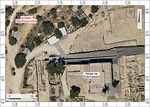
In August 2024, a salvage excavation was conducted in the northern part of the Nabi Samuel National Park (Tomb of the Prophet Shemu’el; Archaeology C.G.A.T. License No. 21-03-2024; map ref. 217136/637780; Fig. 1), prior to laying a water pipeline to comply with fire safety regulations. The excavation, on behalf of the Archaeological Staff Officer of Judea and Samaria and funded by the Israel Nature and Parks Authority, was directed by O. Varoner (field photography), with the assistance of A. Miller (administration), Y. Fleitman-Maman and O. Bejarano (photogrammetry and plan), A. Tavger (consultation), a Nature and Parks Authority team under D. Ouahnouno, and workers from Kafr Beita.
The site of Nabi Samuel is situated on a high summit (880 m asl) northwest of Jerusalem. Previous excavations at the site exposed remains dated from the end of the Iron Age to the Mamluk period (for survey of the excavation results, see Magen and Dadon 1999).
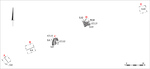
The present excavation was conducted in the northern part of the site, in an area not previously excavated (see Fig. 1). Five excavation squares were opened (A–E; each 4 × 4 m; Fig. 2), and a Jordanian military trench (Square C) and a field wall (Square D) were uncovered.
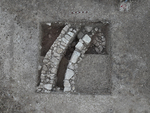
In Square C, a c. 4 m-long segment of a curved wall of a Jordanian battle trench, oriented approximately north–south, was exposed (L5; Fig. 3). The western wall of the trench was built of two rows of medium-sized stones with a core of small stones, and only one row and part of the core of the eastern wall was extant. A similar battle trench, probably its continuation, was identified on the surface about 2 m north of Square C. The trench is probably a previously unexposed part of the military trench network surrounding the site, dug and used by the Jordanian Legion in the 1948 War of Independence, and by the Jordanians in the 1967 Six-Day War.
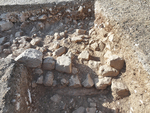
In Square D, an east–west field wall (W10; Fig. 4), built of hewn limestones on the bedrock, was preserved for two courses (0.3 m). Heaps of collapsed stones (L11, L12), at least some fallen from the wall, abutted the wall on the north and south.
In Squares A and B, only half the area of the squares was excavated, exposing piles of various-sized collapsed stones (L4, L9) on the bedrock, overlain by accumulated earth (depth 0.3 m). In Square E, accumulations of earth (L13; depth 1 m) were exposed, and the excavation was stopped before the reached bedrock.
A few worn undatable pottery sherds were found in all the excavation squares (not illustrated).
References
Magen Y. and Dadon M. 1999. Nebi Samwil (Shmuel Hanavi—Har Hasimha). Qadmoniot 118:62–77 (Hebrew).
Keywords
Nebi Samuel, Tomb of Samuel the Prophet, Jerusalem hills, Field wall, 20th-century archaeology, Multi-period site
Publication Date
02/06/2026
Report Type
Final Report