
Naḥal Nevaṭim (A-9488)
Permit/License Number
A-9488
Excavation Report
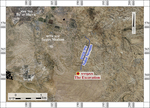
During January–May 2023, a salvage excavation was conducted next to Nahal Nevatim (Permit No. A-9488; map ref. 189509–974/560617–746; Fig. 1), prior to laying a fuel pipeline. The excavation, on behalf of the Israel Antiquities Authority and funded by Energy Infrastructure Company, was directed by S. Talis and D. Biton (field photography), with the assistance of G. Vasiutin (area supervision and field photography), M. Yehuda (area supervision) Y. Alamor (administration), E. Aladjem and A. Montagu (surveying, field photography and photogrammetry), D. Eisenberg-Degen (scientific guidance), I. Azoulay (plans) and workmen from the Hebron area.
The excavation was carried out on a low hill of hard limestone rock between two streambeds—Nahal Nevatim on the east and Nahal Noqedim on the west—containing alluvial sediments and accessible water. During a previous excavation that was conducted in 2007 (Permit No. A-5104), about 20 m west of the current excavation, a Four-Room House, along with a number of stone-lined granaries dug in the ground along with some other building remains, all dated to the tenth century BCE, were discovered.
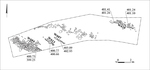
In the present excavation two excavation areas were opened (A, B; Fig. 2), about 200 m apart. In area A two strata (I, II) were identified: in Stratum II a building with two construction phases dated to the Iron Age IIa was uncovered , and above that building, in Stratum I were found meager building remains that were dated to the Iron Age IIb–c. In area B field walls of unknown date were uncovered.
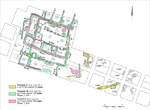
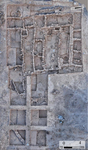
Area A (Fig. 3, 4)
Stratum II. Remains of a building (16.0 × 17.5 m), whose northern part was outside the excavation boundaries, were uncovered in the western part of the area. The building’s walls were constructed of fieldstones, the western part was constructed on the bedrock while the eastern part was constructed on a fill of loess soil, due to the hill’s slope. Some of the walls were constructed of two rows of fieldstones with a core of small stones, while some were built of one row of large stones. The walls survived to a height of 1–6 courses. Some of the internal walls of the building were constructed of equidistant columns (height 0.7–0.8 m), built of large fieldstones. These columns supported cornice stones and created passages between the rooms of the building. Two construction phases were identified in this building (Phases 1, 2).
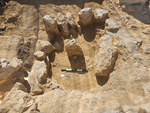
In early Phase 2, a Four-Room House (10 × 13 m) was uncovered, built mostly on bedrock, except for its eastern edge that was built on an earthen fill. The building includes one space (1) in north–south orientation, and three spaces (2–4) separated by two rows of columns, perpendicular to Space 1, in an east–west orientation. It seems that the entrance to the building was set in the eastern wall that led into Space 3. The large quantities of ash that were discovered in Space 3 indicate that it was an open courtyard. The bedrock served as a floor in the western part of the building, while in its eastern part the floors were made of tamped earth. Natural depressions in the bedrock that were filled with earth and small stones were identified in Space 4, in order to keep the floor level. Finds from inside the rooms included a pit filled with ash, cupmarks and a stone installation with a large stone placed at its center, perhaps a stele (Fig. 5) which was surrounded by pottery, stone utensils and ash.
About 5 m south of this building, another wall was uncovered (W491), probably part of an additional building that extended farther south and outside the excavation boundaries.
In the later Phase 1, the building remained in use and underwent modifications, which included building extensions and renovations, new installations and raised floors. A new wall (L409), made of a single row of stones, substituted the southern line of columns that separated Spaces 3 and 4 by incorporating the columns and cornices of Phase 2 into the wall. Added stone walls divided Spaces 1 and 4 into a number of rooms. The floors of some rooms were raised with tamped earth, while in others the floors of Phase 2 remained in use. All the floors from Phase 1 were found underneath heaps of collapsed stones.
New construction took place around the building during phase 1. Two spaces (12, 13), oriented east–west were added south of the building, and to the west of those spaces two more rooms (10, 11) were added. Furthermore, three rooms, which were partly excavated (14–16), were added north of the building. Cupmarks, tabuns, hearths and ash layers were uncovered in the new spaces and rooms, while pottery fragments (Fig. 6), numerous grinding stones and metal utensils were found on the floors.
The pottery vessels in both phases date to the 10th century BCE, which includes bowls, kraters, jars, pithoi, jugs, juglets and chalices. About 15% of the assemblage was handmade vessels.
To the east of the building and throughout the slope were found ash layers in an area of about 25 m long. The pottery in these layers dated to the Iron Age IIa, as were the vessels that were found inside the building. It seems that these ash layers where refuse that was thrown out while the building was in use.
The remains of the Four-Room House, a type of house common in the Iron Age, demonstrate the association between the plan and the construction method as, for example, the construction of stone columns with openings between them that connect the various rooms. It seems that the Phase1 walls that surround the main building were part of additional buildings that abutted it. As was the case in Stratum II, Area A, at Tel Masos (Kempinski et al. 1981:162; Fritz and Kempinski 1983), here too there was an attempt to surround the settlement with a defensive line of adjacent houses. The settlement plan and the construction techniques are also similar to sites of the Negev Highlands, such as Horbat Ha-Ro‘a (Cohen and Cohen-Amin 2004:34–38), Horbat Haluqim (Cohen and Cohen-Amin 2004:41–45), Nahal Boqer (Cohen and Cohen-Amin 2004:28–33) and Horbat Ritma (Cohen and Cohen-Amin 2004:38–40). A public building on the hilltop surrounded by the rest of the settlement-buildings down the slope was uncovered in all of these sites.
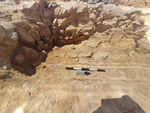
Stratum I. Meager building remains were uncovered over the ash layers of Stratum II in the eastern part of the area. The remains include a few walls that were constructed of a single row of fieldstones that survived to a height of a single course. Above the habitation levels that abutted these walls, two tabuns and a few pottery fragments dated to the eighth–seventh centuries BCE were found.
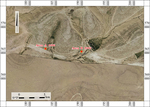
Area B (Fig. 7)
Four field walls (W604, W607, W610, W613) oriented approximately east–west were uncovered. Wall 604 was built of a single row of large fieldstones on a slope and was preserved to a height of c. 12 courses—most likely it was used as a dam. Wall 610 was built of two rows of small fieldstones and survived to a height of a single course. Walls 607 and 613 were built of single row of small–medium sized fieldstones and survived to a height of a single course. The poor preservation of W607, W610 and W613 made it impossible to understand their function.
The remains of the settlement that was uncovered in area A dated to the Iron Age IIa. Taking into consideration the granaries that were found during the excavation at the site in 2007, the field walls that were found in Area B and the large number of grinding stones that were found in Area A, it seems that the economy of this settlement was based on agriculture. An occupation in agriculture is distinct from other sites in the neighborhood as analysis of phytoliths in the nearby settlement remains at Horbat Ha-Ro‘a and Nahal Boqer led to a conclusion that the inhabitants of these sites were pastoralists (Shahack et al. 2014). Most of the pottery assemblage from the present excavation is similar to that of Tel Masos Stratum II. Nevertheless, a small quantity of handmade vessels were found, which is absent from Tel Masos, but comprises about 50% of the assemblages of the Negev-Highlands sites (Cohen and Cohen-Amin 2004:121).
It seems that the site at Nahal Nevatim was located on two ancient trade routes that descended from the Hebron mountains and the southern coastal plain that led through Tel Masos, the site at Nahal Nevatim and other sites in the Negev Highlands, to Qadesh Barne‘a in the central Negev.
References
Cohen R. and Cohen-Amin R. 2004. Ancient Settlement in the Negev Highlands II: The Iron Age and Persian Period (IAA Reports 20). Jerusalem (Hebrew; English summary, pp. 1*–36*).
Fritz V. and Kempinski A. 1983. Ergebnisse der ausgrabungen auf der Ḥirbet el- Mšāš (Tel Māśōś) 1972–1975. Wiesbaden.
Kempinski A., Zimchoni D., Gilboa E. and Rösel N. 1981. Excavations at Tel Masos: 1972, 1974, 1975. Eretz-Israel: Archaeological, Historical and Geographical Studies 15:154–180 (Hebrew; English summary, pp. 82*).
Shahack R., Boaretto E., Cabanes D., Katz O. and Finkelstein I. 2014. Subsistence Economy in the Negev Highlands: The Iron Age and the Byzantine/Early Islamic Period. Levant 46/1:98–117. https://doi.org/10.1179/0075891413Z.00000000034
Keywords
Nahal Nevatim, Iron Age, Four-room house, Field walls, Silos, Cupmarks, Tabuns, Hearths, Ancient agriculture
Publication Date
02/06/2026
Report Type
Preliminary Report