
Jerusalem, Naḥal Refa’im (A-8851)
Permit/License Number
A-8851
Excavation Report
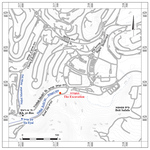
In November 2020, a trial excavation was carried out in a cave discovered in the course of the construction of a drainage channel in Nahal Refa’im, in the Malha neighborhood, Jerusalem (Permit No. A-8851; map ref. 217545/628373; Fig. 1). The excavation, carried out on behalf of the Israel Antiquities Authority and funded by the Moriah Jerusalem Development Corporation, was directed by G. Haklay, with the assistance of I. Milevski and R. Lupo (area supervision), N. Nehama (administration), V. Essman (surveying), S. Halevi (field photography and photogrammetry), O. Zakaim (plans), Y. Asscher (micro-archaeology), H. May (physical anthropology) and A. Frumkin (speleology), O. Barzilai, Y. Baruch, A. Re’em and Y. Zelinger (assistance and consultation).
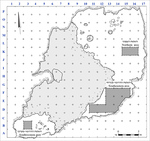
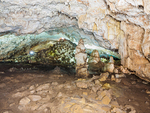
An active karstic cave (648 m asl) composed of a large hall (max. dimensions 25 × 40 m; c. 700 sq. m) was discovered and partially excavated (Figs. 2, 3). About half the cave floor was covered by a talus of collapsed large stones (c. 5 m high; gray-shaded in Fig. 2), and in the cave roof above it there was a natural shaft (c. 6 m long) that probably provided access to the cave. The cave was partially looted shortly after it was discovered. An initial survey of the cave exposed some human bones, among them a child’s skull vault, clusters of pottery sherds and circles of stones near the cave walls (O. Barzilai, pers. comm.).
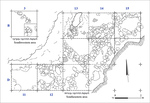
The aim of the excavation was to sample various areas of the cave and assess its potential research value. Thirteen excavation squares were opened (2 × 2 m; Fig. 2) in three parts of the cave—southwestern, southeastern, and northern—exposing remains of walls, stone circles, hearths, pits and burial remnants. The finds were mostly pottery sherds from the Early Pottery Neolithic (6500–5800 BCE) and Late Pottery Neolithic (5800–4500 BCE), dating the period of use of the cave. Other finds included groundstone, flint and obsidian items, bone tools and a figurine modelled from cave sediment (Haklay et al. 2022). It seems that the cave was sealed at the latest, in the Chalcolithic period, and only reopened when recently rediscovered.
Southwestern Area. A single square (Fig. 4) exposed the remains of a wall delineating a cluster of pottery to its north, including a bow rim and a wide handle, dating to the Late Pottery Neolithic. Two pits contained stones and pottery sherds, including one sherd decorated with a pattern characteristic of Wadi Rabah culture pottery vessels.
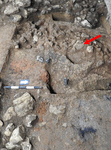
Southeastern Area. Ten squares were opened here (Fig. 4). Remains of walls and a circular installation were visible on the surface next to the eastern wall of the cave, and an accumulation of pottery sherds dating to the Late Pottery Neolithic period was retrieved among the remains. A layer of earth (0.1 m thick) containing flint items lay below these remains, and below it a layer of cave sediment. Away from the cave wall, hearths (Fig. 5) and ash piles were uncovered. Disintegrated human bones were found at the base of the talus, c. 0.5 m below the cave surface, and despite their poor preservation, it was possible to determine that the bones were in articulation and were probably a primary burial of an adult in a flexed position. The human bones were found in association with a cluster of stones, a Yarmukian sickle blade and pottery vessels, mostly dating to the Early Pottery Neolithic. North of the burial, and above the remains of a stalagmite that was probably destroyed by the recent human activity, a figurine carved out of cave sediment containing two stalagmites was found (Haklay et al. 2022: Fig. 6); the stone was cut and modelled along the circumference of the stalagmites that were sharpened.
Northern Area. Two squares were opened in an area of extensive karstic activity. Large and medium-sized stones were uncovered, as well as pottery sherds, including a knob handle and horizontal handles dating from the Early Pottery Neolithic period and the ribbon handle of a jar dating from the Late Pottery Neolithic period.
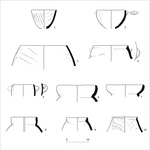
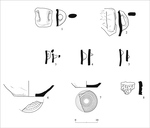
The Finds. The pottery sherds retrieved in the cave date from the Early and the Late Pottery Neolithic periods. Coarsely made, deep and hemispherical bowls (Fig. 6:1, 2), some with small horizontal lug handles and some pierced, dominate the Early Pottery Neolithic assemblage, other vessels including holemouth jars, some with knob handles or horizontal pierced lug handles (Fig. 6:3–5). The Late Pottery Neolithic pottery assemblage mainly comprises bow-rim jars (Fig. 6:6–8), and ribbon handles that widen at the join with the jar (Fig. 7:1, 2); these vessels are not decorated. Other vessels include jars with a splayed rim (Fig. 6:9, 10), horizontal-pierced lug handles (Fig. 7:3), knob handles (Fig. 7:4, 5), jar bases with mat imprints (Fig. 7:6, 7) and a sherd with pierced decoration (Fig. 7:8).
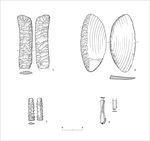
The flint assemblage includes a bifacial knife (Fig. 8:1) and a tabular scraper (Fig. 8:2), both shaped using pressure retouch and dating to the Pottery Neolithic period, a Yarmukian sickle blade with deep denticulation on both sides (Fig. 8:3), and a large flint hammerstone. Two obsidian bladelets, one with a retouched edge (Fig. 8:4), a basalt shaft-hole axe, and bone tools were also retrieved.
The excavation remains reflect non-continuous occupation of the cave in the course of the Pottery Neolithic period, the exploitation of a dark and difficult to access karstic cave not an obvious choice for dwelling. The stone and flint assemblages, albeit small, included special artifacts that required skilled investment, probably indicating that the cave was used in special circumstances rather than for permanent habitation. A similar karstic cave containing Early Pottery Neolithic finds discovered at Nahal Qana, western Samaria, was apparently also not used as dwelling cave (Gopher and Tsuk 1996). Occupation sites in active karstic caves dating from the Pre-Pottery Neolithic period are so far not known in the southern Levant, but similar sites may have served as burial and ceremonial sites as early as the beginning of the Pottery Neolithic period. Based on the finds in the present excavation, the cave seems to have a potential for a long-term and multi-disciplinary research.
References
Gopher A. and Tsuk T. 1996. The Naḥal Qanah Cave: Earliest Gold in the Southern Levant (Tel Aviv University Institute of Archaeology Monograph Series 12). Tel Aviv.
Haklay G., Brailovsky-Rokser L., Lupu R., Eirikh-Rose A., May H. and Milevski I. 2022. The Neolithic Periods’ Finds from the Karstic Cave of Nahal Rephaim, Southwest Jerusalem. Neo-Lithics: The Newsletter of Southwest Asian Neolithic Research 22:13–22.
Keywords
Jerusalem, Nahal Rephaim, Karst cave, Pottery Neolithic, Burial, Stone circles, Hearths, Wadi Rabah culture, Sickle blade, Obsidian, Basalt tools, Bone tools, Ritual activity
Publication Date
02/06/2026
Report Type
Preliminary Report