
Banias, Western Cemetery
Excavation Report
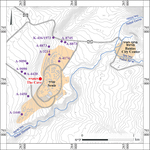
During 2022, photogrammetric documentation of a large rock-hewn burial cave complex was undertaken in the western cemetery of the ancient site of Banias (map ref. 262380/794075; Fig. 1). The documentation was carried out on behalf of the Israel Antiquities Authority, with the participation of O. Zingboym (field photography), A. Kleiner (photogrammetry, plan and drone photography), R. Assis (survey), A. Wiegmann (3D model) and E. Dalali-Amos (final plan).
The western cemetery of the city of Panias (Banias) is located within the area of Kibbutz Senir and to its west (Fig. 2), and is one of a few extensive burial areas located around the ancient city (Hartal 2009:22; Hartal 2017: Site 49). Excavations conducted within the area of the kibbutz in the 1970s, exposed a loculi burial cave and a few hewn graves dated to the Early Roman period (Amir 1974 [Fig. 1: K-436/1973]; Hartal 1986; 2009:22). Excavations conducted in the western cemetery over the last twenty years uncovered numerous cist graves (Hartal 2008 [Fig. 1: A-4174]), burial caves (Permits Nos. A-1440, A-1650, A-9090) and remains of Roman-period mausolea (Stepansky 2004 [Fig. 1: A-3124]; Barbe 2007 [Fig. 1:A-4420]; Tchekhanovets and Najar 2024 [Fig. 1: A-8745]; Bekker-Shamir and Najar 2025 [Fig. 1: A-8873]).
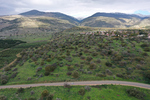
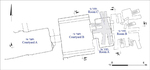
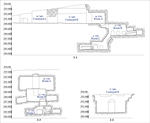
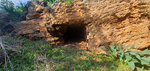
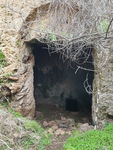
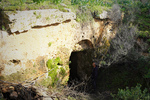
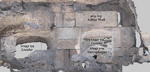
The documented burial cave complex (Figs. 3, 4; 3D model) is one of a series of Roman-period rock-hewn burial caves uncovered at the western part of the cemetery. The complex was identified in the survey carried out by Hartal (Hartal et al. 2009:22, Site 45), but was not studied or published. The burial cave complex is outstanding in its splendor, the extent of work invested in its hewing, and the finds retrieved within it and in its vicinity. The complex was hewn on an approximate east–west axis, and it comprises two adjacent courtyards (Courtyards A, B) and three rooms (Rooms A–C) on different levels, probably connected by stepped passages. Burial on multiple levels enabled maximize use of the cave. The burial complex dates to the Roman period.
The Courtyards
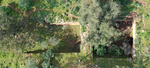
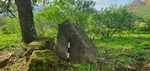
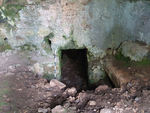
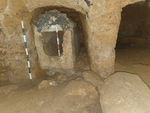
Courtyards A and B (Fig. 5) were carefully hewn and smoothed in the moderate limestone slope. They were connected by a passage hewn through the rock partition between them. Courtyard A is rectangular (6 × 12 m) with an entrance on the west; a broken dressed basalt stone found ex situ next to the entrance was possibly part of an entrance gable (Fig. 6). Similar architectural elements were found in opulent graves, such as the Tomb of Absalom and the Tomb of Zechariah in the Kidron Valley, Jerusalem (Hachlili 2005:131–132). A niche with a rectangular opening in its lower part, possibly leading to an undocumented loculus or burial chamber (Fig. 7), was hewn in the northern side of the courtyard. A rectangular passage cut in the middle of Courtyard A’s eastern wall leading into Courtyard B, at the front of the burial complex (Fig. 8). The upper part of the northern and southern walls of approximately square Courtyard B (7.5 × 8.5 m) were step-quarried, possibly to allow light into Room A. A rectangular entrance overlain by a hewn arch (Fig. 4: Section 2–2; Fig. 8) led from the courtyard into Room A, and part of a hewn cornice was extant above the entrance (Fig. 9). The sockets identified in the doorposts indicate that the cave originally had a door, whether of wood or another material.
The Rooms
Room A. A rectangular room without loculi (c. 12 sq m) probably served as an anteroom to the lower-level quarried burial chambers (Rooms B, C). An entrance hewn on the eastern side of the room led into Room B (Fig. 10). Stone slabs visible just south of the entrance may have served to pave Room A (Fig. 11); this room was probably also used for burial.
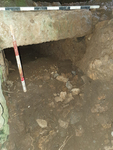
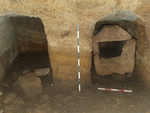
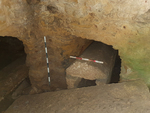
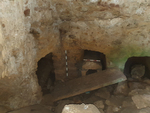
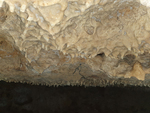
Room B. A square room was quarried at a lower level than Room A, and three loculi were hewn into its northern, southern and eastern walls. The two wider loculi include small internal rooms from which branch two loculi. Four stone sarcophagi were found in the room, three with lids (Figs. 12–14), and all showing evidence of past looting. Fragments of sarcophagi and lids lay around the middle of the room (Fig. 15). Lime stalactites formed by rainwater permeating over the years, were visible on the ceiling (Fig. 16). A passage (width c. 1.5 m) cut through the northwestern corner of Room B down into Room C. It was not possible to determine if there were hewn stairs in the passage due to the collapsed debris that filled it.
Room C. Two loculi were hewn into each of the northern, southern and western walls of the room. The opening into the northern loculus in the western wall was blocked by a well-built ashlar wall (Fig. 17), possibly built to stabilize the hewn rock, or to add grandeur. A sarcophagus with an in-situ lid was found in this loculus, evidently looted in the past. A few hewn niches observed near the opening of another loculus in this room indicated that ashlar stones, no longer extant, were also integrated in this wall.
The plan of the cave, the mode of burial and the surface finds discovered in this burial cave complex, as well as previous excavations conducted to date in the cemetery, attest that the burial cave complex was hewn in the Roman period, between the first–fourth centuries CE, when the city of Banias reached its zenith. An archaeological excavation of the cave complex may provide a more precise date, possibly around the first–second centuries CE (Zingboym 2001; 2018).
References
Amir D. 1974. A Burial Cave at Senir. HA 48–49:24 (Hebrew).
Barbé H. 2007. Senir. HA–ESI 119. https://doi.org/10.69704/jhaesi.116.2004.488
Bekker-Shamir M. and Najar A. 2025. Banias. HA-ESI 137. https://doi.org/10.69704/jhaesi.116.2004.27714
Hachlili R. 2005. Jewish Funerary Customs, Practices and Rites in the Second Temple Period. Leiden. https://doi.org/10.1163/9789047404156
Hartal M. 1986. Banias. HA 86:1 (Hebrew).
Hartal M. 2008. Banias. HA–ESI 120. https://doi.org/10.69704/jhaesi.116.2004.713
Hartal M. 2009. The Baniyas Survey. In Paneas IV: The Aqueduct and the Northern Suburbs (IAA Reports 40). Jerusalem. Pp. 3–26. https://doi.org/10.2307/j.ctt1fzhf2t.5
Hartal M. 2017. Dan – 8 (The Archaeological Survey of Israel).
Stepansky Y. 2004. Senir. HA–ESI 116. https://doi.org/10.69704/jhaesi.116.2004.2
Tchekhanovets Y. and Najar A. 2024. Banias. HA–ESI 134. https://doi.org/10.69704/jhaesi.116.2004.26516
Zingboym O. 2001. Burial in the Jewish Settlement in the Golan in the Hellenistic, Roman and Byzantine Periods. M.A. Thesis. Bar Ilan University, Ramat Gan (Hebrew).
Zingboym O. 2018. The Hippos Necropoleis. In M. Eisenberg ed. Hippos-Sussita of the Decapolis: The First Twelve Seasons of Excavations 2000–2011 II. Haifa. Pp. 24–43.
Keywords
Ancient Banias, Roman period, Stone sarcophagi, Burial systems, Paneas, Roman necropolis, Funerary architecture
Publication Date
02/06/2026
Report Type
Final Report