
Yafo, the Ottoman Quay (A-9375)
Permit/License Number
A-9375
Excavation Report
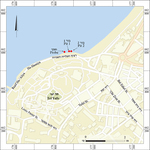
In 2018, a probe was dug in the foundations of the Ottoman Quay in Yafo (map ref. 176620/662484; Fig. 1), and during August–October 2022, an underwater excavation was conducted in the foundations, adjacent to the Customs House (Permit No. A-9375; map ref. 176635–43/662505–11), in order to preserve the quay as part of the promenade development plan. The excavation, undertaken on behalf of the Israel Antiquities Authority and funded by the Atarim Group Ltd., was directed by D. Planer and J. Sharvit of the IAA Marine Archaeology Unit, with the assistance of N. Zeitoune and A. Bar (divers), A van-Zuiden (conservation) and N. Liphschitz (tree identification). Additional assistance was rendered by A. Shadman from the IAA Central Region, D. Barkan from the Tel Aviv District and D. Abu Salah from the Tel-Aviv Sub-District. The excavators wish to express gratitude for the extensive help rendered by the Yafo Harbor employees and directors I. Ben Yakar, Z. Mordo, S. Goslan, A. Ringel and A. Salah, and also to thank Y. Klein and G. Smirnoff of the Atarim Group.
The quay was constructed in 1887 alongside the Customs House in a few stages, and served as anchorage for small watercraft. Sultan Abdul Hamid II promoted administrative reforms throughout the Ottoman Empire, including the development of infrastructure projects, involving the demolition of the old Customs House and the construction of a new building on land reclaimed from the sea (Giller 2016:193). The old Customs House appears in a photograph by Félix Bonfils in the 1860s (Giller 2016:193, Photo 4). The quay was built along the western side of the Customs House, with mooring points for watercraft, a wide staircase descending to the sea, and an open space for passenger access. As a result of the rebuilding of the Customs House and the construction of the quay, the volume of passenger traffic and cargo increased rapidly, leading in turn to the renovation of the entire Yafo harbor and the construction of additional buildings to meet the growing activity. German Kaiser Wilhelm II arrived in Palestine via Yafo Harbor in 1898, and met Binyamin Ze’ev Herzl, who had also arrived through the Yafo Harbor. The imperial visit augmented interest in the Holy Land and tourism subsequently expanded. Export of fruit from the Yafo orchards to the European markets increased, as did the volume of imports. Jewish immigration intensified, and the construction of neighborhoods outside the wall began, and the economy of Yafo developed. The Customs House could no longer accommodate the increased passengers’ traffic, and it was therefore demolished during the British Mandate in 1931, as part of an extensive renovation of the harbor, including the construction of a breakwater and landing stages. It was replaced by a new Customs House, known as the ‘White Administration House’ (Giller 2016:194–212). At this stage, the Ottoman quay was cemented over with a concrete cast.
As part of a 2007 renovation of the harbor, part of the British-Mandate cement cast was partly removed, re-exposing the Ottoman-period quay. Structural cracks in the quay were observed in 2017, and its paving stones started to come loose and sink to the sea floor. Consequently, engineering examinations were carried out, including drilling and inserting a camera to document the condition of the foundations. These investigations identified large cavities in the quay foundations caused by waves generated by storms and by the movement of craft. The waves caused the mortar to crumble and wash away, resulting in the detachment and collapse of the quay’s protecting stones (Makhrez 2017). Following these observations, the Atarim Group formulated a plan for the restoration and preservation of the quay.
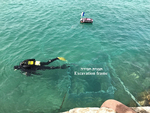
The probe was dug in 2018 in the quay foundations and to their west after winter storms caused the collapse of some of the quay’s stones. In 2020, the Customs House was demolished and it was decided to build a promenade, and renovate and restore the entire length of the quay. This project required a comprehensive underwater excavation of the sea floor adjacent to the quay. The excavation was conducted about 50 m northeast of the probe, and two test pits (1, 2) were opened, about 20 m apart. A preliminary survey conducted prior to the excavation, identified along the quay, a layer of crumbling mortar composed mainly of lime/chalk. The excavation area was cleared manually by the divers, and metal excavation frames (2 × 2 m; Fig. 2) were installed on the harbor floor. The frames were positioned using DGPS (a system that increases the horizontal and vertical precision of the GPS signals) and anchored in place. The excavation was conducted using a seawater pump placed on the quay which streamed seawater at high pressure through the underwater excavation equipment (dredger). The dredger pumped sand and loose sediments out of the excavation square. The excavation was documented using underwater sketch boards and photography. The finds and samples collected were marked and registered according to their relative position in the excavation pit, following methods similar to those employed in land excavations.
The probe. A surface layer comprising medium-sized and small kurkar stones, kurkar fragments, rounded flat pebbles and remains of mortar, which probably originated from the crumbling quay foundations, was identified in the probe at a depth of about 2.3 m bsl. Modern construction debris that was dumped at this location was also found. A row of square-section wooden beams (0.25 × 0.25 m), driven into the sea floor adjacent to the quay side, was exposed, and another row 1.5 m to its west. The beams were identified as Pinus pinea, pine tree. This species grows naturally in the sandy soils of the Mediterranean basin. Mortar composed of aggregates of pebbles and chunks of kurkar (c. 5 cm long), bonded with quicklime (CaO), or with quicklime mixed with some gypsum, were found along the western side of the quay. The proportion of quicklime in the bonding material is exceptionally high relative to this type of bonding material, and does not contribute to the strength of the material.
In an attempt to locate the bedrock, drilling was executed in regular intervals of 1 m. Bedrock was exposed about 2 m from the quay-side, at a depth of c. 2.8–3.0 m bsl. About 5 m from the quay side, bedrock was exposed at a depth of c. 4.8 m bsl, while at a distance of about 6 m, the bedrock depth exceeded 5.2 m bsl.
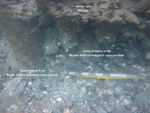
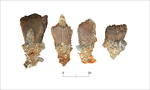
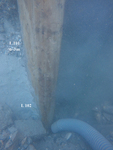
Test Pit 1 (map ref. 176635/662505). The excavation began at a depth of 2 m bsl. The surface was covered with recent debris, metal conglomerates and medium-sized building stones that had fallen from the quay. A layer containing small stones, shells, and worn vessel fragments dating from the Ottoman period to the present day was uncovered (L101; depth 2.4–3.0 m bsl). Within this layer, at a depth of 2.4 m bsl, the top of a round wooden beam (diam. c. 0.2 m; Fig. 3) was exposed. Four rectangular-section beams (8 × 20 cm; Fig. 4) flanked this beam; apparently, they were positioned to prevent mortar from leaking into the sea. The excavation was deepened along the round beam (Fig. 5). At a depth of 3 m bsl, a sealed layer of sterile sand (L102) was uncovered, on which three unidentified lead bullae were found. At this depth, the pointed iron tips of the rectangular beams, preserved only as oxides and conglomerates, were exposed (see Fig. 4). These pointed ends facilitated the penetration of the beams into the sea floor and prevented the beams from breaking when they were driven into place. The excavation continued into the sterile sand down to a depth of 4.2 m bsl. Due to the danger of collapse, excavation below this level was limited to a series of drillings, reaching a depth of 4.7 m bsl, where bedrock was encountered.
Test Pit 2 (map ref. 176643/662511). After the removal of modern debris in the northern part of the test pit, the top of a round wooden beam (diam. 0.2 m) was uncovered at a depth of 2.1 m bsl. Around and adjacent to the beam was a layer of hard modern conglomerate, which made excavation extremely difficult. This conglomerate layer extended westward and covered approximately one-third of the excavation area. Excavation therefore concentrated in the southern part of the test pit, where a layer of shells, small stones, and pottery fragments (depth 2.4–3.0 m bsl), identical to that uncovered in Test Pit 1 (L101), was exposed. Another round wooden beam (diam. 0.2 m) was found approximately 1.5 m from the beam in the northern part of the test pit. At a depth of 3 m bsl, a layer of sterile sand identical to that identified in Test Pit 1 (L102) was reached, and two unidentified lead bullae were found resting upon it. The excavation reached a maximum depth of 4 m bsl.
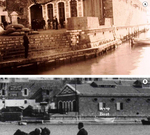
The excavation revealed several phases in the construction and renovation of the Ottoman-period quay. The quay’s foundation was constructed of rectangular-section wooden beams placed adjacent to one another. These beams were driven into the sandy sea floor to a depth of approximately 3 m bsl. Round wooden beams were inserted at intervals of approximately 1.5 m between the rectangular beams and driven down to bedrock (4.5–4.7 m bsl). Along the quay, at a depth of approximately 1 m bsl, a crumbling mortar layer composed primarily of lime and gypsum was identified. Where this material had been washed away, large cavities had formed. The mortar layer extended down to a depth of 3 m bsl, beneath which a layer of sterile sand was encountered. The rectangular and round beams served as a framework for the initial casting of the mortar upon which the quay stones were laid. During excavations in Yafo Harbor, Haddad (Haddad and Glick 2022:150) suggested that the foundations of the southern wall of the Ottoman-period Customs House were constructed using a similar technique. The construction method of the quay and its later expansion are visible in historical photographs. One photograph, documenting the inauguration of the Customs House in 1887, depicts the quay during construction with wooden beams aligned along its side (Fig. 6:A; from the website of the Council for Conservation of Heritage Sites in Israel; Giller 2019: Fig. 1). Another photograph, dating from 1895–1905, shows the westward extension of the quay, upon which rests a 2-m wide boat (Fig. 6:B; from the Archive of the National Library of Israel: IL-INL-YBZ-0197-135). This extension accords with the remains found in the excavation, including two rows of wooden beams, one adjacent to the quay, the other at a distance of 1.5 m from it.
References
Giller, S. 2016. Jaffa Port at the End of the Ottoman Period and in the Early Years of the British Mandate. Merhavim 7:189–220 (Hebrew).
Giller S. 2019. The Bumper of the Ottoman-Period Quai. News of the Council for Conservation of Heritage Sites in Israel.
Haddad E. and Glick A. 2022. The Yafo (Jaffa) Harbor: The Course of the Seawalls during the Crusader and Ottoman Periods and the Remains of a Wharf from the Days of the British Mandate. ‘Atiqot 109:139*–176* (Hebrew; English summary, pp. 245–248). https://doi.org/10.70967/2948-040X.1116
Machraz A. 2017. The Ottoman-Period Pier at Yafo Harbor—Survey and Initial Restoration Plan. Atarim Group (Hebrew).
Keywords
Jaffa, Ottoman quay, Jaffa Port; Underwater excavation, Customs House, Wooden piles
Publication Date
03/06/2026
Report Type
Final Report