
Tel Ḥaẓor, the Lower City (G-42/2023)
Permit/License Number
G-42/2023
Excavation Report
During June–July 2023, an excavation was conducted in the National Park of Tel Ḥaẓor (Permit No. G-42/2023; map ref. 252700/769950; Fig. 1). The excavation, on behalf of the University of Haifa and funded by the Azrieli Foundation, The Center for the Mediterranean World (TCMW) and private donors, was directed by S. Bechar with the assistance of G. Shalvi, P. Over, M. Agnon and C. Crawford (area supervision), M. Sabag and M. Piliponsky (administration), S. Pinski, S. Alon and I. Strand (surveying and drafting), T.J. Edwards (sieving), N. Callaway (office management and registration), S. Freirich and J.J. Gottlieb (conservation and pottery restoration) and T. Grueser (database). Assistance was also rendered by E. Freedman, the owner of the land. Approximately 80 volunteers from the United States, Canada, China, Germany, Ghana, Columbia, Sweden and Israel participated in the excavation; they stayed at Kibbutz Ayyelet Ha-Shahar.
Two excavation areas were opened (H1, H2) at the northern end of the lower city, adjacent to the Orthostats Temple, which had been discovered by Yigael Yadin and dated to the Middle Bronze Age II–Late Bronze Age II (Yadin et al. 1989:213–275, Area H). The aim of the excavation was to re-examine the stratigraphy of Yadin, and the buildings and various activities in the vicinity of the temple, using advanced excavation techniques. The remains that were uncovered correlate with Yadin’s Stratum 3, which dates to the Middle Bronze Age II–III; with Stratum 2, which dates to the Late Bronze Age I; and with Strata 1a–b from the Late Bronze Age II.
Area H1 is located on the northwestern edge of the lower city, south of the temple. In this area about six excavation squares were opened, within which the temple-gate (propylaeum) structure from Strata 3 and 2 was discovered, as well as a ritual favissa and drainage channels from Stratum 1. Area H2 is located west of Area H1, and its topsoil (depth c. 0.3 m) was exposed using a tractor. A number of large stones were found during the clearing, and six excavation squares were opened according to those large stones. Three activity phases were identified in this area that belonged to Strata 3 and 1 and the modern period.
Area H1
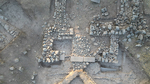
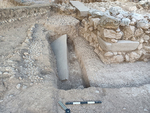
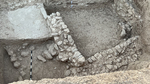
Gate Structure (Propylaeum; Fig. 1). The gate structure was uncovered in the northern part of the area. It had been excavated by Yadin, who recognized two construction phases of Stratum 2 (Late Bronze Age I; Yadin et al. 1989:228–229). The present excavation was located in the western half of the building, uncovering Yadin’s two construction phases of Stratum 2: a floor bedding and installations from the earlier phase, and floors and walls from the later phase. Once the floors were dismantled, Yadin’s Stratum 3 was found, of which Yadin uncovered only remnants in limited areas in the temple court. This stratum, as well, was divided into two phases. The earlier phase contained a floor of small pebbles and a standing orthostat that served as a wall in the western part of the gate; and in the later phase a pit was dug into one of the early-phase floors to cache an orthostat (length c. 1.7 m; Fig. 2), which was probably part of the gate structure in the later phase.
Favissa (Fig. 3). One large ritual favissa was discovered in the southeastern part of the area. The center of the favissa was excavated by Yadin (7.5 × 10.0 m, max. depth 1.4 m; Yadin et al. 1989:247), and in it were found bowls, chalices, stands and fragments of decorated vessels from the Late Bronze Age II (Stratum 1b). The present excavation included areas that had been excavated by Yadin which contained disturbed sediments and few finds, and areas that he did not excavate, in which whole vessels and numerous bones were found. The excavation did not reach the bottom of the pit, but it indicated clearly that the depth of the pit was considerably more than what Yadin had identified. Furthermore, it was determined that the pit cuts through floors of the early Strata 2 and 3. Large quantities of deep and carinated bowls, chalices, oil lamps and miniature vessels dated to the Late Bronze Age II were found in the pit, which seems to have been associated with the Orthostats Temple.
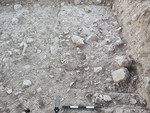
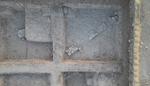
Drainage channels (Fig. 4). Three squares were excavated on the western edge of the area, on the upper part of a steep escarpment sloping toward northeast. The first layer exposed a sterile dark earth, packed and hard, that had accumulated to a considerable height and underneath it was a layer of light earth, consistently soft and easy to excavate. Two phases of activity that date to the Late Bronze Age II were identified in the light earth: Stratum 1a and Stratum 1b. Drainage channels containing a large number of miniature vessels were uncovered in Stratum 1b, while clusters of pottery and one complete carinated bowl were found at a single level in Stratum 1a. Other finds in Stratum 1a included three identical, crescent shaped pendants, one in each square.
Area H2
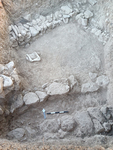
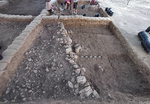
Three activity phases were uncovered: Stratum 3, Strata 1a–b, and a modern stratum. Stratum 3 was dated to the Middle Bronze Age I–II and contained habitation levels and tamped-earth floors. On the floors were found pottery vessels, flint sickle-blades, a bronze axe-head, bronze toggle pin and a cylinder seal. A well-preserved installation with a number of walls and a thick plaster floor (Fig. 5) was found in the southeastern square, the finds from this square were meagre. Strata 1a–b which was dated to the Late Bronze Age II, was found in a light earth in which a pit was dug in the southern part of the area. A wall and pottery fragments, which were not worn, were also dated to Strata 1a–b. Habitation levels abutted the wall, and next to it a large tabun was built (Fig. 6). It seems that during this phase there was an open courtyard in this location, however, it is not clear how it is related to the temple. The modern stratum is dated to modern times, and a number of walls, whose construction style is not uniform were dated to this stratum. The stratum also contained stone-clearance heaps or piles that were formed by erosion (Fig. 7). Worn pottery sherds, coins and metal objects were found next to the walls. The earth of this phase was dark, and was removed using mechanical equipment.
References
Yadin Y., Aharoni Y., Amiran R., Ben-Tor A., Dothan M., Dothan T., Dunayevsky I., Geva S. and Stern E. 1989. Hazor III–IV: An Account of the Third and Fourth Seasons of Excavations, 1957–1958; Text. Jerusalem.
Keywords
Tel Hazor, Orthostat Temple, Cultic Favissa, Drainage Channels, Middle Bronze Age, Late Bronze Age, Ritual Context
Publication Date
03/06/2026
Report Type
Preliminary Report