
Tel Yavne, Area T2 (A-8999)
Permit/License Number
A-8999
Excavation Report
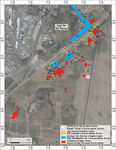
During April–December 2022 and May–June 2024, a salvage excavation was conducted in Area T2, southeast of Tel Yavne (Permit No. A-8999; map ref. 176401/640983; Fig. 1), prior to the construction of a new neighborhood. The excavation, on behalf of the Israel Antiquities Authority and funded by the Israel Land Authority, was directed by P. Betzer and D. Varga, with the assistance of R. Shnabel, K. Sarazo and B. Yuzefovsky (area supervision), Z. Lotan and T. Uriel (administration), A. Peretz, D. Gazit (photography), Y. Shmidov and M. Kahan (drafting and plans), N. Leitner (studio photography and drafting), C. Elimelech (analytical laboratory), students from the Tel Aviv University ‘Excavating Archaeologists Program’, volunteers from the IAA Outreach Program, and workmen from Jenin and Hebron.
Surveys and excavations were conducted in the past on the tell and in its vicinity (for a comprehensive overview, see Fisher and Taxel 2007; Kletter and Nagar 2015). During 2019–2021, an extensive excavation was conducted by E. Haddad, L. Nadav-Ziv and J. Seligman east and southeast of the tell. During the years 2021–2025, a second excavation under the direction of P. Betzer and D. Varga explored extensive areas to the north, west and south of Area T2 (Haddad et al. 2021; Nadav-Ziv et al. 2021; Betzer, Varga and Kogan-Zehavi 2022; Ustinova, Betzer and Varga 2022; Betzer, Varga and Yuzefovsky 2023; Nadav-Ziv, Hadad and Zeligman 2023; Varga, Betzer and Shatil 2023; Yuzefovsky, Varga and Betzer 2023; Abadi-Reiss et al. 2024; Cecconi et al. 2024; Ein Mor, Varga and Betzer 2024; Golding-Meir, Betzer and Varga 2024; Kelman, Betzer and Varga 2024).
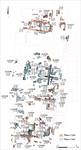
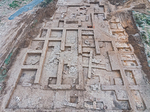
Fifty-nine excavation squares were opened in Area T2 (Figs. 2, 3) and the remains of a large building with two adjacent Hellenistic-period pottery kilns were uncovered. Two building phases (Phases 1 and 2) were identified in the building remains, and a second-century BCE pottery assemblage was exposed, comprising mostly bowls, jars and jugs. A few coins retrieved date the two phases from the end of the third to the end of the second centuries BCE. In addition, a few Roman and Byzantine-period pottery sherds were found on the surface.
Phase 1
A building, constructed at the middle of the excavation area, comprised two wings, an eastern and a southern wing, with a large courtyard between them, and an activity area was uncovered south of the building. The walls were constructed of two rows of fieldstones with an inner fill of small stones and earth.
Eastern Wing (c. 7 × 11 m). Four walls (W53005–W53007, W53031; width 0.6–0.7 m) divide the wing into five rooms (R1–R5). Short segments of a long wall (W53157) delineating the wing on the east were found. Remains of stone paving (L53018) abutting W53006 on the east were found in Room R1, and remains of stone paving (L53035) abutting W53007 on the south, were found in Room R2. No floors were extant in Rooms R3–R5 in the western part of the building.
Southern Wing (c. 4.4 × 17.0 m). Remains of two parallel walls (width 0.8 m), oriented approximately east–west, were uncovered in the southern part of the area: a northern wall (W53102; preserved height 0.4 m) and a southern wall (W53155; preserved height 0.2 m). The walls seem to have delineated a row of rooms south of the courtyard, which was mostly not extant. Another wall (W53267; 0.46 × 0.66 m, height 0.1 m) abutted W53155 on the north, delineating two rooms (R9, R10). Two floors (L53125, L53138) uncovered next to the walls probably belonged to this phase. Floor 53125, constructed of small fieldstones bonded with gray mortar, may have served as a bedding for a stone floor in Room R9, that did not survive. Floor 53138 was made of various-sized kurkar slabs.
Remains of an east–west wall (W53028; width 0.76 m, preserved height 0.14 m) and a floor (L53071) were discovered in the eastern part of the wing. A tabun (L53042; diam. 0.35 m) was installed in the floor-bedding next to the northern face of the wall.
Courtyard (c. 14 × 16 m). Segments of a level stone pavement (L53101, L53107, L53108, L53187) that was probably part of a paved courtyard, were uncovered west of the east wing, and north of the south wing and W53102. The floor was constructed of small and medium-sized fieldstones laid on a bed of yellow sand. Remains of four column bases (P1–P4), built of small and medium-sized stones arranged in squares, were found at the center of the courtyard, indicating that at least part of the courtyard was roofed.
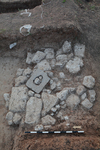
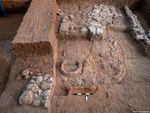
Southern Activity Area. A paved open activity space and a pottery kiln, or possibly two kilns, were uncovered south of the building. A few segments paved with kurkar slabs of various sizes (L53199, L53246, L53255) were extant in the open space, and items in secondary use, such as an ashlar stone with marginal drafting and a rough boss, and a flat basalt grinding stone, were incorporated among the slabs (Fig. 4). A circular kiln (L53229; diam. 2 m, wall thickness 7 cm; Fig. 5) was uncovered southeast of the open space, but its interior was not excavated. About five meters west of the kiln, a mass of burnt clay (L53206, L53222) was found, possibly the remains of another kiln.
Phase 2
In the later phase, the eastern wing was extended and a northern wing was added to the building, which included a row of three rooms (R6–R8) and a pottery kiln. New construction was added in the southern wing and the southern activity area. A stone-paved segment (L53025) that may have been the paving of Room R1 or of another, no longer extant, room in the same area of the building, was found in the northeastern corner of the courtyard, at a level matching this building phase.
Eastern Wing. A few walls and floors were added to this wing in Phase 2. A wall (W53016; width 0.46 m, preserved height c. 0.2 m) was built in the southern part of R2, dividing it into two spaces; a stone floor (L53029) abutted the wall on the west.
Northern Wing. The northern wing contained at least three rooms (R6–R8; 4.5 × 16.0 m). The walls of this wing (W53166, W53170, W53173, W53178, W53180; width 1 m, average preserved height c. 0.2 m) were partly preserved, apart from the western wall that was not extant. Rooms R6 and R7 were identical in size (3 × 4 m), and they had a packed earth layer (L53164), on which four intact simple bowls with inturned rims, dated to the first half of the second century BCE, were found. Room R8 was not entirely excavated.
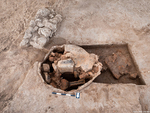
A kiln (L53149) with a circular firing chamber (diam. c. 1.2 m; Fig. 6), a partly preserved firing-chamber floor supported by an arch built of fired bricks, and a stoking channel that extended to the southwest, was uncovered north of the northern wing. The kiln wall was constructed of a thin clay layer, similar to that of the kiln in the Phase 1 southern activity area. Sherds of bowls similar to those lying on Floor 53164 in Rooms R6 and R7 were found inside the kiln.
A wall segment (W53151), oriented northeast–southwest like Rooms R6–R8, was found next to and east of the kiln. Another wall segment (W53152), found northeast of this wall and oriented north–south, unlike the other building’s walls, may have belonged to another building that did not survive. Remains of stone paving (L53171) were uncovered south of this wall. Remains of a wall (W53085) that may have delineated the building on the east, were found south of the paving remains.
Southern Wing. Several changes were made in the southern part of the building in this phase. The southern wing of Phase 1 was put out of use, and walls, floors and ṭabuns were built over its eastern side. In addition, a new courtyard was built over the Phase 1 southern open activity area, and to its south, a new wing comprising at least three rooms (R11–R13) was built. The walls of the new southern wing (W53236/53020, W53024, W53110) were poorly preserved, making it difficult to understand the plan of the building, but three ṭabuns uncovered (L53011, L53037, L53043; average diam. 0.7 m) indicate that this wing was not roofed in this phase. Since no partition walls were found south of W53110, it seems that a new courtyard, delineated on the south by W53263, was built there. Stone paving segments (L53245, L53254) were exposed in the middle of the courtyard, and remains of a circular tabun (L53241; diam. c. 1 m), built of bricks on a bed of small fieldstones, were found in its southern part.
A new wing, comprising at least three rooms (R11–R13) delineated by five walls (W53197, W53204, W53216, W53233, W53263; width 0.5–1.0 m, preserved height 0.2–0.4 m) was built to the south of this courtyard; the western wall of the line of rooms did not survive.
Two segments of stone paving (L53203), whose southern part covered over Phase 1 Kiln 53229, were uncovered in Room R11 (2.2 × 5.0 m). Remnants of stone paving (L53200) were uncovered in Room R12 (4.0 × 5.4 m). Remnants of paving bedding (L53205; 0.8 ×1.1 m) of a floor abutted W53204 were found in Room R13 (5.4 × 5.4 m), covering the mass of burnt clay (L53206) from the early phase, which may have originated from a kiln.
Poorly preserved architectural remains, including a wall (W53225; preserved height 0.1 m) and segments of stone paving (L53209, L53212, L53223), suggesting either that the building continued further south or that there was an activity area at this spot, were uncovered south of the southern wing.
The remains of the building exposed in Area T2 suggest that a farmhouse with two or three pottery kilns occupied this area outside the town of Yavne at the end of the Hellenistic period. The kilns are similar to ones previously discovered in the vicinity (Haddad et al. 2021; Nadav-Ziv, Hadad and Zeligman 2023), and attest to a pottery-manufacturing tradition that began in the Middle Bronze Age and continued until the Early Islamic period (Ein-Mor, Varga and Betzer 2024; Golding-Meir, Betzer and Varga 2024), and to its central role in the economy of the town and its surroundings. Additional remains dating to the Hellenistic period, including residential buildings, installations and a cemetery were uncovered recently south of Tel Yavne, in Area Q (Kelman, Betzer and Varga 2025) and Area R (Abadi-Reiss et al. 2024).
References
Abadi-Reiss Y., Davidesko A., Betzer P. and Varga D. 2024. Tel Yavne, Area R2 – 2022. HA–ESI 136. https://doi.org/10.69704/jhaesi.116.2004.26454
Betzer P., Varga D. and Kogan-Zehavi E. 2022. Tel Yavne, Area H. HA–ESI 134. https://doi.org/10.69704/jhaesi.116.2004.26255
Betzer P., Varga D. and Yzefovsky B. 2023. Tel Yavne, Area K. HA–ESI 135. HA-ESI 135. https://doi.org/10.69704/jhaesi.116.2004.26349
Cecconi G., Milevski I., Davidesko A., Varga D. and Betzer P. 2024. Tel Yavne, Area R3 – 2022–2023. HA-ESI 136. https://doi.org/10.69704/jhaesi.116.2004.26437
Ein Mor D., Varga D. and Betzer P. 2024. Tel Yavne, Area M2. HA-ESI 136. https://doi.org/10.69704/jhaesi.116.2004.26437
Fischer M. and Taxel I. 2007. Ancient Yavneh: its History and Archaeology. Tel Aviv 34:204–284. https://doi.org/10.1179/tav.2007.2007.2.204
Golding-Meir R., Betzer P. and Varga D. 2024. Tel Yavne, Area U – 2023. HA-ESI 136. https://doi.org/10.69704/jhaesi.116.2004.26548
Haddad E., Nadav-Ziv L., Elisha Y., Tal G., Rauchberger L. and Sandhaus D. 2021. Tel Yavne, Area A. HA–ESI 133. https://doi.org/10.69704/jhaesi.116.2004.25883
Kelman I., Betzer P. and Varga D. 2024. Tel Yavne, Area T1. HA-ESI 136. https://doi.org/10.69704/jhaesi.116.2004.26436
Kelman I., Betzer P. and Varga D. 2025. Tel Yavne, Area Q. HA-ESI 137. https://doi.org/10.69704/jhaesi.116.2004.27727
Kletter K. and Nagar Y. 2015. An Iron Age Cemetery and Other Remains at Yavne. ‘Atiqot 81:1–33. https://doi.org/10.70967/2948-040X.1571
Nadav-Ziv L., Haddad E., Elisha Y., Tal G., Ben Shlush R., Gorin-Rosen Y., Tsuf O., Sandhaus D. and Golan D. 2021. Tel Yavne, Areas B and D. HA–ESI 133. https://doi.org/10.69704/jhaesi.116.2004.26102
Nadav-Ziv L., Haddad E. and Seligman J. 2023. Tel Yavne, Area C. HA-ESI 135. https://doi.org/10.69704/jhaesi.116.2004.26361
Ustinova Y., Betzer P. and Varga D. 2022. A New Inscribed Sling Bullet from Iamnia (Yavne). IEJ 72:189–203.
Varga D., Betzer P. and Shatil A. 2023. Tel Yavne, Area L. HA-ESI 135. https://doi.org/10.69704/jhaesi.116.2004.26407
Yuzefovsky B., Varga D. and Betzer P. 2023. Tel Yavne, Area D. HA-ESI 135. https://doi.org/10.69704/jhaesi.116.2004.26358
Keywords
Tel Yavne, Hellenistic city, Farmhouse, Pottery kilns, Ceramic industry, Hellenistic period, Late Roman period, Workshops
Publication Date
04/06/2026
Report Type
Preliminary Report