
Tel Yavne, Areas R2, R3 – 2023–2025 (A-8999)
Permit/License Number
A-8999
Excavation Report
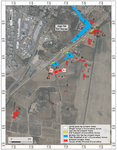
From January 2023 to February 2025, a salvage excavation was conducted in Areas R2 and R3, located south of Tel Yavne (Permit No. A-8999; map ref. 176060/641000; Fig. 1), in preparation for the construction of a residential neighborhood. The excavation, on behalf of the Israel Antiquities Authority and funded by the Israel Land Authority, was directed by P. Betzer and D. Varga, with the assistance of I. Milevski, G. Cecconi and A. Davidesko (area supervision), Y. Amrani (administration and logistics), A. Peretz and N. Leitner (field photography, surveying, drafting and plans), L. Perry-Gal (archaeozoology), Y. Nagar (anthropology), Y. Shmidov, M. Kahan and I. Ionish (surveying, drafting and plans) and N. Weiler and J. Marcus (geomorphology).
Numerous surveys and excavations have been conducted at Tel Yavne and its surrounding areas (see Taxel 2005; Fischer and Taxel 2007; Yannai 2014; Kletter and Nagar 2015). From 2019 to 2021, a large-scale salvage excavation took place southeast of the tell (Haddad et al. 2021; 2024a; 2024b; 2024c; 2024d; Nadav-Ziv et al. 2021; Nadav-Ziv, Haddad and Seligman 2023). Afterward, a new archaeological project from 2021 to 2025 focused on areas east, southeast and south of the tell (Abadi-Reiss, Betzer and Varga 2022; Abadi-Reiss et al. 2022; 2024; Betzer, Varga and Kogan-Zehavi 2022; Varga, Betzer and Weingarten 2022; Betzer, Varga and Yuzefovsky 2023; Davidesko, Betzer and Varga 2023; Golding-Meir et al. 2023; Varga, Betzer and Shatil 2023; Yuzefovsky, Varga and Betzer 2023; Cecconi et al. 2024; Ein Mor, Varga and Betzer 2024; Golding-Meir, Betzer and Varga 2024; Kelman, Betzer and Varga 2024; 2025).
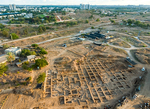
Areas R2 and R3 (Fig. 2) were opened to investigate a Chalcolithic-period settlement previously uncovered in adjacent Areas A and J, located, respectively, north and southeast of the present excavation areas (Haddad et al. 2021; Fadida et al. 2021; Abadi-Reiss 2022; Abadi-Reiss et al. 2022). The two excavation areas extend along the slope of a kurkar hill covered by hamra soil, inclining northeast–southwest. Excavations and geological investigations have shown that the Soreq Stream once flowed much closer to the eastern side of Tel Yavne, with several tributaries draining eastward (N. Weiler, pers. comm.). The clayish soil in this area inhibits drainage, leading to frequent flooding from prehistoric through to modern times. In both Areas R2 and R3, layers of flooding have been discovered in the excavation of the southern squares, which damaged the archaeological remains.
A total of 99 excavation squares has been opened in Area R2, and 91 squares in Area R3. Remains from six different periods have been identified in the stratigraphy of these two areas: Late Chalcolithic (Ghassulian culture), Bronze Age, Iron Age, Persian, Hellenistic and Ottoman–modern.
This report provides a brief description of the excavations in Areas R2 and R3 during the 2023–2025 seasons, while more detailed reports on the Chalcolithic-period findings have been published in a separate paper (Cecconi et al. 2025). We presently focus primarily on the findings from the southern part of Area R3 and most of Area R2 (for the Chalcolithic-period findings from adjacent areas, see Abadi-Reiss et al. 2024—part of Area R2 on the northwestern edge of this area; Cecconi et al. 2024—the northern part of Area R3; Cecconi et al. 2025—Areas R4, R5). These excavations uncovered appreciable finds from the Chalcolithic period and the Bronze Age, as did the previous seasons in Area R3; nevertheless, they also exposed substantial findings from later periods.
The excavation began after removal of the topsoil (thickness 1.5–2.0 m) with a backhoe loader. Given the presence of tombs from several periods in Areas R2–R3, the designation of each tomb (e.g., T1) was assigned an additional letter signifying its period (C, Chalcolithic; M, Middle Bronze; P, Persian; H, Hellenistic; B, Byzantine).
The Late Chalcolithic Period
An impressive village from the Late Chalcolithic period was discovered near Tel Yavne. Finds from this period were retrieved from a total area of around 25 dunams (Areas A, J, R2–R5). The main part of this village, located in Areas R2 and R3, includes domestic buildings and installations covering approximately five dunams (see below). In Area R4, another important part of the ancient village had been uncovered, featuring two structures that are likely public buildings (Yuzefovsky B., pers. comm.).
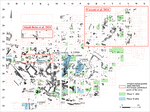
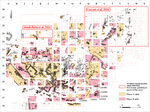
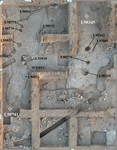
The excavations in Areas R2–R3 have revealed four distinct Chalcolithic-period phases (A–D; Figs. 3, 4), distinguished by the architectural remains.
Phase D. The oldest phase of the Chalcolithic-period village included several floors made of crushed, compacted kurkar (L90061, L90345, L90444, L90741 and L93025). The two best-preserved floors, L90345 and L90741 (4.75 × 8.00 m and 3.5 × 14.0 m, respectively; Fig. 5), were associated with several pits (diam. 0.5–1.0 m; Floor 90345—L93066, L90342, L90270, L90269; Floor 90741—L90775, L90776, L90835, L90841, L90873, L90931, L90932 and L93010) that were dug either during the time the floors were laid down or afterward. The pits were filled with clayey-brown soil, Chalcolithic-period sherds and flint tools. A north–south oriented wall (W93013; Fig. 5), preserved along Floor 90741, directly abuts the floor.
Phase C. This phase comprises the remains of a dispersed village, estimated to be 1.1 dunams in size, lying along a northwest–southeast axis. The architecture of this phase is characterized by narrow stone walls (e.g., W90498 and W90644) and the presence of stone installations (e.g., L93046), silos (e.g., L90542), living surfaces (e.g., L93045 and L90706) and a pottery cache (L90926). Six primary, east–west-oriented burials (TC1–6), belonging to either Phase C or D, were unearthed. The skeletons were in a supine position with bent legs and their heads facing either north or south. They are all single burials of infant/child or adult individuals, except for TC6, a multiple burial, containing two adults, one young adult and two children.
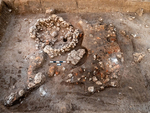
Phase B. The village of this phase was rebuilt over the previous one with a new orientation, northeast–southwest, in alignment with the natural slope. It was significantly bigger than the Phase C village (c. 5 dunams). Six domestic structures separated by open areas were identified (Ba–Bf; Fig. 4; for a detailed description of the structures, see Cecconi et al. 2025), one of which, Ba, was previously noted by Cecconi et al. (2024: L91090). In the southeastern corner of Areas R2–R3 were several accumulations of mudbrick, small stones, charcoal, pottery sherds and clay debris (L91400, L91506, L91533, L93040), arranged around an oval stone structure (L91510; diam. 1.5 m; Fig. 6), with one opening on the northeast and another on the southwest; a small stone table (L91530) was also associated with this structure. Inside Structure 91510 were a few pieces of charcoal, pottery sherds and clay debris. Three caches are attributed to Phase B: L90045, consisting of five ivory objects, dentalium beads and pottery and basalt vessels (Shochat et al. 2025); L90259; and L90417, comprising typical Late Chalcolithic-period pottery vessels, as well as a high-footed jar and two miniaturized vessels (Cecconi et al. 2025).
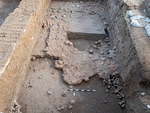
Phase A. During this phase, Structures Bb, Bc, Be and Bf were rebuilt with the same layout and new structures were erected (Bg and Bh). In one of the exposed structures, Bg, parts of the mudbrick walls were found preserved above the stone foundations (Fig. 7). Archaeomagnetic analysis of the mud bricks revealed that the building was destroyed in a fire at the end of Phase A.
The Bronze Age
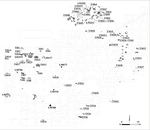
A large Bronze Age necropolis has been discovered (Fig. 8), with the majority of the associated finds dating to the Middle Bronze Age; a few of the tombs contained material dated to the Intermediate–Middle Bronze Age and others to the Middle–Late Bronze Age. In total, 82 tombs have been identified, located mostly in the northern and eastern sectors of the excavation area, with additional tombs found sporadically to the south and west. Twenty-four of these burials, uncovered in the 2022–2023 seasons in Area R3, were previously described by Cecconi et al. (2024), using different numbering, T1–24. The tombs were dug directly into the hamra sand or the underlying Chalcolithic-period layers, in an east–west or southeast–northwest orientation. Other features of the Bronze Age consist of two favissae (dumps connected with sacred activities) of MB IIC–LBA pottery, discovered in the southern excavation sector (L90318, L90388); several deposits or isolated finds of Middle Bronze Age pottery (e.g., Pit 91611, L91615); and a mudbrick structure (L91592) dated to the Middle Bronze Age.
The necropolis of Areas R2 and R3 yielded a total of 53 pit burials (e.g., TM3, TM11, TM15, TM18, TM20, TM22–TM24, TM30, TM33, TM47, TM54, TM61, TM62 and TM64), 24 jar burials (e.g., TM25, TM37, TM40, TM45, TM56 and TM74) and one cist burial (TM50). In addition, three donkey burials were uncovered, two of which (TM12 and TM19) were described in a previous report (Cecconi et al. 2024) and a third with only a portion of the toothed mandible surviving (TM29), the latter remaining unpublished (for further interpretation and parallels of the donkey burials, see Cecconi et al. 2024; see also Way 2010, and see therein further references). Another animal burial (TM21, not shown in Fig. 8) has been discovered near TM20. Pit burials are widespread throughout the necropolis, whereas jar burials are more concentrated in the northern excavation sector, where they are intermixed with the pit burials.
The pit burials are typically oval (0.5–0.8 × 1.5–2.0 m, 0.3–0.5 m deep). Sometimes, a lining of a few stones was placed along a part of the pit wall or on top of it as makeshift tombstones, forming part of the burial kit. In one instance (TM64), some mudbricks were placed over the legs of the deceased. Each tomb contained a primary deposition of either an adult or an infant/child, usually positioned in a supine posture with bent legs. Burials TM3 and TM24 are two child burials in pits that can be associated with one another due to their proximity. The burial kit typically includes jugs, juglets, bowls and lamps, placed near the head or at the foot of the interred individual. In a few cases, bronze jewelry was found, as in TM11 and TM24, or stone beads, as in TM62. Additionally, in TM20 and TM54, animal bones were found among the burial kit, likely serving as food offerings for the deceased. In one infant burial (TM61), the burial kit included, in addition to a lamp, an MB IIC–LB I spouted bowl, similar to a bowl found in Cistern 9024 at Hazor (Bonfil 2019: Pl. 1.3.5:11).
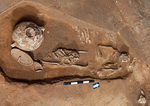
Jar burials generally consist of a storage jar placed in a pit (diam. 0.5 × 0.8 m), sometimes sealed with a ceramic plate or a mug. These storage jars were usually accompanied by jugs, juglets, bowls and lamps. In three cases, a jug (e.g., TM45) or a large dipper juglet (TM40) was used instead of a storage jar. One of the jar burials (TM56), containing an infant, was discovered over the legs of a primary single deposition of a 20-year-old man in a pit burial (TM 54; Fig. 9).
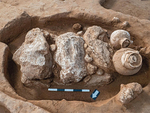
The single cist tomb (TM50; 0.8 × 1.4 m, 0.8 m deep; Fig. 10), is the first of its kind to be unearthed near Tel Yavne from MB II. It is a northeast–southwest oriented stone-built tomb constructed of worked kurkar slabs. The interior of the tomb is lined with a single row of large stone slabs (average size 0.10–0.15 × 0.35–0.50 × 0.35–0.65 m). The tomb was covered with three rectangular blocks (average size 0.25 × 0.25–0.30 × 0.70 m), with the interspaces filled with small stones. Within the tomb, the skeleton of a child was found lying on its back, with the head toward the northeast. Near the head, three juglets were found, along with a necklace of bone beads and a silver bracelet on the left wrist.
The skeletons were poorly preserved or completely disintegrated, as seen in burials TM15, TM18, TM22, TM23, TM30 and TM33, probably due to the chemical composition of the soil, particularly the hamra soil. Of the identifiable skeletons, 21 were adults and 39 were infants/children, aged between 6 months and 7 years.
The mudbrick Construction 91592, located in the northernmost part of the excavation area, is believed to have been constructed during the final phase of Middle Bronze Age activity in the area. The presence of burnt mudbricks and a thin layer of ash outside and within the structure suggests its function as a tabun, maybe related to funerary activities.
Preliminary analysis of the pottery allows us to divide the occupation of the Bronze Age necropolis into two distinct periods. The first period spans from the Intermediate Bronze Age to MB IIA–B (e.g., TM25 and TM37), while the second period spans MB IIC–LB I (e.g., TM30, TM47 and TM74). A more thorough examination of the tombs will provide a clearer stratigraphic sequence, and DNA analysis will furnish ample information of interest.
The Iron Age (Fig. 8)
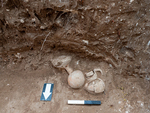
Sporadic finds from Iron Age II were discovered in Areas R2 and R3. In addition to several sherds of this period found in the topsoil, the most significant evidence from this period is a pit (L90521; diam. 0.7 m; Fig. 11) located in the southwestern corner of the excavation area. Inside the pit, two carinated bowls with flat bases were found, which resemble Philistine carinated bowls (see Gitin 2015: Fig. 2.5.1). Additionally, there was a ridged-neck juglet featuring black and red decorations, possibly a Phoenician-Cypriot imitation, and a small jug that has parallels in Stratum A3 at Tell es-Safi/Gath (see Gitin 2015: Fig. 2.5.9:1). Since no skeleton was found in the pit, it has been interpreted as a deposit. The pit is dated to Iron Age IIA.
The Persian Period (Fig. 8)
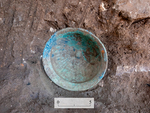
In the southeastern excavation sector of Areas R2 and R3, four tombs from the Persian period were discovered (0.30 × 0.40 × 0.45–0.85 m, 0.15 × 0.20 m deep). One of the tombs can be identified as a rectangular cist grave (TP30), while two others are simple unlined cist graves covered with slabs (TP24 and TP25), and the last one is a simple unlined cist grave (TP29; for the typology of the cist graves, see Varga and Betzer 2025). The constructed tombs feature finely worked kurkar slabs, all oriented east–west, containing a single inhumation of either young individuals or adults in the supine position, with their heads facing east and their arms bent across their chests. A few pottery vessels were found outside the tombs, including two jars with carinated shoulders and pointed bases, one located at the southeast corner of TP30 and the other at the northeast corner of TP25. Inside TP30, a metal plaquette, likely made of silver, was discovered over the superior front teeth of the interred individual. In TP29, a bronze fluted bowl was found (Fig. 12), resembling a Persian-period bowl discovered in Holot Yavne (Gorzalczany and Barkan 2006: Fig. 4).
The Hellenistic Period (Fig. 8)
This period is represented by scattered coins found in the topsoil, and mainly by a necropolis consisting of twenty-one tombs located in the northwestern excavation sector (TH1–3, TH5–9, TH11–23). Some of the tombs (TH1–3 and TH5–9) were previously documented in a report on the 2022 season in Area R2, where they were referred to as T1–12 (Abadi-Reiss et al. 2024). Most of the tombs were dug into the Chalcolithic-period layers, causing disturbances to the older structures, except the northwesternmost two (TH16, TH17), which were dug into the kurkar bedrock.
The tombs are oriented east–west and can be classified into four types (Varga and Betzer 2025): (1) Rectangular cist graves (e.g., TH1, TH3, TH8, TH12, TH13; 0.60–1.12 × 1.97–2.60 m, 0.46–0.60 m deep); (2) ‘Headers-and-stretchers’ cist graves (e.g., TH9, TH14, TH15; 1.12–1.25 × 2.38–2.74 m, 0.90–1.04 m deep), relatively deep, constructed with the blocks arranged as headers and stretchers without a specific order, with the headers protruding outward from the wall of the tomb; (3) simple, unlined cist graves dug into the soil and covered with slabs (e.g., TH5–TH7, TH11, TH18; 0.70–0.92 × 2.00–2.17 m, 0.2–0.4 m deep); (4) and simple, unlined cist graves, similar to Type 3, but covered with soil instead of slabs (e.g., TH2).
The skeletons were in a supine position, with the head oriented to the east. Burial items were found in only a few tombs and included unguentaria and one amphoriskos, dated to the second century BCE, as well as bronze rings and bracelets found in TH6. Additionally, a bronze mirror and a ceramic juglet were discovered above the western end of TH9 (for a nearly identical mirror uncovered in another Hellenistic-period tomb at Yavne [Area Q], see Varga and Betzer 2025: Fig. 9).
Two concentrations of stone slabs (L90137 and L90786) were identified around the tombs, likely remnants from the construction of some of them. The surface coins were discovered especially in the western and central excavation sectors (see Varga and Betzer 2025).
A domestic dog burial (TR31; Canis familiaris; the species had been confirmed according to Detry and Cardoso 2010 and Shafir 2011) has been discovered in the northeastern corner of the excavation. The body was placed on its left side in a southeast–northwest orientation, with the head positioned in the northwest and facing north. The tomb includes an oval pit dug in the soil in a southeast–northwest orientation (0.45–0.55 × 1.70 m). Analysis of pottery discovered inside the tomb gives a preliminary dating to the Early Hellenistic Period. The morphological analysis revealed it was a young adult (3–5 years old) exemplar of Pariah/Canaanite dog (Wapnish and Hesse 1993:63). This kind of tomb is very common in the Persian and Hellenistic Periods; beside the most famous necropolis of Ashkelon, other examples have been discovered at Tel Dor, Beirut, Tell Burak, Abu Dane, Ashdod, Gezer, Tell el-Hesi, Tel Megadim and Jerusalem (Sapir-Hen 2011).
A series of undated tombs was also discovered in Areas R2–R3 (TH4, TH17, TH32–TH34 and TH36) which are still under study, and they will be presented in future publications.
The Ottoman to Modern Periods
The topsoil is composed of soft brown soil (0.5–2.0 m deep), characterized by numerous inclusions and few stones; most of this layer has been removed using a mechanical excavator. Modern-day trenches (c. 0.5 m wide) of varying orientations were dug into this upper layer. The artifacts found within the topsoil include scattered pottery sherds, glass and metal pieces, dating between the Iron Age and the Ottoman period.
Conclusions
The excavation in Areas R2 and R3 uncovered a long stratigraphic sequence, spanning from the Chalcolithic to the Ottoman period, with the most significant representation attributed to the Chalcolithic period and the Middle Bronze Age.
The Late Chalcolithic-period village is a remarkable site, with architecture and planimetry similar to those of Shiqmim and Teleilat Ghassul. All four architectural phases of this period (Phases D–A) are attested in Area R2, while in Area R3, only Phases C–A were documented. The earliest architectural remains (Phase D) are primarily represented by large floors of crushed kurkar, comparable to the PPNB floors found in Yiftah’el (Khalaily et al. 2008), Beisamoun (Bocquentin et al. 2007) and other sites, although the rock material differs from that of the other sites. A crushed kurkar floor dated to the Chalcolithic period was also discovered in Ashkelon-Agammim (Abadi-Reiss and Varga 2019; Varga et al. 2021). The function of these kurkar floors remains uncertain, as few Chalcolithic-period finds were discovered in situ in association with them.
The remains of the Phase C Chalcolithic-period village were located in the southern and central parts of Areas R2 and R3, with the scattered features (isolated walls, installations) suggesting a semi-sedentary settlement. The Phase B village, instead, revealed a complete reconstruction of the settlement, with a different orientation and architecture than its predecessors, featuring several domestic structures that resembled those uncovered in the Chalcolithic-period sites of Shiqmim and Ashkelon-Agammim. The presence of caches in association with both Phases C and B indicates ritual activities in domestic settings.
The Phase A village mostly followed the Phase B layout. The evidence from Structure Bg indicated that this village was partially destroyed by fire and was likely abandoned by the local population after the event.
The Chalcolithic-period tombs uncovered in the excavation align with the tradition of primary on-site burials, typical of the Ghassulian culture (e.g., Gilead 1987:115; 1995:59–60). The fact that only a small number of burials from this period were unearthed may indicate that most burials represent the first stage in the process of secondary burial, followed by relocation of the remains for final burial in a nearby necropolis, perhaps at Horbat Benaya, Maghar or Bet Gamli’el, or even Palmahim, situated somewhat farther away.
The Chalcolithic-period material found in the present excavation is generally characteristic of the Ghassulian culture and includes, for example, V-shaped bowls, fenestrated bases, cornet goblets, churns and basalt vessels; although, unlike at other sites of this period, the churns are present in very small numbers, possibly indicating that the site’s assemblage represents a local variant.
After the abandonment of the Phase A village, the site was reoccupied during the Bronze Age, when an extensive necropolis was established, likely associated with a city located on the adjacent tell; the findings from the necropolis notably included three donkey burials. The rich pottery assemblage found with the tombs suggests that the necropolis was used during two distinct phases: the early phase spanning the Intermediate to the early part of the Middle Bronze Age (MB IIA–B) and the late phase from the late part of the Middle Bronze (MB IIC) to the Late Bronze Age. The tombs belong mainly to two types, pit and jar burials, and a single cist burial (TM50) was also recorded. While cist tombs are known from the Middle Bronze Age, they are infrequent in the archaeological record. Most exhibit larger dimensions than TM50, as seen in T100 from Megiddo (MB IIC/Late Bronze Age; Cradic 2018), Grave 9100 from Tel Lachish (Late Bronze Age; Singer-Avitz 2004: Fig. 17.15), and the earliest phase of the Area A tomb at Tel Burga (MB IIA; Golani 2011). Cist tombs of dimensions and shape similar to those of TM50 were uncovered at Tel Bene Beraq (South; Be’eri et al. 2020); although, the latter are dated to the Late Bronze Age, later than TM50. The presence of two favissae dated to MB IIC–Late Bronze Age further attests to ritual practices during this period.
A necropolis from the Intermediate Bronze Age was previously uncovered in Area D of the excavations near Tel Yavne (Yuzefovsky, Varga and Betzer 2023), consisting of shaft tombs containing medium-sized jars and amphoriskoi (Yuzefovsky, pers. comm.). The burial practices and pottery finds associated with this necropolis indicate that there is no connection between it and the one uncovered in the present excavation, suggesting that the two necropolises were used by different groups of individuals. Tombs uncovered in a pottery production site in Area U, dated to MB IIB, revealed pottery and funerary customs more closely related to those attested in Areas R2 and R3 (Golding-Meir, Betzer and Varga 2024).
The evidence for the use of the site in the Persian and Hellenistic periods is less abundant than that of the Chalcolithic period and the Bronze Age. This evidence suggests that the area remained frequented, even though this part of the site appears to have become less attractive for habitation and use as a burial ground in the later periods.
References
Abadi-Reiss Y. 2022. A New Site from the Chalcolithic Unearthed in Yavne. In E. Haddad, L. Nadav-Ziv, J. Seligman, D. Varga, P. Betzer, A. Shadman, O. Tal and Y. Tepper eds. Yavne and Its Secret: Collected Papers. Jerusalem. Pp. 73–88 (Hebrew).
Abadi-Reiss Y., Betzer P. and Varga D. 2022. Tel Yavne, Area J. HA-ESI 134. https://doi.org/10.69704/jhaesi.116.2004.26203
Abadi-Reiss Y., Davidesko A., Betzer P. and Varga D. 2024. Tel Yavne, Area R2 – 2022. HA-ESI 136. https://doi.org/10.69704/jhaesi.116.2004.26454
Abadi-Reiss Y., Marcus J., Elimelech C., Perry-Gal L., Ktalav I., Akermann O., Asscher Y., Betzer P. and Varga D. 2022. Life On the Soreq Riverbank: A Chalcolithic Ghassulian Site in Yavne. JIPS 52:32–51. https://doi.org/10.61247/s647545
Abadi-Reiss Y. and Varga D. 2019. Inter-Site Complexity in the Ghassulian Chalcolithic Site of Agamim, Ashkelon. In D. Varga, Y. Abadi-Reiss, G. Lehman and D. Vainstub eds. Worship and Burial in the Shfela and the Negev Regions throughout the Ages: Proceedings of the 15th Annual Southern Congress. Be’er Sheva‘. Pp. 67–78 (Hebrew).
Be’eri R., Golan D., Dayan A., Harpak T., Haklay G., Rudin T. and Karkovsky M. 2020. Tel Bene Beraq (South), Burials and Cemetery. HA-ESI 132.
https://doi.org/10.69704/jhaesi.116.2004.25844
Betzer P., Varga D. and Kogan-Zehavi E. 2022. Tel Yavne, Area H. HA-ESI 134.
https://doi.org/10.69704/jhaesi.116.2004.26255
Betzer P., Varga D. and Yuzefovsky B. 2023. Tel Yavne, Area K. HA-ESI 135.
https://doi.org/10.69704/jhaesi.116.2004.26349
Bocquentin F., Barzilai O., Khalaily H. and Horwitz L.K. 2007. The PPNB Site of Beisamoun (Hula Basin): Present and Past Research. In E. Healey, S. Campbell and O. Maeda eds. The State of the Stone: Terminologies, Continuities and Contexts in Near Eastern Lithics (Proceedings of the Sixth PPN Conference on Chipped and Ground Stone Artefacts in the Near East, Manchester 3rd–5th March 2008) (Studies in Early Near Eastern Production, Subsistence, and Environment 13) Berlin. Pp. 197–212.
Bonfil R. 2019. Middle Bronze Age IIB–C. In S. Gitin ed. The Ancient Pottery of Israel and Its Neighbors: From the Middle Bronze Age through the Late Bronze Age 3. Jerusalem. Pp. 77–136.
Cecconi G., Milevski I., Davidesko A., Varga D. and Betzer P. 2024. Tel Yavne, Area R3 – 2022–2023. HA-ESI 136. https://doi.org/10.69704/jhaesi.116.2004.26437
Cecconi G., Betzer P., Varga D. and Milevski I. 2025. The Late Chalcolithic Site in Yavne East: First Insights Based on Findings from Areas R2–R3. JIPS 55:129–156.
Cradic M.S. 2018. Residential Burial and Social Memory in the Middle Bronze Age Levant. NEA 81/3:191–201. https://doi.org/10.5615/neareastarch.81.3.0191
Davidesko A., Betzer P. and Varga D. 2023. Tel Yavne, Area L2. HA-ESI 135.
https://doi.org/10.69704/jhaesi.116.2004.26359
Detry C. and Cardoso J.L. 2010. On Some Remains of Dog (Canis familiaris) from the Mesolithic Shell-middens of Muge, Portugal. JAS 37/11:2762–2774. https://doi.org/10.1016/j.jas.2010.06.011
Ein Mor D., Varga D. and Betzer P. 2024. Tel Yavne, Area M2. HA-ESI 136.
https://doi.org/10.69704/jhaesi.116.2004.26437
Fadida A., Milevski I., Nadav-Ziv L., Brailovsky-Rokser L., Weingarten Y., Peters I., Asscher Y., Shalev S., Ktalav I., Perry-Gal L. and Haddad E. 2021 A Ghassulian Chalcolithic Occupation at the Southern Margins of Tel Yavne. JIPS 51:225–260. https://doi.org/10.61247/s006207
Fischer M. and Taxel I. 2007. Ancient Yavneh Its History and Archaeology. Tel Aviv 34:204–284. https://doi.org/10.1179/tav.2007.2007.2.204
Gilead I. 1987. A New Look at Chalcolithic Beer-Sheba. BA 50:110–117.
Gilead I. 1995. Grar: A Chalcolithic Site in the Northern Negev (Beer-Sheva VII). Be’er Sheva‘.
Gitin S. 2015. Iron Age IIA–B: Philistia. In S. Gitin ed. The Ancient Pottery of Israel and Its Neighbors: From the Iron Age through the Hellenistic Period. Jerusalem. Pp. 257–280.
Golani A. 2011. A Built Tomb from the Middle Bronze Age IIA and Other Finds at Tel Burga in the Sharon Plain. ‘Atiqot 68:69–98. https://doi.org/10.70967/2948-040X.1442
Golding-Meir R., Neumeier-Potashnik B., Lehmann G., Betzer P. and Varga D. 2023. Tel Yavne, Area H, Bronze Age Remains. HA-ESI 135.
https://doi.org/10.69704/jhaesi.116.2004.26262
Golding-Meir R., Betzer P. and Varga D. 2024. Tel Yavne, Area U – 2023. HA-ESI 136.
https://doi.org/10.69704/jhaesi.116.2004.26548
Gorzalczany A. and Barkan D. 2006. Yavne, Holot. HA-ESI 118.
https://doi.org/10.69704/jhaesi.116.2004.395
Harcourt R.A. 1974. The Dog in Prehistoric and Early Historic Britain. JAS 1:151–175. https://doi.org/10.1016/0305-4403(74)90040-5
Haddad E., Nadav-Ziv L., Elisha Y., Tal G., Rauchberger L. and Sandhaus D. 2021. Tel Yavne, Area A. HA-ESI 133. https://doi.org/10.69704/jhaesi.116.2004.25883
Haddad E., Nadav-Ziv L., Seligman S., Torgë H., Tal G., Rauchberger L., Agmon Y. and Davidesko A. 2024a. Tel Yavne, Areas G1 and G2. HA-ESI 136.
https://doi.org/10.69704/jhaesi.116.2004.26442
Haddad E., Nadav-Ziv L., Seligman S., Agmon Y. and Khalatov A. 2024b. Tel Yavne, Areas G3, G4 and G8. HA-ESI 136. https://doi.org/10.69704/jhaesi.116.2004.26445
Haddad E., Nadav-Ziv L., Seligman S., Nagorsky A., Zeitoune N., Shachar N., Ben Porat E., Yuzefovsky B. and Reiss A. 2024c. Tel Yavne, Areas G5 and G7. HA-ESI 136.
https://doi.org/10.69704/jhaesi.116.2004.26515
Haddad E., Nadav-Ziv L., Seligman S., Nagorsky A., Dobrinin A., Vasiutin J., Sandberg L. and Terem S. 2024d. Tel Yavne, Area G6. HA-ESI 136. https://doi.org/10.69704/jhaesi.116.2004.26592
Kelman I., Betzer P. and Varga D. 2024. Tel Yavne, Area T1. HA-ESI 136. https://doi.org/10.69704/jhaesi.116.2004.26436
Kelman I., Betzer P. and Varga D. 2025. Tel Yavne, Area Q. HA-ESI 137. https://doi.org/10.69704/jhaesi.116.2004.27727
Khalaily H., Milevski I., Getzov N., Hershkovitz I., Barzilai O., Yarosevich A., Shlomi V., Najjar A., Zidan O., Smithline H. and Liran R. 2008. Recent Excavations at the Neolithic Site of Yiftahel (Khalet Khalladyiah), Lower Galilee. Neo-Lithics 2/08:3–11.
Kletter R. and Nagar Y. 2015. An Iron Age Cemetery and Other Remains at Yavne. ‘Atiqot 81:1*–33*. https://doi.org/10.70967/2948-040X.1571
Nadav-Ziv L., Haddad E., Elisha Y., Tal G., Ben Shlush R., Gorin-Rosen Y., Tsuf O., Sandhaus D. and Golan D. 2021. Tel Yavne, Areas B and D. HA-ESI 133.
https://doi.org/10.69704/jhaesi.116.2004.26102
Nadav-Ziv L., Haddad E. and Seligman J. 2023. Tel Yavne, Area C. HA-ESI 135.
https://doi.org/10.69704/jhaesi.116.2004.26361
Sapir-Hen L. 2011. Dog Burials at Dor. In J.L. Nitschke, R. Martin and Y. Shalev. Between Carmel and the Sea; Tel Dor: The Late Periods. NEA 74/3:132–154. https://doi.org/10.5615/neareastarch.74.3.0132
Shafir R. 2011. Dog Breeds in the Persian Period in Northern Israel. M.A. Thesis, University of Haifa. Haifa.
Shochat H., Horwitz L.K., Levi-Hevroni A., Pasternak M.D., Betzer P., Varga D., Abadi-Reiss Y., Negnevitsky O., Naor I. and Milevski I. 2025. Researching Chalcolithic Ivories from the Southern Levant: Craft Items for Ritual, Prestige and Exchange. ‘Atiqot 118:1–36. https://doi.org/10.70967/2948-040X.2314
Singer-Avitz L. 2004. The Middle Bronze Age Cemetery. In D. Ussishkin ed. The Renewed Archaeological Excavations at Lachish (1973–1994) III (Tel Aviv University Institute of Archaeology Monograph Series 22). Tel Aviv. Pp. 971–1011. https://doi.org/10.1179/033443504787997791
Taxel I. 2005. The History and Archaeology of Yavneh. In M. Fischer ed. Yavneh, Yavneh-Yam and Their Surrounding: Studies in the Archaeology and History of the Judean Coastal Plain. Tel Aviv. Pp. 139–170 (Hebrew; English summary, pp. XIV–XV).
Varga D., Abadi-Reiss Y., Pasternak M.D., Kobrin F. and Silberklang H. 2021. Ashqelon, Agammim Neighborhood (East). HA-ESI 133.
https://doi.org/10.69704/jhaesi.116.2004.25893
Varga D., Betzer P. and Weingarten Y. 2022. Tel Yavne, Area M1. HA-ESI 134.
https://doi.org/10.69704/jhaesi.116.2004.26172
Varga D., Betzer P. and Shatil A. 2023. Tel Yavne, Area L. HA-ESI 135.
https://doi.org/10.69704/jhaesi.116.2004.26407
Varga D. and Betzer P. 2025. Yavne in the Hellenistic Period. Athens Journal of History. 11:1–26. https://doi.org/10.30958/ajhis.11-4-3
Wapnish P. And Hesse B. 1993. Pampered Pooches or Plain Pariahs? The Ashkelon Dog Burials. BA 56/2:55–80. https://doi.org/10.2307/3210250
Way K.C. 2010. Assessing Sacred Asses: Bronze Age Donkey Burials in the Near East. Levant 42/2:210–225. https://doi.org/10.1179/175638010X12797246583852
Yannai E. 2014. Yavne. HA-ESI 126. https://doi.org/10.69704/jhaesi.116.2004.13677
Yuzefovsky B., Varga D. and Betzer P. 2023. Tel Yavne, Area D. HA-ESI 135.
Keywords
Tel Yavne, Chalcolithic period, Ghassulian culture, Middle Bronze Age, Shaft graves, Jar burials, Box tomb, Ancient architecture, Geomorphology, Flood layers
Publication Date
04/06/2026
Report Type
Preliminary Report