
Migdal Junction (A-9063)
Permit/License Number
A-9063
Excavation Report
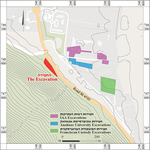
During July 2021, a trial excavation was carried out at Moshavat Migdal Junction on Road No. 90 (Permit No. A-9063; map. ref. 248220–70/747940–8450; Fig. 1), following damage to archaeological remains in the course of upgrading the junction. The excavation, on behalf of the Israel Antiquities Authority and funded by Netivei Israel National Transport Infrastructure, was directed by B. Tzin (field photography), with the assistance of ‘A. Najjar (area supervision), Y. Yaakobi (administration), Y. Harel, A. Shichman and J.A. Sánchez Streger (preliminary inspection), A. Kleiner and A. Wiegmann (photogrammetry and drone photography), A. Shapiro (location map), Y. Gorin-Rosen (glass), H. Tahan-Rosen (pottery and glass drawing), Y. Sheizaf, I. Peters and Y. Asscher (analytical laboratory), S. Rozenberg (painted plaster analysis), D. Gazit (studio photography), R. Be’eri (scientific consultation), H. Mamalya, O. Zingboym and M. Bekker-Shamir (IAA Eastern Galilee and Golan District), workers from Kafr Manda, Bir el-Maksur and Kafr Yasif, and volunteers.
The excavation took place on the western side of the archaeological site of Migdal-Magdala on the western coast of the Sea of Galilee, about 4 km north of Tiberias and just southeast of modern day Moshava Migdal, at the foot of the eastern slope of Mount Arbel. The ancient settlement was founded south of the flood plain of Wadi Ḥammam in the southern Ginnosar Basin, next to the Sea of Galilee. The valley offered fertile ground for agriculture, and today is still densely planted with orchards and agricultural fields. The site appears in historical written sources as Taricheae (fish salting), Migdal Nunia and Magdala. Taricheae is first mentioned by Josephus Flavius (Antiquities 14:120) as a Hellenistic-period urban site on the western coast of the Sea of Galilee, the only settlement located here before Herod Antipas founded Tiberias in 19 CE. Migdal Nunia is mentioned in the Talmud (Pesahim 46:71) as a settlement located about a mile from Tiberias. Migdal Nunia means (smoked) Fish Tower, and can therefore be identified with Taricheae, although there is a contradiction in the written sources regarding the distance from Tiberias (one mile as opposed to four km). The Early Roman settlement is extensively cited by Josephus in relation to the First Jewish Revolt (Jewish Wars II:20; III:10), when the town served as a central base for the rebels in the war against the Romans, and he even records that he fortified the settlement, although not as well as Tiberias. Josephus describes the location and course of the battles, and the conquest by Titus, son of Vespasian, reporting that at the height of the revolt in 66/67 CE there were 40,000 rebels in the town. The site Migdal-Magdala is often mentioned in the Christian canonical gospels in reference to Mary Magdalene (as, for example, Mark 15, 47).
Conder and Kitchener (1881:369) surveyed the site in the late nineteenth century and identified it as Migdal Nunia. Excavations were first carried out at the site in the beginning of the twentieth century by a mission of the Franciscan Institute (De Luca 2009), and the principal discoveries were Roman-period building remains and a Byzantine period public compound. Subsequent trial and salvage excavations carried out by the IAA (Avshalom-Gorni and Najar 2013; Cinamon 2014), and an expedition directed by Anahuac University of Mexico (Zapata-Meza and Garza Díaz-Barriga 2017; Zapata-Meza, Garza Díaz-Barriga and Sanz-Rincón 2018:122), identified the earliest settlement at the site as dating to the Hellenistic period, reaching a peak in the Early Roman period. The excavations yielded remains of an extensive Early Roman settlement with many buildings, shops, fish ponds, streets, a synagogue and miqva’ot ritual baths. The agricultural hinterland of the town was identified north of the site. Settlement continued here, although on a smaller scale, until the Early Islamic period.
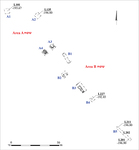
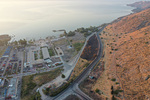
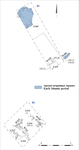
In the present excavation, nine excavation areas were opened (A1–A4, B1–B5; Figs. 2, 3), uncovering two occupational strata (Strata II, I). Remains of Early Roman buildings, including public buildings and streets were attributed to Stratum II, and meager Abbasid-period building remains were attributed to Stratum I. Remains of the Stratum II settlement were uncovered throughout the excavation area, while remains of Stratum I were only found in Area B1. The excavation results indicate that, in contrast to previous estimates, the ancient site of Magdala extended farther west towards the Mount Arbel slopes.
Area A1. An excavation square opened in the Wadi Ḥammam flood plain exposed a few large stones, underlain by a one-meter thick alluvial sediment layer composed of small and medium-sized stones. It seems that the large stones were the remains of a wall erected to divert runoff water, but its poor state of preservation precluded determining its orientation. Worn Roman-period pottery sherds were found in the partially excavated alluvial layer.
Area A2. Roughly hewn building stones and a layer of light alluvial soil were uncovered here, and Early Roman pottery was found on the alluvial layer. The building stones may be the remnants of a building constructed in the agricultural hinterland of the site (for additional building remains in the agricultural hinterland, see Cinamon 2014). The alluvial soil presumably washed down from Wadi Ḥammam.
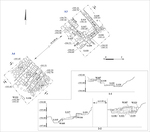
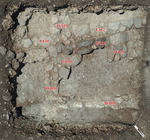
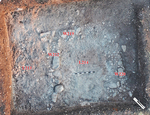
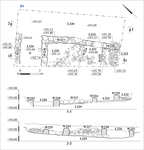
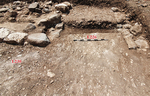
Area A3 (Figs 4, 5). This area was located on the slope descending east towards the Sea of Galilee. Remains of a building containing a room delineated by three walls (W105, W110, W116) were uncovered. Wall 105 (preserved height 0.7 m) and W110 were built of medium-size fieldstones with a fill of small stones. The western part of W110 was preserved for a single course and its eastern part for three courses. Wall 116 (extant height 0.3 m) was built of a combination of roughly hewn basalt stones and basalt and limestone fieldstones. A floor paved with large, flat basalt stones (L117) abutted the three walls in the southern part of the room. Early Roman pottery sherds were found in the earth accumulation layer (L113) below Floor 117. A retaining wall (W125; height 0.5 m), constructed of large and medium-sized hewn stones, and medium-sized limestone and basalt fieldstones was found on the northern side of W116. Wall 116 may have had several construction phases due to the escarpment slope, which necessitated reinforcement. A wall (W129) built of large roughly hewn limestone fieldstones abutted the southeastern part of W116 from the southwest; the excavation not reaching its base. Benches (L112, L130) were placed adjacent to W116, and it seems that W129 separated the two benches and created two separate spaces. Bench 112 (2.6 m long, c. 0.45 m wide) was constructed of a single row of hewn stones and large limestone fieldstones. The excavation did not reach its base, but Early Roman pottery sherds and a few white-painted plaster fragments were found in the bedding to its west (L121), indicating that the bench may have been plastered. Bench 130 (width c. 0.4 m) was not entirely exposed. To its south, an accumulated earth layer (L133) containing Early Roman pottery sherds was exposed. A crushed lime floor (L115) exposed northeast of W105 was overlain by Early Roman pottery sherds and the remains of a tabun that was installed on the floor against the wall (not visible in plan), possibly the remains of a courtyard.
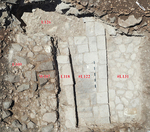
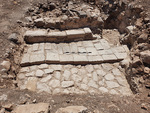
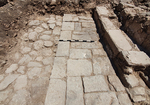
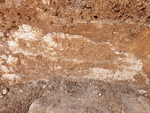
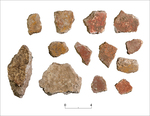
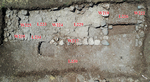
Area A4 (Figs. 4, 6–8). Part of a public building was uncovered, including a wall (W107) and adjacent collapsed stones, mostly large elongated hewn basalt stones (L109), a stone bench (L118), and two floors on two levels (L122, L131). Wall 107 was constructed of a combination of hewn stones and basalt and limestone fieldstones, oriented northeast–southwest. The wall was white-plastered, and at least two plaster layers were identified (Fig. 9) indicating subsequent construction phases. Plaster fragments painted red, yellow and blue (Figs. 10, 11), found below the debris piles of the wall, indicate that it was painted in the secco technique (see below). The base of the wall was not exposed, but preliminary probes indicate that it was built on virgin soil and not on bedrock. Bench 118 (3 m long, c. 0.5 m wide, c. 0.33 m high) was attached to the lower courses of the wall on the northern side. The bench was built of a row of various-sized rectangular limestone ashlars, with small-stone infill at the join with W107. The bench was white-plastered (2 cm thick), and apparently was attached to a previously plastered wall. Floor 122 (4.5 m exposed length, c. 1.15 m wide, c. 0.2 m high), built of rectangular flat and smoothed basalt ashlars, abutted the base of the bench; the floor was slightly damaged in the preliminary probes. Traces of white plaster found on some of the pavers suggest that the floor was also plastered. Floor 131 (3.25 m exposed length, 1.25 m wide) lay 0.2 m lower than Floor 122, which it abutted. The floor was built of large and medium-size basalt and limestone fieldstones whose flattish side faced up; it is not clear if this floor was also plastered. The style of construction indicates that the remains uncovered here were part of a public building with benches, which served as a kind of internal sidewalk in the hall, but its boundaries are unclear; it is possible that the hall was used for gatherings. Wall 123, white-plastered and continuing the line of W107, was identified in the southwestern part of the area. It seems that there was an entrance between W107 and W123. A floor bedding (L126), damaged in the preliminary probes, seems to have been made of small and medium-sized, mostly basalt stones, was uncovered southeast of the entrance; it may have been a corridor or a room, accessed through the entrance. An unexcavated collapse-heap (L109) may cover another room. Only a few Early-Roman period pottery fragments were found in this area.
Area B1 (Fig. 12). A narrow, elongated square was opened, and remains of Strata II and I were uncovered. The earlier Stratum II was characterized by a light-brown earth with small limestones. In the southern part of the square, part of W210, constructed of large and medium-size basalt stones directly on virgin soil, was exposed. No floor was identified, but Early Roman pottery fragments were found in an earth accumulation (L215), south of the wall. A layer of brown alluvial sediment and stones (0.5–1.0 m thick) covered over the Stratum II remains. At ground level in the northern part of the area, a poorly preserved construction of large limestone fieldstones (L204; diam. c. 4 m), possibly a temporary building or installation damaged by recent activity, was uncovered. Abbasid-period pottery fragments (not illustrated) were found south of and inside this structure. A wall (W209), built of a single row of large fieldstones directly on alluvial sediment, was uncovered in the southeastern part of the area; no floor was identified. Abbasid-period pottery was found in the earth accumulation north of the wall.
Area B2 (Figs. 12, 13). Remains of a building, comprising a room and a floor-bedding to its southwest, were uncovered. The rooms was delineated by three walls (W212, W219, W220), constructed of large and medium-sized basalt and limestones, some hewn. The walls were extant for a single course, and no adjacent collapsed stone heaps were found. The walls may have been deliberately dismantled, or the building may have been constructed of ephemeral materials above the stone foundation course. The floor of the room (L214; c. 0.5 cm thick) was made of tamped earth, on which lay Early Roman pottery sherds. The bedding of a no longer extant floor (L213), made of small basalt and limestones bonded with calcareous material (probably lime), was identified west and north of the room, sloping moderately eastward. In the northwestern balk, a few small red, black and white tesserae (1 × 1 cm) were found, indicating that there was probably a mosaic floor nearby, the bedding layer possibly underlying the mosaic floor that did not survive. The southwestern part of Bedding 213 next to the southern face of W212 was dismantled, and an earlier bedding layer (L233) of packed earth over limestone and basalt pebbles bonded with calcareous material, was identified on the virgin soil. Early Roman pottery sherds were found above Bedding 233, the two bedding layers perhaps evidence to phases within the building.
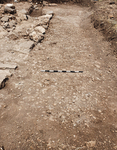
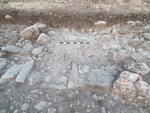
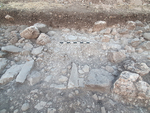
Area B3 (Figs. 14, 15). Part of a northwest–southeast oriented street with an alley branching westward, and the remains of two buildings were uncovered. The gently sloping street (L230; 11 m long, 2.75 m wide; Fig. 16) was paved with small limestone and basalt pebbles, bonded with calcareous material mixed with pottery sherds, over a bedding of crushed lime and stones (0.3 m thick), laid directly on the virgin soil. It seems that no stone paving overlay this stone layer. In the northwestern part of the area an alleyway (L226; 3 m long, 2 m wide; Fig. 17) branched off from the street at a relatively steep upward slope (rising 0.6 m over a length of 3 m), westward towards the Arbel Ridge. The alleyway bedding (0.68 m thick) was built similarly to the street bedding, and it was also laid on virgin soil. A wall (W222; 0.7 m high), built of two rows of large basalt and lime stones, some hewn, and extant for three courses, seems to be the southern wall of a building that lay north of the excavation area. Southwest of the street, three rooms (L223, L229, L232) of a building were uncovered. Room 229 was delineated by three walls (W217, W218, W224), W217 and W218 constructed of a single row of large limestone and basalt fieldstones. A row of small stones attached to the internal face of W217 was perhaps a bedding for plaster that did not survive. The only preserved course of W224, separating Rooms 229 and 223, was built of one to two rows of large and medium-sized fieldstones, mainly limestones but also basalt. The room’s floor, surviving mostly in the southwestern part, was made of small limestone and basalt slabs, laid over a bedding of packed light earth and pebbles (c. 0.3 m thick). No entrance was identified between Rooms 229 and 223, possibly due to the poor preservation of W224, or it lay beyond the boundaries of the excavation. An entrance (L234; 0.78 m wide; Fig. 18) was identified in (W217/W225), leading from Room 223 to the street. Elongated and relatively narrow basalt stones (0.55 × 0.15 m) were placed on both sides of the entrance, probably bases of no longer extant doorposts. The floor of Room 223, extant only in the western part, was made of small limestone and basalt slabs placed on a bedding of pebbles and packed earth. Wall 225, whose foundations were not exposed, survived for at least two courses (0.5 m high). A large squarish basalt stone identified in the southwestern balk was possibly a wall pilaster. A heap of collapsed stones was uncovered in Room 232, but no floor was exposed. On the street and next to the building, broken Early Roman pottery vessels were found, probably in situ. These pottery sherds and others found in the floor beddings permit dating the construction of the building to the Early Roman period, and the few pottery sherds found above the floors suggest that the building was abandoned during this period.
Area B4. The area was damaged by a recently laid telecommunication line that cut through its center. Remains of a street (L227; Fig. 19) were uncovered, probably the continuation of Street 230 from Area B3. Building remains, not uncovered in the trial excavation, were identified on the western side of the area. If, indeed, this was a continuation of the street, then the total length of the exposed street was at least 25 m.
Area B5. A narrow area conforming with the boundaries of the planned development was opened. Interrupted segments of construction (L211) whose plan could not be reconstructed, were discovered underneath layers of alluvium sediment (L201) and a heap of collapsed stones of various sizes (L202). The pottery throughout the area was mostly dated to the Early Roman period, but there were also sherds from the Bronze Age, Iron Age and Persian period (not illustrated) that probably washed down from the Arbel Cliff. Notwithstanding the modern damage, it is clear that the settlement continued southward.
Pottery
After the surface soil was removed, the excavated soil was sieved (1 × 1 cm mesh), and all the diagnostic sherds were collected. The finds from Stratum I were dated to the Abbasid period, and all the pottery from Stratum II was dated to the Early Roman period. The finds were relatively limited, and since no pottery assemblages were found within the building remains, the assemblage is described here according to the typology of the types retrieved. The typology is based on Adan-Bayewitz (1993) and Díez Fernández (1983), and focuses on the Early Roman vessels (for details, see e.g., Tzin 2022: Table 1).
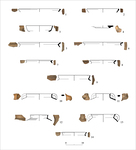
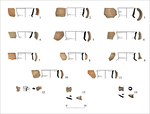
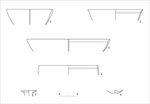
The pottery included bowls, among them Kefar Hananya ware Form 1B (Fig. 10:1, 2), bowls of an unknown type, probably locally produced (Fig. 20:3) and a base of a Terra Sigillata bowl (Fig. 20:4); Kefar Hananya ware casseroles Forms 3A (Fig. 20:5) and 3B (Fig. 20:6–8); Kefar Hananya ware cooking pots Forms 4A (Fig. 20:9–12) and 4B (Fig. 20:13, 14); ‘Shikhin-type’ storage jars Type T1.3 (Fig. 21:1–6) and Type T1.5 (Fig. 21:7–11); juglets (Fig. 21:12); and two Herodian-type lamps (Fig. 21:13, 14).
Most of the retrieved pottery came from the building exposed in Area B3. The pottery enables dating Stratum II to the first century CE. The poor preservation state of the buildings in Area B, and the fact that most of the pottery from the public building in Area A was found in debris piles and not in situ, indicates that the remains reflect the abandonment phase during the Early Roman period.
Glass Finds
Yael Gorin-Rosen
Seven glass fragments were found, six of which were identified and dated. The fragments are fairly small and covered with weathering that caused pitting of the surface. Most of the fragments were found in Area B, including four bowls (Fig. 22:1–4) and a bottle (Fig. 22:5), and the base of another bottle was found in Area A (Fig. 22:6).
The rims of four cast bowls were found, dating from the end of the first century BCE to the beginning of the first century CE. Bowl No. 1, made of good quality blue glass, is conical and plain with a rounded, well-polished rim. Plain cast bowls are relatively rare, sometimes included in a group of bowls with grooved decoration (see below). Deep and shallow plain cast bowls were found in the fill of the stadium built by Herod in Caesarea (for discussion and comparanda, see Gorin-Rosen and Katsnelson 2015:122–124, 126–127, Figs. 6.5, 6.7). A plain cast bowl was also found at Wadi el-Ḥammam, where it was included in the Bowls with linear cut decoration (Jackson-Tal 2018:467, Pl. 13.1:1). Bowls Nos. 2–4 are decorated with a horizontal groove on the interior surface below the rim. Bowl No. 2 is made of colorless glass with purple veins and the rim is everted with a pointed edge. The bowl is well polished, retaining marks of horizontal polishing. Bowl No. 3 leans outward and its rim is well polished inside and out. The rim of bowl No. 4 is upright and its edge is well polished inside and out. The three bowls belong to a type designated Linear-cut Bowls. Bowls Nos. 2 and 4 are deep, while bowl No. 3 is shallow, and all three bowls probably had at least one additional horizontal groove near the base. This type of bowl is very common, and similar bowls were found at Caesarea (Gorin-Rosen and Katsnelson 2015:124–125, 127–128, Figs. 6.6: CG38, CG39, 6.8; see further parallels there). Bowls belonging to the same group, although not identical, were found in the vicinity, as, for example, at Wadi el-Ḥammam (Jackson-Tal 2018:466–467) and at Magdala (Jackson-Tal and Gorin-Rosen 2018:110, 112–113, Fig. 18:1, 2), and are widely distributed.
The two bottle fragments were made of blown glass. Small bottle No. 5 belongs to the group of candlestick-type bottles that have an infolded rim. These bottles are dated mainly from the end of the first to the second centuries CE. Similar bottles with infolded rims were found at Wadi el-Ḥammam (Jackson-Tal 2018:467–468, Pl. 13.3.21–22, and see there for further parallels from the Galilee). Bottles of this group, although not identical, were also found in the Magdala excavation (Jackson-Tal and Gorin-Rosen 2018:110, 113, Fig. 20:1, 2). The base of bottle No. 6 is thickened and slightly concave, with a coarse scar at its center.
The assemblage, albeit small, reflects well the first century CE, when cast bowls were still in use and blown glass vessels gradually entered everyday use. The ratio of blown vessels to cast ones may hint at a date in the first half of the first century CE, correlating well with the dating of Stratum II.
Painted Plaster
Yifat Sheizaf, Ilana Peters, Yotam Asscher and Silvia Rozenberg
Plaster fragments painted red, yellow and a little light blue-green were found in the collapsed debris of W107 and Floor 122, indicating that there was a wall painting on W107. A few samples were taken of each of the colors to determine the composition of the paint and the painting technique. The painted plaster is based on calcitic lime with a minor component of quartz; it is relatively well preserved. This type of plaster was very common in the Second Temple period. The light blue-green paint is based on a green earth pigment (mineral of the celadonite and glauconite family). The pigments used for the red and yellow colors are based on iron oxides (hematite and goethite minerals family). Traces of black paint, probably of carbon-based pigments were also found.
The secco painting technique was employed. It was carelessly executed and many brush strokes from painting an image on a white background with red panels are visible. While the red and yellow paints were made from local southern Levantine materials, the celadonite found in the light blue-green pigment does not exist in the region, and it probably originated in the mines of Cyprus. This pigment was known in the Hellenistic world at ‘Akko (Segal and Porat 1997:87, 89), as well as on Herodian ceramic bowls from Jericho (Porat and Ilani 1998:79). Celadonite-based green paints were found in the synagogue uncovered at Migdal (Piovesan et al. 2016:441–443). In contrast to the Migdal synagogue fresco (Rozenberg 2025), the secco found in the present excavation was carelessly executed and employed a limited palette. This may have been a simple local industry of the Second Temple period (Peters et al. 2023).
The trial excavation at Migdal Junction enabled redefining the boundaries and size (c. 150 dunams) of the Early Roman settlement at Migdal-Magdala. The western boundary of the settlement, previously identified east of Road No. 90, in effect extended westward towards the foot of the Arbel Ridge, beyond the present excavation boundaries, and apparently reaching the escarpment line. The exposed street seems to have been a central long street, extending further south in the direction of Tiberias. The public building uncovered in Area A is highly significant because its architectural style is similar to that of the synagogue previously uncovered in the settlement (Avshalom-Gorni and Najar 2013). Early Roman synagogues—a central research issue—have been uncovered at several sites (e.g., Foerster 1973; On and Weksler-Bdolah 2005; Yavor 2010: Fig. 2.34; Leibner and Arubas 2015; Hasegawa, Kuwabara and Paz 2022: Figs. 4, 5). All have some similar characteristics, including a hall surrounded by benches. In addition, the secco fragments found in the debris piles suggest that the building had wall decoration that did not survive. The remains seem to belong to a public building, and the hall with the benches was intended for gatherings. According to Leibner and Arubas (2015:31), synagogues were the only public buildings in Second-Temple period Jewish settlements used for gathering, and it therefore aspires that we have exposed another synagogue. Since only part of the building was uncovered, its full exposure is required to establish its plan and confirm its function. A combination of painting in red, yellow and light blue-green, as well as the building style, and the pottery all point to a close resemblance to the previously uncovered Migdal synagogue, and both synagogues may have been built and functioned in the same period. The different painting technique—secco rather than fresco— whilst similarity in the use of pigments and simple techniques characteristic of the Second Temple period, indicate that different artists were probably employed. The two buildings were uncovered in the northern part of the settlement, suggesting that public buildings were constructed in this area in the Early Roman period—perhaps an expression of the status of the northern area as the more affluent area of the town. Although the northern boundary of the settlement was not identified in the excavation, the issue remains whether this building functioned at the time of the Roman siege, after the previously excavated synagogue was abandoned, dismantled and lay beyond the fortification line. If indeed the two buildings were constructed at the same time and had a similar function, they present an unprecedented discovery, since Early Roman Jewish settlements usually have one public building for gatherings. It is possible that the large size of the settlement, redefined in the present excavation, influenced the planning of public buildings, and that in this large settlement more than one synagogue was built. Discovery of additional gathering buildings dating to the Second Temple period at other sites will contribute to a more in-depth understanding of the phenomenon, perhaps even to re-defining these buildings and their role in the congregation. Such buildings will also make it possible to understand better the centralization of ritual while the Temple was still standing.
The paucity of small finds may reflect the abandonment of the western part of the settlement, possibly stages of the Roman conquest of the town, whereby the western part was abandoned in the course of the Great Revolt. The absence of significant quantities of debris may point to a deliberate dismantling of the buildings, probably as a defensive measure to erect barricades and military posts, as was previously suggested by the excavators of the first synagogue (Avshalom-Gorni and Najar 2013). If this is the case, we may have evidence of the failure to defend the settlement, since this area was subsequently abandoned and never resettled.
The trial excavation at Migdal Junction shed light on the previously unknown area of the settlement and its research potential. Exposure of a second public building in the settlement is indeed a discovery, but more than that, it is a test-case of the phenomenon of such buildings in the Early Roman period. In addition, the excavation offers a new glimpse into the extent of the settlement during the First Jewish Revolt, and the processes that the settlement underwent before and after its defeat to the Romans.
References
Adan-Bayewitz D. 1993. Common Pottery in Roman Galilee: A Study of Local Trade. Ramat Gan.
Avshalom-Gorni D. and Najar A. 2013. Migdal. HA–ESI 125. https://doi.org/10.69704/jhaesi.116.2004.2304
Cinamon G. 2014. Migdal. HA–ESI 126. https://doi.org/10.69704/jhaesi.116.2004.11620
Conder C.R. and Kitchener H.H. 1881. The Survey of Western Palestine I: Galilee. London.
De Luca S. 2009. La città ellenistico-romana di Magdala/Taricheae. Gli scavi del Magdala Project 2007 e 2008: relazione preliminare e prospettive di indagine. LA 59:343–562. https://doi.org/10.1484/J.LA.1.102174
Díez Fernández F. 1983. Cerámica común romana de la Galilea: Aproximaciones y diferencias con la cerámica del resto de Palestina y regiones circundantes. Madrid.
Foerster B. 1973. The Synagogues at Masada and Herodium. Eretz-Israel 11:224–228 (Hebrew; English summary, P. 30*).
Gorin-Rosen Y. and Katsnelson N. 2015. The Glass Vessels. In Y. Porath. Caesarea Maritima I: Herod’s Circus and Related Buildings 2: The Finds (IAA Reports 57). Jerusalem. Pp. 111–137. https://doi.org/10.2307/j.ctt1fzhdh2.9
Hasegawa S., Kuwabara H. and Paz Y. 2022. Tel Rekhesh—2017. HA–ESI 134. https://doi.org/10.69704/jhaesi.116.2004.26123
Jackson-Tal R.E. 2018. Glass Finds. In. U. Leibner. Khirbet Wadi Ḥamam: A Roman-Period Village and Synagogue in the Lower Galilee. Jerusalem. Pp. 465−494.
Jackson-Tal R.E. and Gorin-Rosen Y. 2018. Glass. In M. Zapata-Meza, A.G.D. Barriga and R. Sanz-Rincón. The Magdala Archaeological Project (2010–2012): A Preliminary Report of the Excavations at Migdal. ‘Atiqot 90:110−117. https://doi.org/10.70967/2948-040X.1829
Josephus, Antiquities: Antiquities of the Jews. The New and Complete Works of Josephus (trans. W. Whiston, Kregel Publications). Grand Rapids, Mich. 1999.
Josephus. The Jewish War. H. St. J. Thackeray transl. (Loeb Classical Library). London–New York 1927–1928. https://doi.org/10.4159/DLCL.josephus-jewish_war.1927
Leibner U. and Arubas B. 2015. Summary of the Excavation Project at Khirbet Wadi Hamam, a Roman Period Village in the Galilee. Qadmoniot 149:28–39 (Hebrew).
On A. and Weksler-Bdolah S. 2005. Khirbet Um el-Umdan: A Jewish Village with a Synagogue from the Second Temple Period at Modiin. Qadmoniot 130:107–116 (Hebrew).
Peters I., Shezaf I., Rozenberg S., Najar A., Tzin B. and Asscher Y. 2023. Painted Plaster Fragments in the 'Public Building' at Migdal. Open Access Journal of Archaeology and Anthropology 5.1:1–8.
Piovesan R., Maritan L., Amatucci M., Nodari L. and Neguer J. 2016. Wall Painting Pigments of Roman Empire Age from Syria Palestina province (Israel). European Journal of Mineralogy 28:435–448. https://doi.org/10.1127/ejm/2015/0027-2500
Porat N. and Ilani S. 1998. A Roman Period Palette: Composition of Pigments from King Herod’s Palaces in Jericho and Massada, Israel. IJES 47:75–85.
Rozenberg S. and Neguer J. 2025. Appendix 3: Wall Paintings from the Magdala Synagogue. In R. Talgam, D. Avshalom-Gorni and A. Najar. From the Magdala Stone to the Syriac Bema: Mutual Influences between the Liturgical Space in the Early Synagogue and Church (Supplements to the Journal for the Study of Judaism). 218:432–452. Leiden. https://doi.org/10.1163/9789004707733_013
Segal I. and Porat N. 1997. Composition of Pigments from the Hellenistic Walls in Acre. In M. Maggetti., M. Fuchs and H.A. Bearat eds. Roman Wall Painting: Materials, Techniques, Analysis and Conservation. Fribourg. Pp. 85–91.
Tzin B. 2022. Karm er-Ras. HA–ESI 134. https://doi.org/10.69704/jhaesi.116.2004.26247
Yavor Z. 2010. The Architecture and Stratigraphy of the Eastern and Western Quarters. In D. Syon and Z. Yavor. Gamla II: The Architecture: The Shmarya Gutmann excavations, 1976–1989 (IAA Reports 44). Jerusalem. Pp. 13–112. https://doi.org/10.2307/j.ctt1fzhdk3.6
Zapata-Meza M. and Díaz-Barriga A.G. 2017. Migdal—2015. HA–ESI 129. https://doi.org/10.69704/jhaesi.116.2004.25336
Zapata-Meza M., Diaz Barriga A.G. and Sanz-Rincón R. 2018. The Magdala Archaeological Project (2010–2012): A Preliminary Report of the Excavations at Migdal. ‘Atiqot 90:83–126. https://doi.org/10.70967/2948-040X.1829
Keywords
Migdal, Magdala, Early Roman Period, Synagogue, Great Revolt, Roman Street, Roman Glass, Sea of Galilee
Publication Date
04/06/2026
Report Type
Final Report