
Be’er Sheva‘, ‘Emeq Sara Industrial Zone (A-9126)
Permit/License Number
A-9126
Excavation Report
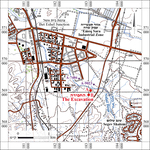
During October 2021, a trial excavation was undertaken at the industrial zone of ‘Emeq Sarah in southern Be’er Sheva‘ (Permit No. A-9126, map. ref. 182979–3010/569072–100; Fig. 1), prior to expansion. The excavation, on behalf of the Israel Antiquities Authority and funded by the Be’er Sheva‘ municipality was directed by A. Dobrinin, with the help of Y. Alamor (administration), E. Aladjem (surveying and drafting), S. Talis, A. Fraiberg, F. Kobrin and A. Golani (scientific guidance and consultancy), Y. Abadi-Reiss (flint), D. Eisenberg-Degen (flint photography), I. Azoulay (plan) and workmen from Hebron.
The ‘Emeq Sara industrial zone is located near Naḥal Beqa‘, a tributary of Naḥal Be’er Sheva‘, in an area covered by the loess soil characteristic of the Be’er Sheva‘ Valley. Remains of winepresses and farmhouses from the Byzantine and Early Islamic periods were previously found about 500 m northwest of the excavation area (Kobrin 2016 [Fig. 1: A-7486]), and about 200 m northeast of the excavation remains of a building from the Byzantine and Early Islamic period and a pile of stones from the Mamluk period were also found (Permit No. A-9023).
Chalcolithic-period sites, including Be’er Matar, Be’er Ẓafad and Ḥorbat Beter were uncovered and excavated along Nahal Be’er Sheva‘ in the 1950s, 1980s and 1990s, while Tel Sheva‘ was excavated in recent years (Abadi-Reiss 2016; Paz et al. 2014; Pasternak 2022). These Chalcolithic period sites belong to the Be’er Sheva‘(Ghassulian) culture, which is characterized by rural agricultural settlements containing subterranean quarried spaces (Gil‘ad and Fabian 2008).
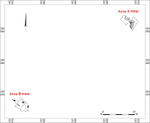
Part of one of these semi-subterranean spaces from the Chalcolithic period, one of the Be’er Sheva‘ (Ghassulian) culture sites, was exposed in Area B in the current excavation (Fig. 2), with a pair of field walls exposed in Area A.
Area A
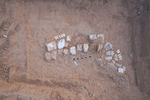
In this area two field walls that formed a corner (W100, W101; Fig. 3) were uncovered on the northern moderate slope of a hill. The walls were built of large, roughly hewn, chalk stones. Wall 100 (length 3.2 m, width 0.8 m), was constructed of two rows of stones and preserved to a height of two courses. Whereas, W101 (length 2.1 m, width 0.7m) had three courses preserved, and was constructed of one row of stones laid in a staggered manner. Runoff soil containing small river pebbles was exposed next to the southern face of W100. No datable finds were discovered in this area. It seems that the walls delineated an L-shaped cultivation terrace, which was part of an agricultural system. Despite the lack of finds, the walls can be dated to the Byzantine period according to other sites that were uncovered in the vicinity.
Area B
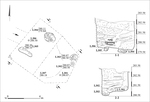
In this area a small part of a semi-subterranean space (Fig. 4), which was dug into the loess soil, was exposed and within it two habitation levels were identified. The semi-subterranean space appears to extend beyond the excavation areas to the north, east and southeast. Several Chalcolithic-period pottery sherds were found in this area, as well as flint and stone items (Abadi-Reiss below).
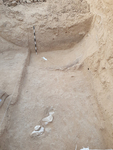
The early habitation phase includes a level of tamped dark loess soil (L306; Fig. 5), in which two shallow oval pits were hewn (L304—0.5 × 0.9 m, depth 0.3 m; L305—0.4 × 1.1 m, depth 0.1 m). The pits’ walls are reddish, and small burnt chalk stones were found in them, indicating that these pits were used for lighting fire. Above this early habitation phase was found an accumulation of sterile, fine-grained, loess soil, and above this layer was an accumulation of brick-material and greyish soil, which was deposited after the site was abandoned.
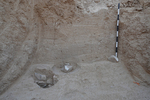
The late habitation phase was comprised of a layer of hard, light loess soil (L301; thickness 1–3 cm; Fig. 6), into which two shallow oval pits were also dug adjacent to each other (L302, L303; 0.3 × 0.5 m, depth 0.1 m, 0.4 m respectively). The color of the walls of these pits is also reddish, and in them burnt chalk stones were found, and it therefore seems that they too were used for lighting fire. In the western part of the space a passageway or an entrance (length 0.9 m) was dug into the loess soil.
The Finds from Area B
Yael Abadi-Reiss
The pottery finds comprise four body fragments that were manufactured from orangish clay fired at a low temperature, and they contained coarse, dark, and light inclusions. The pottery’s technological characteristics are in line with a date in the Chalcolithic period.
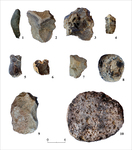
The flint finds include 38 flaked items (Table 1). Most of the flint is fresh and not worn. The raw material is very varied, including river-pebbles of brown-hued chert, which are common around the site and striped, grey chert of law quality, which contains veins of lime. Two tools were identified in the assemblage: an end scraper (Fig. 7:1) and a retouched flake (Fig. 7:2). A single amorphic core with one striking platform was also found (Fig. 7:3). Nearly half the items in the assemblage are flakes, and most of the flakes are secondary (Fig. 7:4–7). The assemblage derives from several distinct activity sequences that were undertaken close by. The flint assemblage is therefore an assemblage of flakes, with a single formal tool, the end scraper, and it can therefore be identified as a proto-historian assemblage.
The stone tools. Three worked stone items were found: a spheroid hammerstone, a limestone flake and a grinding stone, all related to food processing and tools manufacturing. The hammerstone (diam. 5–6 cm; Fig. 7:8) is made of flint with calcareous cortex, bearing peripheral impact marks. The limestone flake (Fig. 7:9) contains a small quantity of chert, and flaking marks are visible on all sides. It is possible that this flake was produced during the removal of the cortex from the core, when flint other than from the stream pebbles near the site was used. It is also possible that this flake was produced while manufacturing a limestone tool. The grinding stone is made of beach rock (Fig. 7:10), and has one flat face with wear marks, while the other sides were carelessly rounded. The stone was found lying upside down in pit 303, with its upper face blackened with soot.
References
Abadi-Reiss Y. 2016. A Chalcolithic Settlement at Tel Sheva‘. ‘Atiqot 87:43*–69* (Hebrew; English summary, p. 106). https://doi.org/10.70967/2948-040X.1772
Gil‘ad I. and Fabian P. 2008. 7,000 Years of Settlement: The Archaeological Remains in Be’er Sheva‘ from the Sixth Millennium BCE until the End of the First Millennium CE. In Y. Grados and E. Meir Glitzenstein eds. Be’er Sheva‘: Metropolis in the Making. Be’er Sheva‘. Pp. 303–331 (Hebrew).
Kobrin F. 2016. Be’er Sheva‘, ‘Emeq Sara Industrial Zone. HA–ESI 128. https://doi.org/10.69704/jhaesi.116.2004.25026
Pasternak M.D. 2022. Tel Sheva‘, Educational Campus. HA–ESI 134. https://doi.org/10.69704/jhaesi.116.2004.26235
Paz Y., Aladjem E., Abadi-Reiss Y., Kahalani N. and Timmer N. 2014. Tel Sheva‘. HA-ESI126. https://doi.org/10.69704/jhaesi.116.2004.9566
Keywords
Be’er Sheva‘ Valley, Naḥal Be’er Sheva‘, Chalcolithic period, Be’er Sheva‘ culture, Ghassulian culture, semi-subterranean space, field walls, agricultural system, Byzantine period, flint find
Publication Date
08/06/2026
Report Type
Final Report