
Bir el-Maksur (A-8340)
Permit/License Number
A-8340
Excavation Report
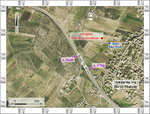
During August–September 2018, a trial excavation was conducted in the west of Bir el-Maksur, southeast of Shefar‘am (Permit No. A-8340; map ref. 220516–602/742300–400; Fig. 1), following damage to antiquities while constructing a road for a bypass. The excavation, on behalf of the Israel Antiquities Authority and funded by the Ministry of Transport, was directed by Y. Gur (field photography), with the assistance of Y. Yaakobi (administration), R. Mishayev and E. Aladjem (surveying and drafting), M. Peleg (field photography and photogrammetry), N. Feig and R.S. Martin (pottery), E. Dalali-Amos (final plans), Y. Gorin-Rosen (glass), H. Tahan-Rosen (pottery and glass drawing), M. Shemer (flint tools), M. Smilanski (flint drawing), and workmen from Shefar‘am.
The excavation was conducted at Khirbet Bir el-Maksur, an archaeological site extending over a hill northeast of Road No. 79 and in the west of the village Bir el-Maksur. A spring emerges in the area of the excavation. Previous excavations carried out in the vicinity uncovered a Pre-Pottery Neolithic site (Malinsky-Buler et al. 2013), layers of flint dating to the Middle Paleolithic and Epi-Paleolithic periods (Yaroshevich 2013), and a Late Roman-period burial cave (Abu Zedan and Mitler 2014).
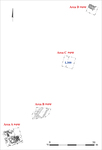
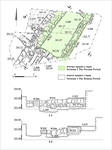
Four areas were opened (A–D; 200 sq m; Fig. 2). Remains of an ancient working surface and a silo dating to Middle Bronze II were excavated in Area A, building remains from the Persian and Roman periods were uncovered in Area B, a Persian-period pottery assemblage without architectural remains was found in Area C, and an Iron II stone layer was exposed in Area D.
Area A
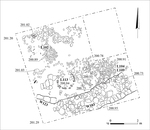
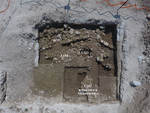
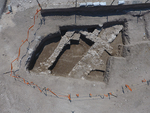
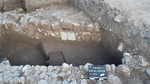
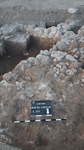
Four squares (c. 100 sq. m, Figs. 3, 4) were excavated next to the spring, in an area damaged by the development works and the construction of a revetment wall between Areas A and B. Most of the area comprised an ancient working surface (L102, L104), constructed of small and medium-sized fieldstones, on which pottery vessels from Middle Bronze II were found. The working surface abutted a massive wall (W103; length 10 m, width 1.6 m), constructed of two rows of large stones and a fill of large and medium-sized stones. Two courses of the wall were exposed but it was not possible to excavate deeper as the spring’s groundwater was reached. Surface 104 abutted another wall (W123; exposed length c. 2 m, width 0.4 m), of which a single course of three ashlars was uncovered, the excavation again stopped due to reaching groundwater. The two walls were extant to the same height, but the relation between them was not clear. A third course of W103 was exposed in a probe (L109) dug between Surface 104 and W103, again stopped due to reaching groundwater. A round silo lined with pottery sherds and fired bricks (diam. 1.5 m; L113), and incorporated in the southwestern part of Surface 104, was excavated to a depth of 0.5 m until groundwater was reached; it contained mostly Middle Bronze Age jars.
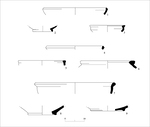
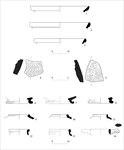
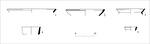
The rich MB IIB pottery assemblage retrieved from Area A included bowls, kraters, cooking pots, pithoi, jars, a jar or jug, and a lid. One bowl (Fig. 5:1) is a common MB II form, a similar bowl found at Tel Qashish Stratum IXB (Ben-Tor and Bonfil 2003:205, Fig. 83:1–3, Type B IVb), and one bowl (Fig. 5:2) has a disc base characteristic of bowls with in-turned rims (Bonfil 2015:79, Pl. 1.3.1). Fig 5:3 is a carinated bowl with a gutter rim, a distinct MB IIB indicative marker, similar bowls uncovered at Tel Qashish Strata X–IXC (Bonfil 2003:280, Fig. 114:10, Type CB 1). Fig. 5:4 may be an open krater, and two closed kraters (Fig. 5:5, 6)—one with a gutter rim, the other with a ledge rim—are similar to MB IIB kraters at Tel Yoqne‘am Strata XXIIIB–XXI (Ben Ami and Livneh 2005:264–265, Figs. II.21:16, II.23:21, IV.6:1, Type CK 1a). An open krater with a mid-body carination (Fig. 5:7), is similar to kraters uncovered in MB IIB and early LB I strata at Tel Yoqne‘am (Ben Ami and Livneh 2005:269, Fig. IV.6:10, Type K IIIa), and two krater bases (Fig. 5:8, 9) may also be of large barrel-shaped kraters.
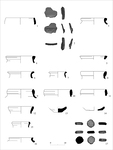
A handmade cooking pot of coarse brown clay has a straight wall with a perforated-line decoration below the rim (Fig. 6:1), similar pots coming from Tel Qashish Strata IXC–IXB (Bonfil 2003:285; Fig. 117:2, Type UCP 1B). The decorated body sherd of another cooking pot (Fig. 6:2) belongs to the group of globular cooking pots with square folded rims, some characterized by a cordon decoration or relief of crosses surrounding the vessel, usually mid-body. Cooking pots of this type were mostly found in strata attributed to the end of MB IIB, such as at Tel Qashish Strata X–VIII (Bonfil 2003:285, Fig. 118:6, Photos 107, 111, Type GCP II).
Pithoi predominate the assemblage, and three types were identified. Pithoi Type A have a short neck and a thickened square rim (Fig. 6:3–5), Nos. 3 and 4 having an out-turned thickened square rim, typical of MB IIA–MB IIB, with similar pithoi at Tel Qashish Strata IXC–IXA, whilst No. 5 has a square inward folded rim, similar pithoi dated towards the end of MB II, found at Tel Qashish Strata IXB–IXA (Bonfil 2003:293, Fig. 123:2, Type P IIa, Fig. 123:4, Type P IIc). Pithoi Type B have an out folded rim (Fig. 6:6, 7), similar vessels found at Tel Qashish Strata IXB–IXA, again attributed to the end of the period (Bonfil 2003:294, Fig. 124:2, Type P V). Pithoi Type C have a thickened folded rim (Fig. 6:8–12), and are not common at Tel Yoqne‘am, but some were found in fills in Strata XXV and XXIV (Ben Ami and Livneh 2005:286, Fig. IV.11:14, Type P IV). Pithos No. 12 has a folded simple rim, a form not found at Yoqne‘am, but found at Tel Qashish (Bonfil 2003:293, Fig. 124:1, Type P V). One pithos base (Fig. 6:13) is probably of a pithos with an elongated body, the other pithos base (Fig. 6:14) probably of a barrel-shaped pithos.
A jar with a thickened convex rim (Fig. 6:15) is similar to a jar from Tel Qashish Stratum IXA, dated to the end of MB IIB (Bonfil 2003:292, Fig. 122:18, Type SJ VIII). A hybrid-type vessel between a jar and a jug, although no extant handle (Fig. 6:16), is identical to a vessel from Shiloh Stratum VII, and apparently had a limited distribution (Bonfil 2015:86, Fig. 1.3.25). Stopper No. 17 was made for a jar.
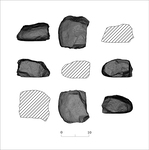
The other finds from Area A are flint tools, including two large geometric sickle blades dated to the Middle Bronze Age (see Shemer, below), and a grinding stone. The grinding stone (L113, B1514/2; Fig. 7) is a reddish brown coarse crystalline (crystals up to 1 mm) ferruginous limestone, containing numerous concentrations of iron ore (most likely hematite) and sporadic rounded transparent quartz grains, originating in an area characterized by metamorphic rocks, possibly in Turkey. No stone vessels from this region were found in the other excavation areas. It is possible that imports arrived at nearby ‘Akko in boats carrying stones as ballast, and that one stone was reshaped as a grinding stone.
Area B
Two squares (50 sq m; Figs. 8, 9) were excavated in an area damaged by modern agricultural activity and by the construction of a retaining wall delineating the area on the south. Two occupation strata were uncovered, Stratum 2 dated to the Persian period, and Stratum 1 to the Roman period.
Stratum 2. A massive wall comprising two unevenly-built courses was uncovered (W211; length 7 m, width 1.1 m, preserved height c. 1 m; Fig. 10). The northern part of the lower course was built of rectangular stones (0.2 × 0.4 m) and two large square stones (length 0.4–0.5 m), and its southern part of medium-sized fieldstones. The upper course was built of two parallel rows of large square stones, similar to those in the lower course, with a fill of small and medium-sized fieldstones between them. Pottery sherds found east of W211 (L205, L206, L216), were mostly of mortaria bowls, jars and an amphora, dated to the Persian period.
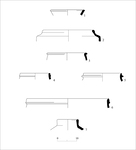
Mortaria are the most common open vessel in Persian-period assemblages (Fig. 11:1–5), sometimes with reed imprints on the exterior (Fig. 11:4, 5), similar bowls with reed imprints found at sites in Jerusalem (Tushingham 1985: Fig. 16:1–4; Shalev 2015:206, Fig. 4.1:30–33). Mortaria with ring bases (Fig. 11:6–8) are dated to the fifth–third centuries BCE, several found at Tel Gil‘am (Stern 1970:37, Fig. 7:1–12) and Tel Dor (Stern 1995: Figs. 2.17:1–4, 2.28:2, 3).
Jars, the most common vessel in Persian-period assemblages in the Galilee and along the northern coast, appeared in several types. Some jars made of a yellowish-greenish fabric have a straight shoulder and no neck (Fig. 11:9, 10), similar jars discovered at Dor (Stern 1995: Fig. 2.8:17–20). One jar has a sloping shoulder (Fig. 11:11), a form dated to the fifth–fourth centuries BCE (Stern 1995:62; Fig. 2.8:12–14), another jar is a type characterized by an elliptical body, rounded base and four handles (Fig. 11:12), found at inland sites and continuing the tradition of the Iron Age II ‘lmlk jars’ (Stern 2015:570). One jar (Fig. 11:13) is a ‘coastal jar’ type that first appeared in the Persian period, and was common in Phoenicia, northern Syria, Mesopotamia, Cyprus and Egypt, from the mid-fifth and throughout through the fourth centuries BCE. A similar jar was found at Tel Mevorakh, and its origin may be in Cyprus, whence the jars were distributed to all other destinations (Stern 1978:570; Fig 7:5).
An amphora (Fig. 11:14), made of well-levigated, light-colored clay, is one of five amphora types manufactured at Chios. It first appeared during the fifth century CE, and became the most common type in Athens and the Black Sea in the end of the fifth and the beginning of the fourth centuries BCE (Shalev 2014:236–240, Type VI, with chronological discussion). The largest assemblage of this amphora-type, with about 60 fourth-century BCE amphora fragments, was found was found at Remez Street, ‘Akko, (Finkielsztejn 2007).
Stratum 1. Three walls (W202, W204, W217) and a crushed-lime floor (L215) of a Roman-period building were uncovered (Fig. 12), W204 cutting Stratum 2 W211, and Floor 215 laid over it; a stone bedding was uncovered under the southern part of the floor. It seems that the floor extended to the east and south, abutting W202 and W204. Roman-period pottery sherds were found on the floor. Remains of a wall (W203) and earth fills (L207, L208) were uncovered south of W204, but this area was damaged by recent works.
The Stratum I pottery assemblage includes a shallow red-slipped ETS-type bowl (Fig. 13:1), dated to the mid-first century BCE–mid-second century CE; a Kefar Ḥananya bowl Form 1C (Fig. 13:2), dated mid-third to end fourth centuries CE; (Adan-Bayewitz 1993:98–100); a Kefar Ḥananya cooking pot Form 4B (Fig. 13:3), dated mid-first to mid-second centuries CE (Adan Bayewitz 1993:126–128,); a Type T.1.3 storage jar (Fig. 13:4) dated to the first century CE (Díez Fernández 1983:107); and a juglet (Fig. 13:5) of a type found at Ẓippori, dated to the mid-Roman period (Meyers 2013: Pl. 39:3).
A flint tool assemblage was also found in this area (Shemer, below).
Area C
Light gray earth layers (L300) with a few pottery sherds dating to the Persian and Roman periods, without architectural remains, were exposed in a square (25 sq m) opened in a field. Other finds included a Roman-period stone bead, and an assemblage of flint objects (Shemer below).
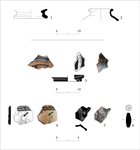
The Persian-period vessels include the ring-base of a mortaria (Fig. 14:1), dated to the fifth–third centuries BCE, and the cylindrical neck and squared thickened rim (Fig. 14:2) of an elliptical-shaped jar, a type found at Persian-period sites in Israel. The Roman-period vessels include Attic vessels (Martin, below), among them a bowl (Fig. 14:3), a lekythos (Fig. 14:4), and a discus lamp made of local light-brown clay with thin dark gray slip and decorated left of the nozzle with a spiral and three dots (Fig. 14:5). The lamp, common in the north of the country, is dated to the first–third centuries CE, a similar lamp found at ‘Ibillin, about 8 km northwest of Bir el-Maksur (Feig and Hadad 2015:110, Fig. 14:26).
The marble bead (Fig. 14:6) was probably from Carrara (Anastasia Shapiro, pers. comm.), marble objects first arriving in this area during the Roman period, as part of the Mediterranean-basin trade network.
Attic Wares
Rebecca-Susan Martin
The ring-base of a bowl and a sherd of a cylindrical lekythos were found in Area C. The bowl (Fig. 14:3) was made of orange-red clay with mica and white grits and coated on the interior and exterior with black slip. The internal surface is decorated with two incised concentric circles with roulette fill, and the external surface is grooved with burnished grooves at the join between the base and the body. A similar Attic vessel from the Athens Agora was dated to 350 BCE (Sparkes and Talcott 1970:95, No. 830, Figs. 8, 22, Pl. 33), the bowl from Area C dated by its shape and decoration as later than 350 BCE. The lekythos body sherd (Fig. 14:4) is covered in white and decorated in black. The top of the sherd, from just below the vessel shoulder, depicts a black-painted meander running between two black lines, and the upper part of a standing woman facing right, looking over her shoulder, apparently with her left arm outstretched; her head is in profile while her upper body faces front. She wears a sakkos head covering over her dark hair, and wears earrings and at least two garments, probably a cloak with a few folds over a chiton with many vertical folds. There are no traces of the original polychromy, and the worn black outline of the artist’s preliminary drawing is visible on the left side of the sherd. Similar imagery is found on an Athenian white-slipped lekythos dating to the late Archaic and Classical periods. A lekythos in the Ashmolean Museum (1928.170 = BAPD 208762) shows a woman in a sakkos holding a wreath, this lekythos attributed by Beazley (ARfVP 1963: 715.184) to the painter Aischnes (c. 475–425 BCE). The eye on the Bir al-Maksur fragment appears to be depicted frontally, however, suggesting a late Archaic date. A better parallel may be found on a lekythos in Leiden (Rijksmuseum van Oudheden ROII51 = BAPD 9661), attributed by Vos to the ATL Class, c. 500–450 BCE (PL. [204] 110.6.8-9). The lekythos from the excavation probably dates to the first quarter of the fifth century BCE.
Area D
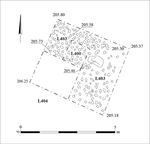
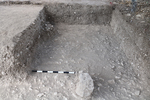
A layer of small field stones (L403) laid over tamped earth was uncovered in a single square (25 sq m; Figs. 15, 16). A probe (L404) excavated at the center of this layer to clarify its nature, yielded Iron II pottery sherds, and an assemblage of flint tools (Shemer, below). A Roman-period glass fragment was found on the surface (L400; Gorin-Rosen, below).
The Iron Age II vessels include bowls, kraters, cooking pots and a jar. One sherd (Fig. 17:1) was probably of a bowl with a slight carination towards the base, characteristic of the ninth century BCE, a similar bowl found at Ḥaẓor Stratum VIII (Ben-Tor and Zarzecki-Peleg 2015: Fig. 2.2.2:19). Two types of ninth-century BCE kraters with a rounded body and no handles were identified, one with a simple rim and a carinated shoulder (Fig. 17:2), similar to a krater from Tel Yoqne‘am Stratum XIII (Zarzecki-Peleg 2005: Fig. I.71:4), and the other with a rounded rim, with a parallel from Ḥaẓor Stratum VIIIA (Ben-Ami 2012: Fig. 3.5.1). One cooking pot has a triangular rim (Fig. 17:4), characteristic of tenth-century BCE cooking pots, and two cooking pots have pinched rims (Fig. 17:5, 6), a type more common in the ninth century BCE, with parallels from Tel Yoqne‘am (Ben-Tor and Zarzecki-Peleg 2015: Pl. 2.27:9–IV 10). A high-necked jar with a simple rim (Fig. 17:7) has a parallel at Ḥorbat Rosh Zayit (Gal and Alexandre 2000: Fig. III.92:10).
Roman-Period Glass
Yael Gorin-Rosen
The flat thickened base of a miniature free-blown bottle (L400, B1408; Fig. 18) found in Area D, has a greenish hue, covered with silvery pitted weathering. The base is truncated, and judging by its size and shape, it seems to belong to a small bottle with a piriform body, a narrow neck and an in-folded rim, a common type in the first century CE, mostly retrieved in tombs, and rarely in settlements. Since the bottles are usually photographed rather than drawn, it is difficult to judge the thickness of the base that distinguishes them from contemporary, similarly shaped bottles with thin, pressed-in bases. A small bottle with a flat thickened base from a Roman-period tomb near Ben Shemen was dated to the first–third centuries CE (Reich 1982:19–21, Fig. 3:9). Although no other Roman-period finds were found in Area D, contemporary finds were found in Area B.
The Flint Assemblage
Maayan Shemer
A total of 338 flint items were found in Areas A–D (Table 1): 91 items in Area A (c. 27%), 157 in Area B (c. 47%), 44 in Area C (c. 13%) and 46 in Area D (c. 14%). The flint tools had mid-level wear, manifest on the one hand in the partial blunting of the active edges, and the full preservation of the scar ridges on the other hand, and many of the items are partly patinated with a yellowish or reddish patina, or fully covered with white-orange patina. It thus seems that the flint assemblage was knapped at the site or in its vicinity, and was probably affected by post-depositional processes, such as short-distance erosion or surface exposure.
Two predominant flint types were identified in the assemblage. About 52% of the items were manufactured on opaque flint in gray-brown hues with reddish/yellowish veins, partly coated with yellowish patina, and about 16% were manufactured on translucent/semi-translucent flint in reddish-brown hues, partly coated with reddish patina, the source of both types identified as Eocene outcrops of the Timrat and Adulam formations (Ekshtain et al. 2014; 2017), common in the vicinity of the site.
The technological and typological distribution of the assemblage in the excavation areas is typical of industries that focused on producing flakes not larger than 10 cm from multiplatform cores. Use of single-platform or bidirectional cores, whether opposing or perpendicular, was identified in low frequency on tools in Areas A and B. There was also indirect evidence of other industries, such as bladelet production, identified in a core from Area B, and blades, flakes and bi-facial tools, identified in the tool assemblage.
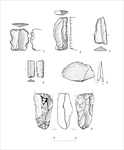
The tool assemblage comprises a range of types (Table 2), most identified as ad-hoc industries with a wide chronological range. Rare datable items include three sickle blades from Area A, a fan scraper fragment from Area D, and three bi-facial tool fragments from Areas B–D. Two of the three sickle blades are of the ‘large geometric’ type (Rosen 1997:50–57), manufactured on a wide blade or flake, their back formed by two notches (Fig. 19:1), or with a natural back (Fig. 19:2) and a truncation. Blade 1 was formed on local brown-gray flint, and its active edge is finely denticulated, while Blade 2 was formed on pinkish flint of unknown origin, and its active edge was denticulated after the gloss was generated, by adding two notches. Sickle blades of this type are characteristic of flint industries from the Middle Bronze to the Iron Ages. The third sickle blade (Fig. 19:4) was formed on a primary blade, and it has one truncated and one broken edge, its active edge formed by fine ventral denticulation. Such blades have a wide chronological range (Rosen 1997:44–60), primarily typical of Chalcolithic-period industries but also present in low frequencies in Bronze Age industries. One similar flint item (Fig. 19:3) has no sheen, and was probably unfinished or little used (Table 2: Other). The tool fragment identified as a fan scraper (Fig. 19:5) has calcareous cortex and fine, semi-abrupt retouch around most of its circumference. Scrapers of this type are usually manufactured from flat flakes with cortex, bearing uniform retouch on their circumference, and they characterize Chalcolithic and Early Bronze Age flint industries (Rosen 1997:71–80; Zutovski et al. 2016). Two bi-facial axes were found in Areas B and D (Fig. 19:6) and a bi-facial adze came from Area C. All were broken and poorly preserved, their active edges sufficiently worn to distort their shape, attesting to post-deposition wash and erosion. These tool types are characteristic of the Neolithic and Chalcolithic periods, and were probably secondarily deposited here.
The small flint assemblage mainly represents industries with a wide chronological range, and the medium wear-level attests to post-depositional processes that the assemblage underwent, such as wash and transport, or to its being exposed, at least partially, to sun and rain. The presence of two geometric sickle blades in Area A supports activity in this area during the Middle Bronze Age, whilst the possibility of earlier industries was identified in the end-scraper fragment and in the third sickle blade, which is not geometric. The poor preservation state of the bi-facial tools from Areas B–D attests to their not being in situ. Perhaps they should be attributed to the extensive Neolithic site uncovered at Bir el-Maksur in recent years (Malinsky-Buller et al. 2013).
Conclusion
The settlement at Bir el-Maksur began in the Middle Bronze Age next to the spring. Contemporary nearby sites (within 4–6 km radius) include Tel Shimron (Alexandre 2015), ‘En Ẓippori (Milevski and Getzov 2014) and Yiftaḥel (Braun and Barda 2003:90–91), but it is not possible to specifically associated these sites to Bir el-Maksur. The stone layer uncovered in Area D with Iron Age IIB pottery indicates that there was a site here, possibly associated with the nearby Iron Age IIA–IIB settlement at Ḥorbat Ofrat (Alexandre 2019:108), whilst Iron Age I–II finds were also discovered at Tel Ḥannaton (Gal 1990:39, Site 1.38), located c. 4 km southeast of the site. The remains of a Persian-period building were uncovered in Area C. Persian-period pottery retrieved at Ẓippori includes imported Black-Glazed Attic wares, the excavators suggesting that there may have been an administrative center here, supervising trade from Greece (Meyers and Meyers 2009:140–141). A site founded at the beginning of the Persian period at Tel Gil‘am, c. 12 km northwest of Bir el-Maksur (Stern 1970), also yielded imported vessels. The imported vessels retrieved at Tel Gil‘am, Bir el-Maksur and Ẓippori may attest to trade relations along the main ‘Akko–Jezreel valley road (Stern 1970:53). It is possible that Bir el-Maksur was a satellite-site of Tel Gil‘am, controlling agricultural areas next to Naḥal Yiftaḥel. Fragmentary Roman-period building remains were exposed, and the Roman-period pottery uncovered on the lime floor in Area B, is similar to pottery retrieved at the third–fourth century CE settlement at Ḥorbat Ofrat (Peleg 1990:91–92: Plan 1; Alexandre 2019:16–19), the Bir el-Maksur settlement remains, possibly associated with the settlement at Ḥorbat Ofrat in this period.
References
Abu Zedan F. and Mitler I. 2014. Bir el-Maksur. HA–ESI 126. https://doi.org/10.69704/jhaesi.116.2004.8544
Adan-Bayewitz D. 1993. Common Pottery in Roman Galilee: A Study of Local Trade. Ramat-Gan.
Alexandre Y. 2015. Tel Shimron (West). HA–ESI 127. https://doi.org/10.69704/jhaesi.116.2004.24891
Alexandre Y. 2018. Ḥorvat ‘Ofrat in the Late Hellenistic, Roman and Byzantine Periods. ‘Atiqot 92:1–68. https://doi.org/10.70967/2948-040X.1973.
Alexandre Y. 2019. Iron Age to Mamluk Periods at Ḥorvat ‘Ofrat. ‘Atiqot 95:65–114. https://doi.org/10.70967/2948-040X.2042
Barda L. and Braun E. 2003. Tomb 1 of the Second Millennium BCE at Yiftaḥel, Lower Galilee. ʻAtiqot 44:67–95. https://doi.org/10.70967/2948-040X.2386
Ben-Ami D. 2012. The Iron Age II (Strata VIII–VII). In A. Ben-Tor., D. Ben-Ami and D. Sandhaus. Hazor VI: The 1990–2009 Excavation, The Iron Age. Jerusalem. Pp. 154–285.
Ben-Tor A., Ben-Ami D. and Livneh A. 2005. Yoqne‘am III: The Middle and Late Bronze Ages; Final Report of the Archaeological Excavations (1977–1988) (Qedem Reports 7). Jerusalem.
Ben-Tor A. and Bonfil R. 2003. The Stratigraphy and Pottery Assemblages of the Middle and Late Bronze Ages in Area A. In A. Ben-Tor, R. Bonfil and S. Zuckerman. Tel Qashish: A Village in the Jezreel Valley; Final Report of the Archaeological Excavations (1978–1987) (Qedem Reports 5). Jerusalem. Pp. 185–276.
Bonfil R. 2003. Pottery Typology of the Middle Bronze Age II and Late Bronze Age. In A. Ben-Tor, R. Bonfil and S. Zuckerman. Tel Qashish: A Village in the Jezreel Valley; Final Report of the Archaeological Excavations (1978–1987) (Qedem Reports 5). Jerusalem. Pp. 277–318.
Bonfil R. 2019. Middle Bronze Age IIB–C. In S. Gitin ed. The Ancient Pottery of Israel and its Neighbors: From the Middle Bronze Age through the Late Bronze Age 3. Jerusalem. Pp. 77–136.
Díez Fernández F. 1983. Cerámica común romana de la Galilea: Aproximaciones y diferencias con la cerámica del resto de Palestina y regiones circundantes. Madrid.
Ekshtain R., Malinsky-Buller A., Ilani S., Segal I. and Hovers E. 2014. Raw Material Exploitation around the Middle Paleolithic Site of ‘Ein Qashish. Quaternary International 331:248–266. https://doi.org/10.1016/j.quaint.2013.07.025
Ekshtain R., Ilani S., Segal I. and Hovers E. 2017. Local and Nonlocal Procurement of Raw Material in ‘Amud Cave, Israel: The Complex Mobility of Late Middle Paleolithic Groups. Geoarchaeology 32/2:189–214. https://doi.org/10.1002/gea.21585
Feig N. and Hadad S. 2015. Roman Burial Caves at ‘Ibllin. ‘Atiqot 83:93–124. https://doi.org/10.70967/2948-040X.1705
Finkielsztejn G. 2007. ‘Akko, Remez Street. HA–ESI 119. https://doi.org/10.69704/jhaesi.116.2004.492
Gal Z. 1990. Lower Galilee: Historical Geography in the Biblical Period. Tel Aviv (Hebrew).
Gal Z. and Alexandre Y. 2000. Ḥorbat Rosh Zayit: An Iron Age Storage Fort and Village (IAA Reports 8). Jerusalem. https://doi.org/10.2307/j.ctt1fzhfg1
Malinsky-Buller A., Aladjem E., Givol-Barzilai Y., Bonnes D., Goren Y., Yeshurun R. and Birkenfeld M. 2013. Another Piece in the Puzzle – A New PPNA Site at Bir el-Maksur (Northern Israel). Paléorient 39/2:155–172. https://doi.org/10.3406/paleo.2013.5525
Marchese R.T. 1989. Aegean and Cypriote Imports in the Persian Period (Strata XI–VI). In Z. Herzog, G. Rapp Jr. and O. Negbi eds. Excavations at Tel Michal, Israel (Tel Aviv University Institute of Archaeology Monograph Series 8). Minneapolis–Tel Aviv. Pp. 145–152.
Meyers E.M. 2013. Additional Roman Pottery. Roman Pottery. In E.M. Meyers and C.L. Meyers eds. The Pottery from Ancient Sepphoris (Duke Sepphoris Excavation Reports I). Winona Lake. Pp. 130–141. https://doi.org/10.5325/j.ctv1bxh4tm.6
Meyers E.M. and Meyers C.L. 2009. The Persian Period at Sepphoris. Eretz Israel 29:136–143.
Milevski I. and Getzov N. 2014. ‘En Zippori. HA–ESI 126. https://doi.org/10.69704/jhaesi.116.2004.13675
Mullins R.A. 2007. The Late Bronze Age Pottery. In A. Mazar and R.A. Mullins eds. Excavations at Tel Beth-Shean 1989–1996 II: The Middle and Late Bronze Age Strata in Area R (The Beth-Shean Valley Archaeological Project 2). Jerusalem. Pp. 390–547.
Peleg M. 1990. Excavations at Ḥorvat ‘Ofrat (Kh. et-Taiyiba). ‘Atiqot 10:9–91 (Hebrew; English summary, p. 19*).
Reich R. 1982. A Decorated Roman Tomb near Ben Shemen. ‘Atiqot: Hebrew Series 8:16–21 (Hebrew; English summary, pp. 2*–3*).
Rosen S.A. 1997. Lithics after the Stone Age: A Handbook of Stone Tools from the Levant. Walnut Creek, CA.
Shalev Y. 2014. “The Mighty Grain Lands”: Demographic and Economic Aspects of “Southern Phoenicia” under the Achaemenid Regime. Ph.D. diss. University of Haifa. Haifa (Hebrew; English abstract).
Shalev Y. 2015. The Early Persian Period Pottery. In. E. Mazar ed. The Summit of the City of David, Excavations 2005–2008; Final Reports I: Area G. Jerusalem. Pp. 203–242.
Sparkes B.A. and Talcott L. 1970. Black and Plain Pottery of the 6th, 5th and 4th Centuries B.C. (Athenian Agora XII). Princeton. https://doi.org/10.2307/3601977
Stern E. 1970. Excavations at Gil‘am (Kh. er-Rujm) ’Atiqot: Hebrew Series 6:31–55 (Hebrew; English summary, pp. 4*–6*).
Stern E. 1978. Excavations at Tel Mevorakh (1973–1976) I: From the Iron Age to the Roman Period (Qedem 9). Jerusalem.
Stern E. 1995. Local Pottery of the Persian Period. In E. Stern ed. Excavations at Dor; Final Report I, B: Areas A and C. The Finds (Qedem Reports 2). Jerusalem. Pp. 51–92.
Stern E. 2015. Persian Period. In S. Gitin ed. The Ancient Pottery of Israel and its Neighbors from the Iron Age through the Hellenistic Period II. Jerusalem. Pp. 565–617.
Tushingham A.D. 1985. Excavations in Jerusalem 1961–1967 I. Toronto. https://doi.org/10.1163/9789004671607
Vos M.F. 1972. Corpus Vasorum Antiquorum: The Neatherland, Fasc 3, Leiden Rijksmuseum van Oudheden fasc i. Leiden.
Yaroshevich A. 2013. Bir el-Maksur. HA–ESI 125. https://doi.org/10.69704/jhaesi.116.2004.3338
Zarzecki-Peleg A. 2005. Stratigraphy and Architecture. In A. Ben-Tor, A. Zarzecki-Peleg and S. Cohen-Anidjar. Yoqne‘am II: The Iron Age and the Persian Period; Final Report of the Archaeological Excavations (1977–1988) (Qedem Reports 6). Jerusalem. Pp. 5–232.
Zutovski K., Yerkes R.W., Agam A., Wilson L., Getzov N., Milevski I. and Gopher A. 2016. A Techno-Typological Analysis of Fan (Tabular) Scrapers from Ein Zippori, Israel. Journal of Lithic Studies 3/1:207–238. https://doi.org/10.2218/jls.v3i1.1454
Keywords
working surface, silo, attic ware, remains of a settlement from the MB II Age, remains of a settlement from the Iron 2 Age, remains of a settlement from the Persian period, remains of a settlement from the Roman period
Publication Date
08/06/2026
Report Type
Final Report