
Kafr Kanna (A-4240, A-4369)
Permit/License Number
A-4240, A-4369
Excavation Report
During June 2004 and February–March 2005, trial and salvage excavations were carried out at Kafr Kanna (Permit Nos. A-4240, A-4369, respectively; map ref. 231750/739250), before construction. The excavations, on behalf of the Israel Antiquities Authority, were directed by Karen Covello-Paran and Howard Smithline (field photography), with the assistance of Y. Laban (administration), N. Getzov (protohistoric pottery), E.J. Stern (Mamluk pottery), U. Ben Zioni (general assistance), V. Essman and V. Pirsky (surveying and drafting), D. Porotsky (final plan preparation), H. Tahan-Rosen (drawing of finds), P. Spivak (flint analysis and drawing), Z. Turgeman-Yaffe (archeozoological analysis; Appendix), V. Raisa (coin cleaning), D.T. Ariel (numismatics) and workers from Nazareth, Nof Ha-Galil and Kafr Manda. Special thanks are due to Nimrod Getzov for scientific guidance with the pottery and the interpretation of the protohistoric finds.
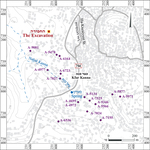
The excavation was located 500 m northwest of the perennial Kanna Spring (Fig. 1), where previous excavations uncovered remains dated to the Pre-Pottery and Pottery Neolithic, Early Chalcolithic, Late Chalcolithic, Early Bronze Age IA and the Intermediate Bronze Age (Covello-Paran 2013 [Fig. 1: A-6536]; 2015a [Fig. 1: A-5877]; 2015b [Fig. 1: A-5971]; Be’eri 2015 [Fig. 1: A-7155]; Bron 2020 [Fig. 1: A-7525]; van den Brink 2019 [Fig. 1: A-7827]; van den Brink et al. 2022 [Fig. 1: A-7827]; Shatil 2024 [Fig. 1: A-8832]; Permit Nos. A-4977, A-5134, A-5346, A-5566, A-6723, A-7024, A-9081).
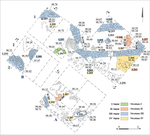
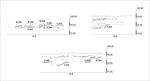
Four adjoining excavation squares (A–B/1–2; 4 × 4 m each; Figs. 2, 3) were opened, in which four strata (IV–I) were exposed, reaching varying depths of the archaeological deposits (1.0–1.3 m) due to the sloping bedrock. In situ architectural remains were uncovered from the Pottery Neolithic (Stratum IV) and Early Chalcolithic II (Stratum III) periods, as well as the Intermediate Bronze Age (Stratum II), while the uppermost deposits (Stratum I) consisted of stream overflow containing finds dated to the Mamluk and post-Mamluk period. In addition, potsherds dating to the Roman, Mamluk and Ottoman periods (not illustrated) were retrieved from topsoil. All excavated sediments were dry-sieved through 5 and 10-mm mesh screens.
Stratum IV
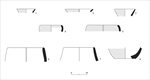
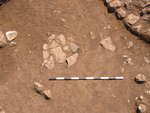
At the lowest level of the excavation, several stone surfaces or floorings (L266, L267, L287, L292; Figs. 4, 5) overlay sterile soil or bedrock and underlay the Stratum III architecture; the small exposed area precluded clarification of the nature of the surfaces. In situ accumulations atop bedrock (L265, L295; Figs. 6, 7) are assigned to Stratum IV and comprised moist soil, loamy soil chunks and phytolith patches. Potsherds retrieved from these contexts date to the Pottery Neolithic period and are characterized by Jericho IX Ware, including small bowls or cups with red-brown slip on the exterior (Fig. 8:1–3), deep bowls with red slip (Fig. 8:4, 5) and coarse ware storage jars with a converging neck (Fig. 8:6, 7) and a flat base (Fig. 8:8). This assemblage has close affinities to pre-Stratum II material at the nearby site of Yiftah’el (Braun 1997:124).
Stratum III
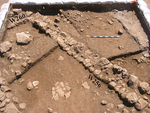
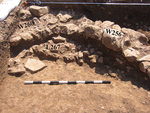
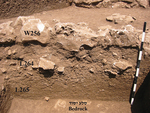
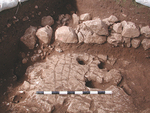
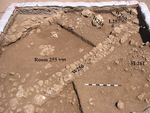
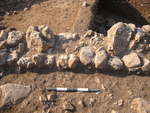
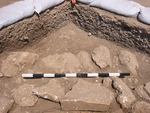
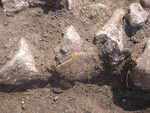
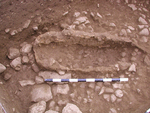
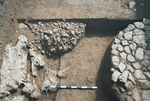
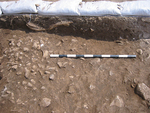
This stratum yielded the best-preserved building remains in the excavation, lying directly below the Stratum II features (Fig. 9). A well-preserved building comprised a completely exposed, large elongated narrow room (L255) enclosed by four walls (W253, W256, W260 and W278), a courtyard (L264) and part of an additional room of the same unit west of Room 255, of which one wall segment was exposed (W284); the latter wall segment may have abutted W278 of Room 255. An entrance was detected in W256 (Fig. 10). The walls are all constructed from two rows of medium–large stones with smaller filler stones in-between them, above which stood a superstructure of orange bricks as indicated by collapsed brick material found just north of W253 (L252; Fig. 11), as well as isolated bricks exposed throughout the excavation area and in trench probes dug before the excavation. The basal elevation of W256 was higher near its corner with W260 on account of the presence of Stratum IV remains in this area, indicating a lack of extensive leveling before construction. The inner stone row of W256 was partially lined with potsherds of large pithoi (Fig. 12). In the center of Room 255 was a circular stone installation (L263) with a flat stone laid in the center, which, according to the signs of intense heat on the limestones, must have functioned as a hearth (Fig. 13). The floor of Room 255 comprised hard-packed earth.
South of W256 and west of W278, were stone floors (L264, L297), and also exposed was an oval-shaped clay-lined installation (L299) directly overlying Stratum IV Floor 287 (Fig. 14). Two additional stone features (Sq. B2: L293, L301) stood directly atop the rising bedrock in this part of the excavation (Fig. 15).
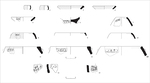
The Stratum III pottery assemblage includes small bowls (Fig. 16:1, 2); open bowls with straight or rounded red-slipped walls (Fig. 16:3–5); a large, thick-walled chalice with thumb-impressed rope decoration at the join between the base and bowl (Fig. 16:6); holemouth jars, some with thumb-impressed bands (Fig. 16:7–10); and pithoi with thick, flat rims and thumb-impressed handles below the rim (Fig. 16:11–13). This assemblage fits into the recently defined ‘En Esur culture of the Early Chalcolithic II period, identified at ‘En Esur (Asawir) Stratum VIIa and ‘En Zippori (Shalem and Getzov 2023).
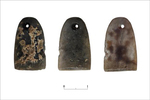
Also found was a broken perforated obsidian pendant or bead from Room 255 (Fig. 17).
Stratum II
Fragmentary architectural remains dating to the Intermediate Bronze Age include short wall segments (W258, W280) and floors (L257, L261, L268). Wall 258 was constructed from a single row of large stones (width 0.6 m) and abutted on both sides by small floor patches made of hard-packed earth and small stones (L257, L268). The similarly made Floor 261, which yielded large quantities of potsherds (Fig. 18) and a Canaanean sickle blade (below), is most likely connected to the same structure.
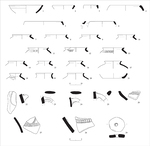
The pottery assemblage comprises a typical domestic repertoire of the Intermediate Bronze Age, notably comprising types associated with food processing, serving and storage. The finds include open bowls (Fig. 19:1, 2), one with exterior riling (Fig. 19:1); deep bowls (Fig. 19:3, 4); a holemouth jar (Fig. 19:5); and a spouted holemouth jar (Fig. 19:6). The cooking pots (Fig. 19:7–13) are globular with an outturned rim, frequently bearing thumb-impressed bands attached at the base of the neck (Fig. 19:11–13). The storage jars have short everted necks (Fig. 19:14–18) or longer more upright necks (Fig. 19:19–20) and a flat base (Fig. 19:21). The handles of the closed vessels include folded envelope handles (Fig. 19:22), flat loop handles (Fig. 19:23, 24) or triangular-sectioned lug handles typical of amphoriskoi (Fig. 19:25). The decoration of the storage vessels included oblique incisions (Fig. 19:18, 26), combing (Fig. 19:27) and applied rope decoration (Fig. 19:28). Among the finds from Stratum II is a spindle whorl (Fig. 19:29) fabricated from a recycled potsherd. The pottery assemblage is comparable to contemporary domestic and funerary assemblages from Lower Galilee, such as those at Horvat Qishron (Smithline 2002) and Horvat Zelef (Covello-Paran 2011). A single identified pig bone (below) was retrieved from this stratum (Appendix 1).
Also found in earth accumulations were two sherds (Fig. 16:14, 15) of typical Wadi Rabah decoration of incisions and impressions. They are most likely associated with an Early Chalcolithic I settlement outside the excavated area.
Stratum I
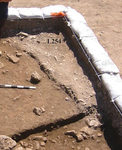
Stratum I comprises a single architectural feature—a stone-built circular installation (L291)—and demonstrates evidence of the impact of stream activity (L254; Fig. 20) in the form of size-sorted small pebbles, many worn Mamluk-period pottery sherds (fourteenth–fifteenth centuries CE) and a few animal bones. Hence, Installation 291 is attributed to the Mamluk-period occupation of this part of the site. Two residual coins retrieved from L291 consist of a Hasmonean bronze of Alexander Jannaeus (104–76 BCE; IAA 111915) and a small Byzantine-period cast bronze minima dated to the fifth–sixth centuries (IAA 111914).
Nine additional ex situ coins found in different parts of the excavation are dated to the Hellenistic, Late Roman and Mamluk periods: a bronze coin dating to the reign of Antiochus III (198–187 BCE; IAA 111913); four Hasmonean-period prutot (IAA 111906, 111910, 111911, 111916); a bronze from the time of Herod’s reign (37–4 BCE; IAA 111912); a billon Antoninianus of the reign of Roman Emperor Numerian (283–294 CE; IAA 111907); a ‘Late Roman-period’ type bronze dated to the fifth–sixth centuries CE (IAA 111908); and a Mamluk-period fals dated to the fifteenth century (IAA 111909).
The Flint
Polina Spivak
A total of 2065 flint artifacts were collected in the excavation (Table 1). The flint was analyzed according to the excavation squares, combining the finds from Sqs A2, B1 and B2 into one sub-assemblage and those from Sq A1 into another. The Sq A1 material was kept separate due to its well-differentiated in situ loci, potentially offering a more secure identification of the chronology of this assemblage. In total, 58 tools were identified, of which 19 are sickle segments diagnostic of the Pottery Neolithic and Chalcolithic periods, as well as the Early to Intermediate Bronze Ages.
Raw Material. The flint assemblage is quite uniform in terms of the raw material. Almost all items were made of opaque yellowish-gray flint, sometimes with pink or yellow veins, commonly found in Eocene outcrops in the region (Sneh, Bartov and Rosensaft 1998; Ekshtain et al. 2014). All the flint edges are sharp, indicating minimal exposure to post-depositional processes.
Square A1. Three small assemblages were retrieved from stratigraphically secure loci in Sq A1 from Strata IV (L265), III (L255) and II (L261). All assemblages contain debris and debitage, indicating in situ knapping, dominated by flake production.
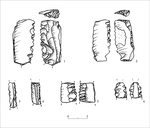
Locus 255 (Stratum III) yielded as many as 12 tools (4.4% of the assemblage), of which six are diagnostic. Four sickle blades were found, of which two are simple Chalcolithic sickles made on prismatic blades, each having one lustrous working edge (Rosen 1997:49–51); of the latter two, one is backed and truncated (Fig. 21:3) as with another example retrieved from Sq B1 (see below, Fig. 21:4). The two other sickles are residual Pottery Neolithic items, characterized by their backed, truncated and rectangular forms, with a denticulated, glossy working edge. One was fashioned by bifacial pressure retouch (Type A; Gopher 1989:95) and the other with coarse denticulation (Type C; Gopher 1989:95). Two additional tools are a medial fragment of a pressure retouched blade and a distal fragment of a truncated blade.
Six non-diagnostic ad hoc tools include three retouched blades, two perforators and one notch. One of the perforators and the notch are made on core tablets. Although no CTEs were retrieved in this assemblage, three small and extremely utilized cores were identified, which testify to in situ knapping. The three cores present hinges and other scars of unsuccessful sporadic removals from multiple striking surfaces.
Only a few tools were retrieved from Loci 265 (Stratum IV) and 261 (Stratum II). The former sample contained three ad hoc tools, including a small perforator and two truncated pieces. The latter sample included a single tool, a fragment of a bilaterally glossed sickle segment, possibly made on a Canaanean (or Canaanean-like) blade, widely associated with the Early–Intermediate Bronze Ages.
Squares A2, B1 and B2. The material in this assemblage was retrieved mostly from small-stone surfaces of occupational Strata IV–II (above). A total of 1722 (Table 1) flints were found. The number of debris pieces, chips (N = 144) and chunks (N = 806), in the assemblage is substantial, indicating in situ flint knapping at the site. As a considerable portion of the chunks bear fire-cracking signs, some pieces in the chunk category may be the result of exposure to fire rather than knapping.
The debitage includes pieces from all basic components of the reduction sequence. There is a significant presence of primary elements (cortical flakes and blades; N = 180 and N = 13, respectively), indicating that the initial flaking was executed on site. Pieces from subsequent stages of reduction comprise the flakes (N = 349), blades (N = 26), bladelets (N = 7), core trimming elements (CTEs; N = 12) and cores (N = 14).
All the cores are small and exhausted. In eight of the cores, blank removals, mostly those of flakes, were made from all directions, resulting in amorphous cores with multiple striking platforms, typical of ad hoc production. Three small cores (<4 >cm) have one striking platform. Three flat cortical items bearing isolated knapping scars are best described as tested nodules. While most cores exhibit unstandardized flake scars, the CTEs, comprising four ridge blades, seven blade-scarred core spalls and a core tablet, indicate more complex blade manufacture. The presence within the debitage category of large blades (max. 15 cm long) with 2–4 unidirectional blade scars on their backs, as well as primary blades, also indicates local blade-oriented production.
The tools (N = 42) are composed of two main categories: formal tools, e.g., sickle blades and bifacial tools (N = 58); and ad hoc tools (N = 26). Among the formal tools, the sickle blades (N = 14) are the most chronologically diagnostic. Four of the sickles are backed—one with partial backing—and truncated; they are either rectangular (N = 3) or trapezoidal (N = 1) in shape. They vary in width (1.5–2.5 cm) and present a single working edge bearing gloss that is denticulated coarsely (N = 2; Fig. 21:1) or finely (N = 2; Fig. 21:2). These sickles correspond with the Pottery Neolithic Types C and D defined by Gopher (1989:95). Another four sickles have a single, lustrous plain or nibbled working edge; they are either backed or have a plain opposite edge and are delicate and narrow (0.7–1.2 cm wide; Fig. 21:4). These are commonly referred to as simple Chalcolithic sickles (Rosen 1997:49–51; Shimelmitz and Mendel 2008:233). Three small medial fragments represent sickles with the working edges retouched by bifacial pressure, corresponding to Crowfoot-Payne’s (1983:708–709) and Gopher’s (1989:95) Pottery Neolithic Type A. Two of those items have a single gently denticulated working edge (Fig. 21:5). One of the items is a fragment of a narrow (1.4 cm), bilaterally denticulated sickle (Fig. 21:6), possibly indicative of the Early Yarmukian phase of the Pottery Neolithic period. Similar pieces were recently reported from the Yarmukian site at Nahal Zippori III (Barzilai et al. 2016). The remaining three items are too fragmentary and damaged to be classified further securely. Two medial fragments of bifacial tools, a chisel and an axe, were made using pressure retouch on all faces and bear no signs of polish.
The ad hoc tools are generally made on flakes. Scrapers/end-scrapers (N = 10) are the largest tool group within this category, followed by perforators (N = 6), notches/denticulates (N = 5), retouched flakes (N = 4) and one truncated primary blade.
Summary and Discussion. The flint assemblage from Kafr Kanna presents local manufacture. The three periods, as evidenced by the ceramic assemblages from Strata IV–II, are also demonstrated by the flints, although only a few of the chronologically diagnostic items occur in their expected stratigraphic context. The presence of ad hoc tool types is noted in all three strata. Diagnostic pressure-flaked pieces are indicative of the Pottery Neolithic period, while sickles of both Types C and D are known to have been found together at many Early Chalcolithic Wadi Rabah sites in the region, such as Tel Dover (Khalaily et al. 2016), Munhata Level 2a (Gopher 1989) and Naḥal Zehora I and II (Barkai and Gopher 1999). The finely denticulated sickles are not as diagnostic as the other types since they seem to have continued from the Pottery Neolithic well into the Chalcolithic period (Rosen 1997:140), when they occurred together with the simple Chalcolithic-period sickles (Barkai and Gopher 1999:69). Based on the flint assemblage, it seems that the site was occupied during both the Pottery Neolithic and Chalcolithic periods. During this time span, the sickle blades underwent changes in shape and technology in response to the evolving economy, particularly in accordance with the demands of agro-technology. The Early–Intermediate Bronze Ages appear to be represented by a fragment of a bilaterally glossed sickle segment that was possibly made on a Canaanean blade.
The Fauna
Zohar Turgeman-Yaffee
The excavations yielded very few identifiable animal remains of poor preservation, one specimen from Stratum II and six from Stratum III (Appendix 1). The assemblage was studied using the methods described by Lyman (1994; 2008). It comprised household animals, including pigs (Sus scrofa), ovicaprines (sheep, Ovis aries; goat, Capra hircus) and cattle (Bos taurus; see Appendix). Two unidentifiable specimens were assigned to the size class of ‘medium ungulate.’ The skeletal parts featured in the assemblage represent both meat-rich and meat-poor parts. The demographic indicators retrieved from four specimens reveal the presence of a medium-sized ungulate under two years of age and another three adult individuals, a pig and two ovicaprines.
Conclusion
The excavations revealed evidence of protohistoric settlements that developed in close proximity to one another, due to their location near the spring of Kafr Kanna. Although no substantial architectural remains were uncovered in the earliest occupation (Stratum IV), dated to the Pottery Neolithic period, the sparse remains indicate that the occupants from this period settled directly above the bedrock or sterile soil; they probably cultivated the nearby fertile lands, as evidenced by the finding of sickle blades used for harvesting. While flint artifacts dating to the Pre-Pottery Neolithic period were previously retrieved by H. Smithline in his excavations adjacent to Kanna Spring (Fig. 1: A-4695, A-4972), it appears that this earlier site did not extend to the location of the present excavation.
Following a gap in occupation, the excavated area of the site was resettled during the Early Chalcolithic II period, attested by the Stratum III building. The flint artifacts from this stratum, such as the sickle blades and the faunal remains, indicate a village-based agro-pastoral economy. Considering contemporary installations previously exposed c. 800 m to the southeast of the present excavation (Covello-Paran 2015b; Fig. 1: A-5971), the Early Chalcolithic II settlement at Kafr Kanna must have extended over a large area. The attribution of the unearthed material to the ʽEn Esur culture of this period (Shalem and Getzov 2023) contributes to the reconstruction of settlement networks and cultural connections during this period. There was no evidence of Late Chalcolithic settlement in the excavated area, yet this period is known from previous excavations 400 m south of the current excavation (see also Fig. 1: A-7827).
The fragmentary domestic architectural remains of the Intermediate Bronze Age settlement (Stratum II) are a noteworthy addition to the sparse remains of this period known from two other excavations (Fig. 1: A-5346, A-9081). The spatial distribution of the known remains from this period suggests that the settlement was not densely populated and extended both north and southeast of Kanna Spring. Recent excavations at a site dubbed Kafr Kanna North, an IBA settlement located approximately 1.5 km northeast of the present excavation site, revealed better-preserved architectural remains than those uncovered in the present excavation (Covello-Paran 2024). However, it remains unclear whether these two adjacent sites are truly contemporary or instead represent different temporal phases (i.e., a case of horizontal stratification).
No later architectural or settlement remains were uncovered in the excavation. The absence of remains spanning the Iron Age to the Byzantine period indicates that the excavation was beyond the settlement boundaries of the site of Karm er-Ras, due west of the current excavation that was occupied during those periods (Alexandre 2008). The Stratum I installation and finds suggest that this area had sparse human activity at this time. The evidence of stream activity indicates periodic inundation during and after the Mamluk period. Similar findings were documented in other excavations 200 m to the south (Alexandre 2009 [Fig. 1: A-5478]; 2012 [Fig. 1: A-6164]).
The findings from the excavation significantly contribute to our understanding of the proto-historic settlement in Kafr Kanna, adding further to the information that is mainly available from previous excavations near Kanna Spring. The evidence suggests that this area was abandoned by the conclusion of the third millennium BCE. Subsequently, the excavation area became an open expanse situated between the neighboring sites of Karm er-Ras to the west of the spring and Kafr Kanna to its east.
References
Alexandre Y. 2008. Karm er-Ras (Areas A, B). HA-ESI 120. https://doi.org/10.69704/jhaesi.116.2004.600
Alexandre 2009. Kafr Kanna. HA-ESI 121. https://doi.org/10.69704/jhaesi.116.2004.992
Alexandre Y. 2012. Kafr Kanna. HA-ESI 124. https://doi.org/10.69704/jhaesi.116.2004.1937
Barkai R. and Gopher A. 1999. The Last Neolithic Flint Industry: A Study of the Technology, Typology and Social Implications of the Lithic Assemblage from Nahal Zehora I, A Wadi Raba (Pottery Neolithic) Site in the Menashe Hills, Israel. JIPS 29:41–122. https://doi.org/10.61247/s381128
Barzilai O., Brink E.C.M. van den, Vardi J., and Liran R. 2016. The Yarmukian Site at Tel Mitzpe Zevulun North (Nahal Zippori 3) Lower Galilee, Israel. In S. Ganor, I. Kreimerman, K. Streit and M.K. Mumcuoglu eds. From Sha‘ar Hagolan to Shaaraim: Essays in Honor of Prof. Yosef Garfinkel. Jerusalem. Pp. 19–40.
Be’eri R. 2015. Kafr Kanna. HA-ESI 127. https://doi.org/10.69704/jhaesi.116.2004.24885
Braun E. 1997. Yiftaḥ’el: Salvage and Rescue Excavations at a Prehistoric Village in Lower Galilee, Israel (IAA Reports 2). Jerusalem. https://doi.org/10.2307/j.ctt1fzhdrp
Brink E.C.M. van den. 2019. Kafr Kanna. HA-ESI 131. https://doi.org/10.69704/jhaesi.116.2004.25524
Brink E.C.M. van den, Roux V., Shapiro A. and Shemer M. 2022. Late Chalcolithic and Early Bronze Age IA Settlement Remains at Kafr Kanna, Lower Galilee. ‘Atiqot 108:1–45. https://doi.org/10.70967/2948-040X.1141
Bron H. 2020. Kafr Kanna (South). HA-ESI 132. https://doi.org/10.69704/jhaesi.116.2004.25812
Covello-Paran K. 2011. A Rock Cut Burial Tomb from the Early, Intermediate and Late Bronze Ages near Horbat Zelef. ‘Atiqot 68:1–46. https://doi.org/10.70967/2948-040X.1438
Covello-Paran K. 2013. Kafr Kanna. HA-ESI 125. https://doi.org/10.69704/jhaesi.116.2004.2211
Covello-Paran K. 2015a. Kafr Kanna (A). HA-ESI 127. https://doi.org/10.69704/jhaesi.116.2004.16744
Covello-Paran K. 2015b. Kafr Kanna (B). HA-ESI 127. https://doi.org/10.69704/jhaesi.116.2004.24866
Covello-Paran K. 2024. Rural Complexity in the Intermediate Bronze Age: Settlement Patterns and Intrasite Spatial Organization in Lower Galilee. ‘Atiqot 115:23–47. https://doi.org/10.70967/2948-040X.1001
Crowfoot-Payne J. 1983. The Flint Industries of Jericho. In K.M Kenyon and T.A. Holland eds. Excavations at Jericho V: The Pottery Phases of the Tell and Other Finds. Oxford. Pp. 622–759.
Ekshtain R., Malinsky-Buller A., Ilani S., Segal I. and Hovers E. 2014. Raw Material Exploitation around the Middle Paleolithic Site of ‘Ein Qashish. Quaternary International 331:248–266. https://doi.org/10.1016/j.quaint.2013.07.025
Gopher A. 1989. The Flint Assemblages of Munhata (Israel): Final Report (Les Cahiers du Centre de Recherches Français de Jerusalem 4). Paris.
Khalaily H., Milevski I., Horwitz L.K. and Marder O. 2016. Early Wadi Rabah and Chalcolithic Occupations at Tel Dover: Environmental and Chronological Insights. In S. Ganor, I. Kreimerman, K. Streit, M. Mumcuoglu M. eds. From Sha‘ar Hagolan to Shaaraim: Essays in Honor of Prof. Yosef Garfinkel. Jerusalem. Pp. 109–154.
Lyman R.L. 1994. Vertebrate Taphonomy. Cambridge. https://doi.org/10.1017/CBO9781139878302
Lyman R. L. 2008. Quantitative Paleozoology. Cambridge. https://doi.org/10.1017/CBO9780511813863
Rosen S.A. 1997. Lithics after the Stone Age: A Handbook of Stone Tools from the Levant. Walnut Creek.
Shalem D. and Getzov N. 2023. ‘En Esur Culture (Early Chalcolithic II): A Suggested Definition Based on Ceramic Characteristics. JIPS 53:242–265. https://doi.org/10.61247/s803642
Shatil N. 2024. Kafr Kanna. HA-ESI 136. https://doi.org/10.69704/jhaesi.116.2004.26528
Shimelmitz R. and Mendel S. 2008. A Chalcolithic Workshop for the Production of Blades and Bi-facial tools at Khirbet Yoah, the Manasseh Hills. JIPS 38:229–256. https://doi.org/10.61247/s497261
Smithline H. 2002. An Intermediate Bronze Age Site at Horbat Qishron. In Z. Gal ed. Eretz Zafon: Studies in Galilean Archaeology. Jerusalem. Pp. 21*–46*.
Sneh A., Bartov Y. and Rosensaft M. 1998. Geological Map of Israel 1:200000. Sheet 1 (Geological Survey of Israel). Jerusalem.
Keywords
Kafr Kanna, Pottery Neolithic, Early Chalcolithic, ‘En Esur Culture, Intermediate Bronze Age, Protohistoric Architecture, Flint Sickle Blades, Agro-Pastoral Economy, Lower Galilee
Publication Date
08/06/2026
Report Type
Final Report