
Bet Shemesh, Ramat Bet Shemesh, Be’er Ḥalaf (A-6226)
Permit/License Number
A-6226
Excavation Report
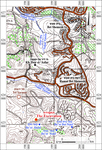
During August–September 2011, a salvage excavation was conducted north of Be’er Ḥalaf, Ramat Bet Shemesh (Permit No. A-6226; map ref. 198247–67/623164–76; Fig. 1), prior to construction of an access road to Neighborhood Gimmel 1. The excavation, on behalf of the Israel Antiquities Authority and funded by the Ministry of Housing, was directed by R. Avner, with the assistance of N. Nehama (administration), M. Kunin (surveying), B. Antin (drafting), N. Zak and I. Brin (location map), A. Peretz (field photography) and D.T. Ariel and G. Bijovsky (numismatics).
The area surrounding the excavation was previously excavated, revealing remains of a building, stone-clearance heaps, two hewn basins and an agricultural terrace. Flint items and pottery fragments from the Early Bronze Age III–II, as well as pottery fragments from the Iron Age II and the Byzantine period (Dagan 2010: 232, No. 296), have also been collected from the surrounding area.
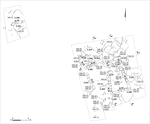
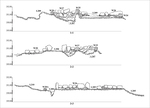
The primary finds from this excavation (15 × 18 m; Figs. 2, 3) were the remains of a building dated to the Byzantine period (fifth–seventh centuries CE). This building may have been related to the nearby central settlement at contemporary Bet Naṭif.
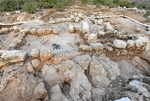
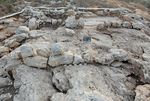
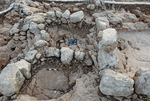
The walls of the exposed building (W20–W26; Figs. 4, 5) were built on bedrock of a single line of carelessly hewn large and medium-sized stones; they were preserved to a height of a single course, with one exception (W27)—a wall preserved to a height of two courses at the point where the level of the bedrock dropped. No floors were recognized in most of the building and the bedrock was seemingly leveled to serve as a floor. The building comprised two rooms in its eastern part (L207, L209; Fig. 6), with another adjacent space in its western part (L202, L206). Room 207 was paved with stone slabs, two of which survived in the southeastern corner. In Room 209, the doorway in the northern wall was preserved. The wall that delineated the southern boundary of the western space of the building was not found.
Another space (L200; max. dimensions 1.4 × 4.6 m), delineated by two walls (W28/W28A—length 6 m, width 0.2–0.5 m; W29—length 1.6 m, width 0.6 m) was discovered north of the building. The walls were constructed of a single line of carelessly hewn small and medium-sized stones. The discrepancy between the orientation of W28 and the building’s other walls, and the use of smaller stones in its construction lead to the conclusion that Space 200 was probably a late addition to the building.
A limited area was also excavated next to a wall that was visible on the surface (W10; length 3 m, width 0.6 m) about 11 m northwest of the building remains. This wall was set on the bedrock and preserved to a height of a single course, as were most of the walls of the nearby Byzantine-period building. Although a few ribbed pottery fragments were found in the earth that accumulated next to the wall, a survey employing aerial photographs determined it to be a modern-day wall that delineated an agricultural plot of the Arab village of Bet Naṭif in (Y. Dagan, pers. comm.).
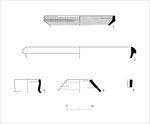
The Pottery Finds. Most of the pottery fragments found in this excavation were dated to the Byzantine period (fifth–seventh centuries CE). The finds include a Red-Slip bowl (Fig. 7:1) that has rouletted decoration and a large bowl (Fig. 7:2) with an in-turning rim that has a triangular section, both belonging to common Byzantine-period types, with several other sherds of these types found in a number of loci in the building (L206, L207, L209); a jar (Fig. 7:3) with a thickened in-turned rim; and a carelessly made Gaza jar (Fig. 7:4) with a low rim and rough surface. East of the building, close to the surface, a single ex situ pottery fragment was found: the base of an unguentarium (Fig. 7:5), typical of the Hasmonean and Herodian periods (second century BCE–first century CE).
Coins. Four coins were found in this excavation, of which only one was identified. This coin was found in an accumulation on the bedrock in Room 209 and was identified as a serrated Seleucid coin, probably from the reign of Antiochus IV (175–164 BCE; IAA 140902).
References
Dagan Y. 2010. The Ramat Bet Shemesh Regional Project: The Gazetteer (IAA Reports 46). Jerusalem. https://doi.org/10.2307/j.ctt1fzhf8x
Keywords
Ramat Bet Shemesh, Be’er Ḥalaf, Byzantine Period, Horbat Bet Naṭif, Seleucid Coin, Antiochus IV
Publication Date
08/06/2026
Report Type
Final Report