
Ramat Beqa‘, Industrial Zone (A-9087, A-9200)
Permit/License Number
A-9087, A-9200
Excavation Report
The region was first surveyed in 1980, as part of the Emergency Survey of the Negev (Eldar-Nir and Daninoo 2014: Site 2), but the areas of the excavations were only surveyed in 2015 (Permit No. S-575/2015). The 2015 survey identified 1498 remains and defined 36 sites, dating to the prehistoric and historic periods known in the Negev. The surveyed area encompasses high and lower hills, steep slopes, narrow and wide wadis and flat areas, and it seems that the location of the exposed sites is related to the varied topography. A nearby excavation in 2020 uncovered remains of a dam, agricultural terraces, an agricultural booth, stone installations and scattered flint (Sapir 2022); the limited finds precluding dating the remains, apart from the flint that was dated to the Early Bronze Age. Two salvage excavations conducted in the vicinity in 2025 and 2026 (Permit Nos. A-10123, A-10154) uncovered farmhouses from the Byzantine and Early Islamic periods and flint scatters from the Middle Paleolithic to the Chalcolithic periods.
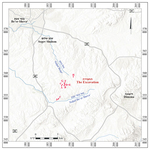
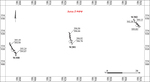
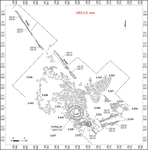
Ten areas (A–J; Fig. 1) were opened in the current excavations. Most of the remains were exposed in Areas D and E, including a water-carrying system with a diversion wall directing water to a settling pit and thence to a feeder channel, and from the channel to a cistern. Installations, field walls, cairns and dams, reflecting agricultural activity over a wide area, were found in Areas A, F–J (Appendix 1; Fig. 2), the building remains poorly preserved. The field walls and the dams were built of one or two rows of medium-sized–small fieldstones, and mostly preserved for one or two courses. Sieving was undertaken in Areas B and C to identify finds after the antiquities were damaged, but only a few Ottoman-period pottery sherds (not illustrated), and a few undatable flint items were found.
The finds in the excavations were limited, including mostly pottery sherds from the Byzantine, Early Islamic and Ottoman periods in Areas E and H, and flint items—mostly from the Chalcolithic and Early Bronze Age periods and a few from the Lower Paleolithic and Epipaleolithic periods—in Area I, indicating that a large flint-knapping area was located here. Other finds include glass and iron items.
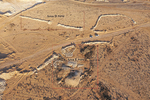
Areas D and E (Figs. 3–5)
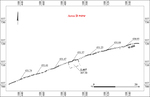
Water-diversion wall. A single-course diversion wall (W400; estimated length over 100 m), built of a row of medium-sized–small fieldstones along a northeast–southwest axis, was found. The wall was built on the middle of a low hill, the location exploiting the topography to maximize the water channeled into the cistern located at a lower point to its southeast. Two diversion walls (W501, W503) extending from W400 that curved sharply to the southeast, were found in Area E. Wall 501 (length 10.5 m, width 0.15 m) was built of a single row of large chalk stones set on their narrow side, and comprising one course, and W503 (length 11.5 m, width 0.15 m) was built from a single row of small fieldstones laid on their broad face, also composed of one course.
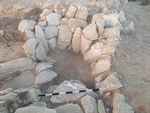
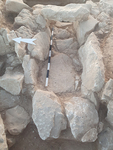
Settling pit and feeding channel. An oval pit (L537; 0.2 × 0.8 m; Fig. 6), lined with elongated large stones placed on their narrow side (average stone length 0.5 m), was uncovered, and the pit bedding, made of tamped earth and crushed limestones, was exposed at its bottom. The settling pit filtered down heavy material in the water that flowed into it. When the pit was full, the clean water flowed into the feeder channel (L530; Fig. 7) that led to the cistern. The channel, attached to the northwestern side of the cistern, was constructed of large, flat hewn stones (average size 0.2 × 0.6 × 1.6 m); its eastern end collapsed into the cistern.
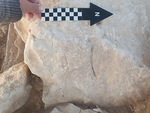
The symbols (wusum) of the Bedouins tribes ‘Azazma and Adulam were incised on the inner face of one of the stones lining the western side of the settling pit (Davida Eisenberg-Degen, pers. comm; Fig. 8).
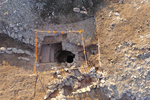
Cistern. The cistern (L521; exposed depth c. 3 m; Fig. 9) was located at the lowest spot in the area between two low hills, exploiting the topography to maximize the efficiency of water collection. The cistern was circular, its lower part hewn into the ground and lined with stones (exposed depth c. 1.5 m), and its upper part built (depth c. 1.5 m). Since the lower part was blocked with modern debris, its maximum depth is not known. Large chalk stones were laid over the cistern opening (diam. 0.6–0.7 m). A few stones with rope-pulling marks were uncovered while excavating the cistern.
Large refuse heaps, mixed with soil, stones, flint and pottery were uncovered to the west, east and south of the cistern. The refuse heaps accumulated from the daily maintenance and cleaning of the cistern. Two walls (L534) that were probably part of a feeder channel or were used to divert water to the cistern, were uncovered east of the cistern. The northern wall (length 3 m, width 0.15 m) was built of a single row of medium-sized field stones extant for one course, and the southern wall (length 2.5 m, width 0.15 m), adjacent to a refuse pile, was built of a single row of medium–small fieldstones, and was extant for one course. Three piles of large chalk stones (L524, L525, L533), some partially dressed, were exposed north and east of the cistern. The largest pile L524 (diam. c. 15 m) seems to have collapsed and dispersed over time, covering the settling pit and Channel 530. It seems that the chalk stones were removed from the cistern when it was hewn, and were possibly intended for building purposes, but the site was abandoned before they were used.
Pottery
Area E. Pottery sherds from the Byzantine, Early Islamic and Ottoman periods were retrieved. The Byzantine and Early Islamic-period sherds (not drawn) were found around the large stone heaps north and east of the cistern, as well as on the surface. The sherds are made of reddish-gray clay with few inclusions, and are well-fired. A few storage jar sherds from the Late Byzantine–Early Islamic periods (seventh century CE), and a few buff-clay body sherds, not exactly dated but characteristic of the Abbasid and Ayyubid periods (eighth–ninth centuries CE), were uncovered next to the settling pit and the feeder channel.
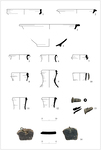
The Ottoman-period pottery vessels were manufactured of dark gray clay with many white inclusions, and they are well fired. They include bowls of the Ikashkul/Zavdiya types with upright rims decorated with combed lines (Fig. 10:1, 4; Israel 2006: Figs. 210, 216); bowls of the Masharat/‘Arabe types with ledge rims (Fig. 10:2, 3; Israel 2006: Figs. 178–182); closed cooking pots of the Tanjara type with an out-sloping ledge rim and a ribbon handle extending from rim to shoulder (Fig. 10:5; Israel 2006: Fig. 167); jars of the Beurroniye type with a concave neck and outward-leaning thickened rim for ‘leben’ cheese (Fig. 10:6, Israel 2006: Fig. 247); jars of the Jara type to carry water, some with a bulbous neck with a ridge and an inward-leaning thickened rim (Fig. 10:7, 8; Israel 2006: Fig. 58), and some with a leaning out rim and a protruding ridge below it (Fig. 10:9; Israel 2006: Figs. 65–68); briq/ibriq style jugs, some with stone inclusions sometimes visible on the surface, pulled-out neck and sometimes simple rims (Fig. 10:10), but mostly out-folded (Fig. 10:11, 12), some with a handle extending from the neck to below the shoulder and a spout (Fig. 10:13); and a body sherd of a bowl with a repair hole still containing the rope used for the repair (Fig. 10:14).
The Ottoman-period pottery assemblage is typical of the Bedouin nomad population of the Negev. The almost complete absence of objects, such as tobacco pipes, nargilas and porcelain vessels, usually found in similar assemblages, indicate that the site served as a temporary camp, rather than for semi-nomadic occupation or sedentary settlement.
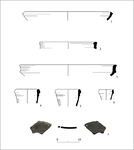
Area H. A few Byzantine-period pottery sherds were found (not illustrated), mixed with the Ottoman-period pottery. The Ottoman-period assemblage includes one bowl with a cut rim, made of pinkish-orange clay (Fig. 11:1). The other pottery vessels of this period are made of dark gray clay with many white inclusions and are well-fired, and include bowls of the kashkul/zavdiya types with combed lines on the rim (Fig. 11:2, 3); water jars of the jara/‘asliyah types with an out-folded rim and a ridge-decoration below it (Fig. 11:4, 5); a pouring-jug of the ibriq type, with a simple neck and an outward-leaning rim (Fig. 11:6); and a bowl body sherd with a repair hole (Fig. 11:7).
Flint Assemblage from Area I
Nineteen squares (each 2 × 2 m) were excavated on the lower moderate hillslope on which a large flint scatter was observed, the squares placed where the flint scatters were most concentrated (30–40 items/sq m). The flint items were collected from the surface, and subsequently an excavation was conducted to a depth of c. 0.15 m, or until no more flint items were found.
Altogether 5023 flint items were found, including knapping debitage, cores and tools (Table 1). Most of the items are made of dark or light brown chert, and some are covered with brown patina, characteristic of the desert region. The origin of about 90% of the objects is the ‘Adulam Formation (Finkel et al. 2022: supplemental Fig. 2), and about 10% are of the Mishash Formation. This chert is the local raw material found in close vicinity to the site, and besides the use of translucent gray chert for the micro-awls (see below), there seems to be no preference for a specific raw material. The items, with a few exceptions, are badly preserved.
A high level of wear, brown patina and broken edges were observed on many items, indicating rolling or water transportation. Some of this activity may have taken place on site and some in the vicinity, perhaps on the adjacent hill.
Most of the flint items (c. 90%) are knapping debitage, including items of all stages of the reduction sequence that characterizes on-site flint tool manufacture. The flint manufacture included mainly flakes (over half the assemblage), as can be seen from the flakes/blades/cores proportion. The assemblage is characteristic of desert ad-hoc industries, comprising mainly flakes, unidentifiable items and little use of cores, these items intended for immediate household use. A few cores and tools date activity at the site to the Chalcolithic and Early Bronze Age, while a few items found from the Middle Paleolithic and Epipaleolithic periods are intrusive, and not evidence of flint industry.
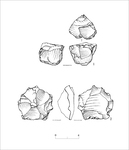
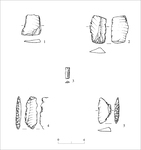
Cores (Table 2). The cores in the assemblage (N=30) were mainly for manufacturing flakes; scars from flake-knapping (Fig. 12:1) were identified on 66% of the cores. The most common technique was using cores with a single striking platform, whilst cores with multiple striking platforms and cores with mixed scars were also found. Other finds include two cores on flakes, a single Levallois core (Fig. 12:2) and four unidentified core fragments.
Tools (Table 3). The tools assemblage (N=437) primarily comprises partly retouched items (N=245)—retouched flakes, retouched blades and retouched bladelets—as well as notches (N=108).
Retouched Flakes. This group is heterogeneous, comprising items that are not morphologically uniform. Most of the items have fine retouch along one edge, and a few are retouched along both edges. Twenty-seven items were manufactured on primary flakes (Fig. 13:1).
Retouched Blades and Bladelets. The blades are finely retouched on one or both edges (Fig. 13:2). One object was manufactured on a primary blade. All bladelets carry a very fine retouch on one edge. A rectangular geometric bladelet (Fig. 13:3) with a retouched back and double truncation was found, this bladelet known from the Epipaleolithic-period Geometric Kebaran Culture (Goring-Morris 1978: Fig. 3:1–5).
Truncated Blades. All the items have a single truncation, mostly on the distal edge. Retouch as well as truncation was identified on one item.
Backed Blades. The blades have abrupt retouch on one edge, and four have additional retouch on one other side. Eight objects have straight back (Fig. 13:4), and two have convex back (Fig. 13:5), blades with a convex back being more common during the Early Bronze Age (Rosen 1997:60, Fig. 3.21:5–9). One convex-backed blade was burnt.
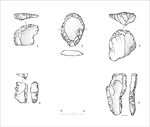
End-Scrapers and Side-Scrapers. The items were all made on flakes, four of the side-scrapers (Fig. 14:1) and seven of the end-scrapers made on primary flakes. One of the end scrapers (Fig. 14:2) was made on an oval flake, over 90% covered with cortex, and has inclined peripheral retouch. This type was called by Rosen ‘tongued-shaped end scraper’, and is known primarily in assemblages from the Chalcolithic period, but is also found in Early Bronze-Age sites (Rosen 1997:87, Fig. 3.44:5). Two tabular end scrapers with smoothed cortex were also found. End scrapers of this type were common during the Chalcolithic period and the Early Bronze Age (Rosen 1997:75). Another item was manufactured on a thick primary flake, and has an inclined retouch on the distal end (Fig. 14:3), this type being a mark of the Timna Industries in the desert area, and others similar ones were found in sites dated to the end of the Neolithic period, the Chalcolithic period and the beginning of the Early Bronze Age (Rosen 1997:87, Fig. 3.45:4).
Notches and Denticulates. The denticulates, on which two adjacent notches or more were fashioned, were manufactured on a range of flakes and blades (Fig. 14:4). The items on which there is one notch, on the other hand, show a clear preference for flakes (96%), nine made on primary flakes (Fig. 14:5).
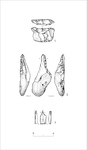
Awls. Three types of awls were discovered: awls (N=15), drills (N=9) and micro-drills (N=6). The awls (Fig. 15:1) were manufactured on a wide range of wide flakes or blades. These items were formed by fashioning one or two notches, creating shoulders and a pointed edge. The drills (Fig. 15:2) were formed on elongated blades, and have a long point, narrower and thinner than that of the awls, and most fashioned with abrupt retouch. The micro-drills (Fig. 15:3) were manufactured on short and broad bladelets of translucent gray chert. This chert is rare in the assemblage, and seems to have been deliberately selected for the micro-drills. The deliberate choice of chert may reflect some importance attributed to perforation at the site. These items may also be related to an earlier industry, but this cannot be confirmed.
Burins. Two burins were found, one on a large irregular flake, the other on a small flake.
Varia. One item with white patina was found, carrying scars on the dorsal and ventral sides. This may be a bi-facial tool abandoned at the preliminary production stage.
Additional Finds
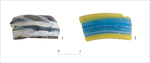
The finds in Areas D and E include an incised stone integrated in the wall, fragments of glass vessels, including bottles and a fragment of an Ottoman-period glass bracelet (L535, B5093; Fig. 16:1), and poorly preserved iron objects. Another fragment of an Ottoman-period glass bracelet (L101, B1004; Fig. 16:2) was found in Area A.
References
Eldar-Nir I. and Daninoo D. 2014. Masaf Negev Map - 160 (The Archaeological Survey of Israel Site).
Finkel M., Erel Y., Dor Y.B., Tirosh O., Levy T.E., Najjar M., Avni Y., Gopher A. and Ben-Yosef E. 2022. High Resolution Elemental Characterization of Prehistoric Flint Sources in Southern Israel: Implications for Archaeological Provenance Studies. JAS 43:1–12. https://doi.org/10.1016/j.jasrep.2022.103438
Goring-Morris A.N. 1978. Ma‘aleh Ziq: A Geometric Kebaran Site in the Central Negev, Israel. Paléorient 4/1:267–272. https://doi.org/10.3406/paleo.1978.4230
Israel Y.M. 2006. Black Gaza Ware from the Ottoman Period. Ph.D. diss. Ben-Gurion University of the Negev. Be’er Sheva‘ (Hebrew; English summary).
Rosen S.A. 1997. Lithics after the Stone Age: A Handbook of Stone Tools from the Levant. Walnut Creek–London–New Delhi.
Sapir T. 2022. Ramat Beqa‘. HA–ESI 134. https://doi.org/10.69704/jhaesi.116.2004.26119
Keywords
Ramat Beka, Water Management System, Cistern, Settling Pit, Byzantine Period, Ottoman Period, Gaza Black Ware, Flint Industry, Chalcolithic Period
Publication Date
08/06/2026
Report Type
Final Report