
Korazim, the Synagogue (A-9304)
Permit/License Number
A-9304
Excavation Report
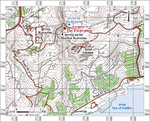
During June–July 2022, an excavation was conducted in the synagogue at Korazim (Permit No. A-9304; map ref. 253150/757410; Fig. 1). The excavation, on behalf of the Israel Antiquities Authority and funded by the Israel Nature and Parks Authority, was directed by O. Zingboym (digital registration and photography), and A. Kleiner (digital registration, surveying, and drone photography), with the assistance of Y. Yaakobi (administration), M. Bekker-Shamir (area supervision), R. Be’eri (scientific guidance), Y. Shaaltiel and A. Oz (conservation and plans simulation), J. Peterson, N. Adadi and N. Korem (conservation), and A. Kohn-Tavor (aerial photography in Fig. 10).
The excavation was undertaken in preparation for conservation and restoration work in the synagogue prior to opening the site for visitors according to the plan of the Israel Nature and Parks Authority. The plan included reconstruction of the paving stones, some of the stone benches, and installation of a pergola that will fit with the aesthetics of the synagogue.
The synagogue in Korazim was built during the Roman period in the southern part of the ancient settlement. To the south of the synagogue are a few oil presses and a winepress that mark the boundary of the settled area of Korazim. The synagogue has been known since the nineteenth century CE and prior excavations had been conducted there by several archaeologists (for details regarding the excavations, see Yevin 2000, Kohn-Tavor and Arubas 2023:34–39).
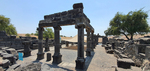
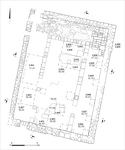
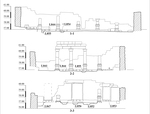
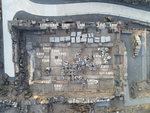
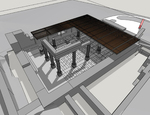
The synagogue was built as a basilica with a central nave and three aisles, eastern, northern and western, which are separated from the nave by colonnades (Fig. 2). The entranceway led from the south of the synagogue to the central nave and the western and eastern aisles. The conservation department of the IAA prepared an architectural and engineering plan for levelling the area prior to laying the paving stones and laying the infrastructure for the columns that will support the pergola. The excavation was conducted according to this plan, with the excavation focusing on areas that had not been excavated yet (max. excavation depth 0.2 m; Figs. 3–5), and in areas where it was necessary to excavate down to the bedrock to set the columns.
The central nave. In the northern part of the central nave the modern gravel fill was removed as well as the layer of collapse below it (L840, L842). This section was then excavated down to a plaster floor (L844; thickness 4 cm). The floor extends to the east and covers the lower part of the eastern stylobate whose upper most level is 0.25m higher than the plaster floor. Segments of the plaster floor were also uncovered next to the northern stylobate. Due to the relation of the floor to the stylobates, it is possible that the nave was lower than the colonnades, and that the stylobates were used for sitting.
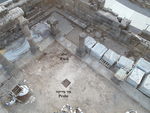
On the floor were found fragments of pottery vessels, among them numerous oil lamps, tile-fragments and two folded gold coins. In a probe (L854; 0.6 × 0.6 m; Fig. 6) excavated down to the bedrock underneath the floor were found numerous fragments of Late-Roman period pottery vessels that were obviously broken deliberately to a uniform size (max. size 4 cm) to be used for levelling the bedrock as part of the floor bedding. Two other probes, which were opened below the floor next to the eastern (L843) and northern (L855) stylobates, exposed the bedrock on which the stylobates had been built which in turn was levelled using brown soil that contained few pottery fragments.
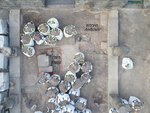
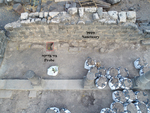
In the southern part of the nave, below a layer of modern gravel and adjacent to two stones that protrude above the surface (Fig. 7) was found a fill that contained building stone fragments that were laid over the bedrock (L856). In a previous excavation to the east of the two stones Yevin (2000:32) uncovered a plaster floor. This current excavation uncovered that plaster floor also to the west of these stones; therefore, those two stones were deliberately integrated into the floor. Furthermore, next to the stones to the southwest, a square depression of a size appropriate to accommodate another similar stone was exposed in the plaster floor. Moreover, it seems that next to this depression was a step or a bench. Finally, to the south, and adjacent to the stones were found depressions were used to hold wooden columns or an installation, ergo these stones may have been part of a stage for reading.
Adjacent to the southern wall of the nave, below a layer of collapsed debris (L851), a plaster floor like the one near to L856 was exposed, and on its surface level a square stone was found integrated into the plaster (see Fig. 7). A similar stone as well as a rectangular stone were found nearby during previous excavations (Yevin 2000), all of them were found at the same height. Yevin (2000:62–63) from his excavation surmised that an aedicule stood at this spot. While only three stones have been found in this spot it is possible that a fourth stone was originally located there, and that these stones served as foundations that supported the aedicule. A probe (L852) was excavated into and under the floor’s surface, the finds from which were mixed with modern material as a result of Yevin’s excavation, but included a large number of coins, where numerous coins had also found in previous excavations (Yevin 2000; Kohn-Tavor and Arubas 2023).
The eastern aisle. Five excavation squares were opened (1 × 1 m each) where the pergola columns were to be set, and in them were found traces of the previous excavations and the reconstruction of the eastern wall. In one of the squares (L849) a surface of small stones laid over the bedrock next to the eastern wall was discovered. The foundation course of the eastern wall in this square was missing stones, indicating that there was once an opening or a probe dug through the foundation and the stones found there today are part of a reconstruction of the foundation wall. However, Yevin reported that the foundation course of the eastern wall and most of the first course on the outer face were found as they are today, and it is therefore not clear if the missing stones indeed indicate an opening in the wall. In a probe dug under a bench near the eastern wall, a bedding of stone fragments (L858) was found, and below that bedding but above the bedrock was found a layer of brown soil (L859) containing a coin and a number of pottery sherds.
The western aisle. The modern-day gravel fill was removed, as well as the sterile layer of collapse debris below it. A fragment of a tile and remains of fine plaster, which covered the walls, were found in the foundation of a bench next to the western wall (L857; Fig. 8). The plaster may indicate an early phase in which there were no benches.
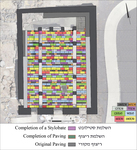
The preservation and accessibility works. Preservation work and the erection of shade structures were undertaken during the excavation and after it ended. The reconstruction of the stone pavement was based on characterization of the original stone pavemet which was preserved in the northeastern part of the synagogue (Figs. 9, 10) and includes stones of ten different sizes. In planning the stone pavement, emphasis was placed on adhering to the original layout of the pavement and avoiding contiguous joints between the pavers, to strengthen the pavement. The eastern bench was reconstructed with reference to the benches that still exist in the synagogue and with meticulous care to adhere to an appropriate level of reconstruction and keep a clear line between the original and the reconstructed floor. During the planning and execution of the pavement restoration process, the challenge of drainage and management of surface runoff water became apparent. The synagogue building had a roof, and the rain drained from it to the sides of the building, due to this the original stone floor was level or had a minimal slope. The new pavement, on the other hand, is not covered and it was therefore necessary to find a solution for directing the rainwater outside the building. After examining a considerable number of alternatives, the pavement was designed with a minimal external slope of approximately 1% towards the south. In the southern part of the building the pavement was designed with a channel that is slightly lower than its surroundings and drains rainwater to a drainpipe in the eastern part of the building. The work demanded a high level of precision and expertise and was undertaken by a team of IAA conservators.
References
Kohn-Tavor A. and Arubas B. 2023. The Synagogue at Korazim: New Insights and a Reassessment. In L.I. Levine, Z. Weiss and U. Leibner eds. Ancient Synagogues Revealed 1981–2022. Jerusalem. Pp. 34–39.
Yeivin Z. 2000. The Synagogue at Korazim: The 1962–1964, 1980–1987 Excavations (IAA Reports 10). Jerusalem (Hebrew; English summary, Pp. 1*–31*, 51*–54*). https://doi.org/10.69704/iaaRepV000.1996.76
Keywords
Korazim, Synagogue, Late Roman period, Plaster floor, Stylobates, Conservation and Restoration
Publication Date
14/06/2026
Report Type
Preliminary Report