
Even Yehuda (A-8867)
Permit/License Number
A-8867
Excavation Report
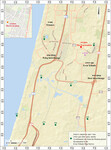
In November 2020, a salvage excavation was conducted in the northwestern area of Even Yehuda (Permit No. A-8867; map ref. 188996–9218/687648–920; Fig. 1), prior to building a new residential neighborhood. The excavation, on behalf of the Israel Antiquities Authority, was directed by A. ‘Azab, with the assistance of D. Masarwa and N. Shahar (area supervision), Y. Amrani (administration) I. Jonish (surveying and drafting, field photography, aerial photography and photogrammetry), S. Krispin (archaeological supervision, metal detection), Y. Nagar (physical anthropology), Y. Tepper (scientific guidance), Y. Sheizaf (sediment sampling), E. Ayalon (consultation), A. Keinan and E. Oren (work safety), A. Amit and A. Harosh (outreach program), Y. Gorin-Rosen (glass), C. Hersch (glass drawing), S. Goralik (metal laboratory), D. Gazit (studio photography), and A. Glick, E. Jakoel, P. Gendelman, ‘U. ‘Ad and D. Ben-Ami (consultation).
The excavation area was located on the easternmost of the three coastal kurkar ridges, bordering on the west with the Sharon plain agricultural land. In the Roman period, this region, forested with Tabor Oak, underwent development (Arsuf Forest; Porath, Dar and Appelbaum 1985:62). The Even Yehuda Survey Map documented some prehistoric flint items in the vicinity, as well as occupational remains from the Roman, Byzantine and Ottoman periods (Gofna et al. 2016: Sites 36–41, 48–52). Eight Roman-period settlements were identified (Sites 22, 48, 92, 127, 162, 166, 169, 177), including a third-century CE farm (Site 166, Khirbat Jayus). A rich Early Epipaleolithic flint assemblage of the Kebaran and Geometric Kebaran Culture was uncovered south of the excavation area (Brailovsky-Rokser 2025; Fig. 1: A-8341).
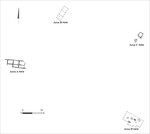
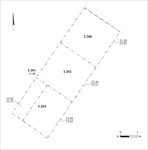
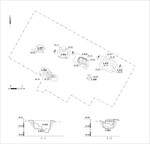
Four excavation areas (A–D; Fig. 2) were opened on the gentle northern hill slope. In Area A, a large building was uncovered, in Area B, a habitation level, in Area C, two burial structures, and in Area D, installations. Roman-period pottery retrieved in all the areas date the remains to the second–third centuries CE. The remains, located close to the surface, were damaged by modern cultivation.
Area A (Figs. 3, 4)
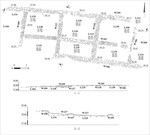
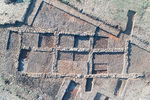
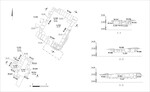
The foundations of a large rectangular building were exposed (156 sq m; W105–W109, W118, W127), damaged by plough marks due to the proximity to the surface (see Fig. 4). The wall foundations were built of various-sized, partially dressed kurkar stones. The east–west oriented building comprised two rows of rooms, the northern row with three large rooms (L128–L130; 3.7–3.8 × 5.4–5.6 m), and the southern row with three narrower rooms (L131–L133; 2.00–2.30 × 5.35–5.50 m). The northern and southern outer walls of the building (W105, W108) were cut on the west and east, and they probably extended to include at least two more large rooms (L104 on the west, L121 on the east).
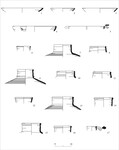
Roman-period pottery sherds, including a bowl (Fig. 5:1), a casserole (Fig. 5:2), a cooking pot (Fig. 5:5), bag-shaped jars (Fig. 5:7, 8) and a jug (Fig. 5:17), were found in the rooms and around the walls of the building.
Area B (Fig. 6)
A brown clayey soil layer (L200, L202, L204), containing unworn Roman-period pottery but no building remains, was exposed in the three excavation squares. The pottery included a casserole (Fig. 5:3) and a cooking pot (Fig. 5:6).
Area C (Fig. 7)
Two adjacent burial structures were discovered, containing three tombs (L316, L320, L325). The structures were dug into the ground and lined with stones, whose upper surface was damaged, presumably by agricultural activity. Roman-period bag-shaped jar sherds were found in the tombs (Fig. 5:9–12).
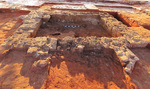
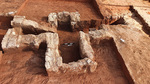
Burial Structure 325 (Fig. 8). A rectangular burial structure (3 × 4 m) was built of hewn kurkar stone walls (W305–W308), whose inner face was plastered with grayish-white plaster and whose outer face was of small kurkar stones bonded with white mortar. Two walls abutting western W306 delineated an anteroom leading to an entrance (c. 2 m wide). The anteroom was only partly excavated, and it is not clear if it had steps, as in similar tombs (for details, see below). Small and medium-sized kurkar stones and many pottery sherds were found near the entrance. A vaulted stone, found in the northeastern corner of the structure, indicated that the structure had a vaulted roof. Piles of small and medium-sized stones mixed with brown earth and plaster fragments from the collapsed ceiling were uncovered inside the building. Only two courses of the walls were exposed, and since the excavation did not reach floor level, it was not possible to determine the internal division of the structure.
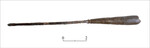
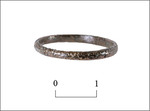
Two copper alloy artifacts—a spatula (length 7.5 cm; Fig. 9) and a round ring (diam. 1.5 cm; Fig. 10)—were found in the tomb. One end of the well-preserved, copper alloy spatula is rounded and thickened, the other broad and square. Spatulae were used for cosmetics or as medical implements (Hershkovitz 1996:354; Rimon 1996:58–62), and similar spatulae were found at many sites in Israel (Dayagi-Mendels 1989:36–50), as, for example, at ‘En Gedi (Chernov 2007:509–511) and Caesarea (Rafael 2008:446–447), and they are also common in tombs (Jakoel 2016; Kloner and Zisso 2003:64).
A few human bone fragments, including three skull vault fragments and long bones, were found in the tomb, their poor preservation state precluding estimating age and gender. The different locations of the skull-vault fragments in the tomb probably indicated multiple burials, or alternatively a primary burial that was later disturbed.
The burial structure belongs typologically to the built tombs with vaulted roofs, a type known in the coastal plain in the Late Roman and Byzantine periods (Huster and Sion 2006). In the absence of rock for quarrying tombs along the coastal plain, tombs used purpose-dug pits. Some sub-types are known, the most common being a chamber tomb accessed by a stepped anteroom. The burial chamber was usually divided into loculi, and the deceased were laid directly on the loculi floor or in wooden coffins that did not survive. Three additional sub-types include tombs with a central chamber, either with loculi in the walls or surrounded by additional burial chambers; narrow tombs with lead or stone coffins; and tombs that emulate burial caves, with a central hall and several burial cells next to it (Huster and Sion 2006:50–58). Built tombs with vaulted roofs have been discovered recently at Nes Ziyyona (Jakoel and Nagar, forthcoming) and at Hafez Hayyim (Arbel and ‘Ad 2021:186–189), this type of tomb reflecting the high socio-economic status of the interred. Pit or cist graves, requiring minimum investment of effort, are the most common burials in the coastal plain, the Shephelah and Judea in the Late Roman and Byzantine periods (Avni 1997:25–27; Jakoel 2013:112–114), built burial structures involving investment in material and construction, indicating that the interred in built tombs came from affluent families.
Burial Structure 316/320 comprises two burial chambers, constructed perpendicularly, Chamber 316 built above Chamber 320 (Fig. 11). The walls were built of kurkar stones, some dressed, and were preserved for two courses. Chamber 316 was covered with kurkar slabs, only one of which survived; the upper part of the chamber was damaged and its southern side was cut. A skull-vault fragment found in the chamber, crumbled on exposure and was therefore not identified. No human bones were found in Chamber 320. This burial structure may also belong to the built tombs with vaulted roof type, its poor preservation precluding its identification.
Area D (Figs. 12, 13)
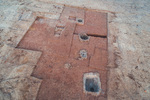
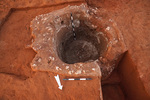
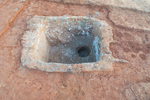
Four pits (L402, L405, L410, L415) and two floor-bedding segments (L400, L408) were uncovered, probably the remains of industrial installations. Pits 402 and 405 were circular (L402: diam. 1.3 m, depth 1 m; L405: diam. 1.03 m, depth 0.5 m), while Pits 410 and 415 were rectangular with rounded corners (L410:1.85 × 2.05 m; L415:0.65 × 1.10 m). The pits were dug into the ground and lined with small and medium-sized kurkar stones bonded with gray mortar and plastered with a few grayish plaster layers. A sump (diam. 0.4 m, depth 0.2 m; Fig. 14) was uncovered in Pit 402, and a rounded kurkar step was built into the northern part of the pit wall due to the depth of the pit (1 m). Two kurkar steps were built in Pit 410, and an oval sump (L412; diam. 0.4–0.5 m) was exposed in its floor. A small sump (diam. 0.2 m, depth 0.1 m) was also uncovered in Pit 415. Roman-period pottery sherds were found in the pits, including a casserole (Fig. 5:4) and bag-shaped jars (Fig. 5:13–16).
The two floor-bedding fragments (L400, L408) were of small fieldstones laid on virgin hamra soil at the level of the pits’ openings, and were probably part of the working floor.
The Glass Finds
Yael Gorin-Rosen
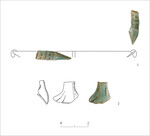
Five identifiable glass vessel fragments dated to the Early Roman period were found in the excavated building. The most diagnostic fragment is the rim of a fine bowl, leaning out and rounded by fire (L121; Fig. 16:1); a glass strip decorated with a regular vertical decoration was added along the edge of the rim. The bowl was made of glass with a greenish-bluish hue. The type, ‘Bowl with Crimped Trails’, is well known and characterized by two parallel decorative strips on the rim. These bowls usually have a hollow pinched ring base. Two fragments of hollow ring bases were found in the excavation (L112, L204; not illustrated), and a body fragment of a bowl with a double hollow tube was found with the base fragment from L204. These bowls, some decorated with glass strips similar to bowl No. 1, were very common during the Roman period. These types are characteristic to assemblages that are dated to the period between the First Jewish Revolt and the Bar-Kokhba Revolt, as, for example, in the assemblages from the ‘Abud Cave and the Cave of the Letters (Jackson-Tal 2016:42, 45, Fig. 11:5, 6, and see discussion there with references to wide distribution).
In addition to the bowl fragments, a small wide ribbon handle (L121; Fig. 16:2) was found, which can be attributed to an aryballos dated to the same period as the bowls. The handle is made of glass with a greenish-bluish hue, similar in quality to the glass of the decorated bowl. Aryballoi with such handles were found in the Judean Desert caves, in assemblages dated to the Bar-Kokhba Revolt (Jackson-Tal 2016:47, Fig. 13:8, and see discussion and further references there). The two vessel types are known from other Early-Roman assemblages in the area, as, for example, at Caesarea (Israeli 2008:372, 375, 398, 400, Nos. 23, 58) and in the Ben-‘Ami neighborhood in Netanya (Ouahnouna 2014:1, Fig. 1).
The bowl and the Aryballos date to the end of the first and beginning of second centuries CE, and presumably represent the habitation phase of the building.
A large building, probably a farmhouse used as a dwelling and to store agricultural produce, was uncovered in Area A. The pottery and glass finds dating the building to the Roman period. The layer with the unworn pottery in Area B, was probably part of a habitation level near the farmhouse. The burial structures exposed in Area C probably served the farmhouse residents, but since the graves were not excavated, there is no information about the burial types and customs, albeit built tombs with vaulted roofs indicating affluent family burials. The pits and floor bedding uncovered in Area D were probably part of a wine or oil press, or of another liquid-production industrial installation.
The farmhouse, habitation levels, industrial installations and burial structures are all components of a Roman-period, second–third century CE, rural settlement complex in the coastal plain, joining other small agricultural sites that began to appear in this region during this period (see above; see Fig. 1).
References
Arbel Y. and ‘Ad U. 2021. An Agricultural Settlement and Cemetery from the Roman, Byzantine and Mamluk Periods at Gane Ṭal. ‘Atiqot 102:145–210. https://doi.org/10.70967/2948-040X.1950
Avni G. 1997. The Necropoleis of Jerusalem and Beth Govrin during the 4th–7thCenturies A.D. as a Model for Urban Cemeteries in Palestine in the Late Roman and Byzantine Periods. Ph.D. diss. The Hebrew University. Jerusalem (Hebrew; English summary, pp. 1–12).
Brailovsky-Rokser L. 2025. Even Yehuda, Ha-Mahteret Street. HA–ESI 137. https://doi.org/10.69704/jhaesi.116.2004.27723
Chernov E. 2007. Metal Objects and Small Finds from En-Gedi. In Y. Hirschfeld. En-Gedi Excavations II: Final Report (1996–2002). Jerusalem. Pp. 507–543.
Dayagi-Mendels M. 1989. Perfumes and Cosmetics in the Ancient World. Jerusalem (Hebrew).
Gophna R., Ayalon E., Marom R. and Shemesh N. 2016. Map of Even Yehuda (59) (The Archaeological Survey of Israel Website) (Hebrew).
Hershkovitz, M. 1996. Roman Medical Instruments on Masada: Possible Evidence of a Roman Infirmary? Eretz Israel 25:351–355. (Hebrew; English summary pp. 101*–102*).
Huster Y. and Sion O. 2006. Late Roman and Byzantine Vaulted Tombs in the Southern Coastal Plain. Jerusalem and Eretz-Israel 3:49–67 (Hebrew; English summary, p. 7*).
Israeli Y. 2008. The Glass Vessels. In J. Patrich. Archaeological Excavations at Caesarea Maritima, Areas CC, KK and NN; Final Reports I: The Objects. Jerusalem. Pp. 367–418.
Jackson-Tal E.R. 2016. Glass Vessel Use in Time of Conflict: The Evidence from the Bar Kokhba Refuge Caves in Judaea, Israel (135/136 CE) BASOR 376:29–62. https://doi.org/10.5615/bullamerschoorie.376.0029
Jakoel E. 2013. Tombs and Burials in Jaffa (Joppa) in the Roman Period (first–fourth centuries CE). M.A. thesis, Tel Aviv University. Tel Aviv (Hebrew).
Jakoel E. 2016. Tombs and Burials in Jaffa (Joppa) during the Roman Period. Cathedra 159:25–56. (Hebrew; English summary, p. 225).
Jakoel E. and Nagar Y. Forthcoming. El-Khirba (Nes Ziyyona): Tombs from the Late Roman, Byzantine and Early Islamic Periods. ‘Atiqot.
Kloner A. and Zissu B. 2003. The Necropolis of Jerusalem in the Second Temple Period. Jerusalem (Hebrew).
Ouahnouna B. 2014. Appendix: The Glass Vessels from Netanya, Ben-‘Ami Neighborhood. In Masarwa D. Netanya, Ben-‘Ami Neighborhood. HA–ESI 126. https://doi.org/10.69704/jhaesi.116.2004.13669
Porath Y., Dar S. and Appelbaum S. 1985. The History and Archaeology of ‘Emek Ḥefer. Tel Aviv (Hebrew).
Raphael K. 2008. The Metal Objects. In J. Patrich. Archaeological Excavations at Caesarea Maritima, Areas CC, KK and NN; Final Reports I: The Objects. Jerusalem. Pp. 437–469.
Rimon O. 1996. Surgical Instruments from the Roman Period. In O. Rimon ed. Illness and Healing in Ancient Times. Haifa (Hebrew). Pp. 58–65.
Keywords
Even Yehuda, Roman period, Farmhouse, Rural settlement, Vaulted-roof tombs, installations
Publication Date
14/06/2026
Report Type
Final Report