
Kafr Kanna (A-9081)
Permit/License Number
A-9081
Excavation Report
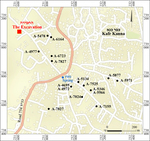
In August 2021, a trial excavation was conducted at Kafr Kanna (Permit No. A-9081; map ref. 231587–645/739072–121; Fig. 1), prior to the construction of a house. The excavation, on behalf of the Israel Antiquities Authority, was directed by G. Leyfirer (field photography, pottery, flint), with the assistance of Y. Yaakobi and Y. Gur (administration), A. Ibrahim (consultation, photogrammetry, survey), A. Shapiro (GIS), R. Be’eri (pottery, consultation), B. Hanna (consultation), Y. Bukengolts (pottery restoration), D. Gazit (studio photography), H. Tahan-Rosen (drafting, finds drawing), I. Koch (stamp seal), C. Hersch (stamp drawing) and workers from Kafr Manda.
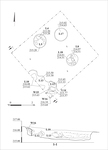
The excavation was located in the northwestern part of Kafr Kanna, about 500 m northwest of the village spring. A single excavation square was opened (Fig. 2) after a rock-hewn installation was exposed in mechanical probes. Three similar small rock-hewn pits (L5, L8, L17), probably installations of unclear function, and the limited remains of two walls (W15, W16), were uncovered, the remains dated by the pottery to the Late Bronze Age and Iron Age I; a few scattered Intermediate Bronze Age sherds were also found.
Many excavations have been carried in the vicinity over the last decades, exposing the remains of Chalcolithic and Early Bronze Age settlements, including an EB I fortification wall exposed in an excavation carried out by Howard Smithline (Fig. 1: A-4695, A-4972, A-4977, A-5134, A-5346, A-5566). A segment of a Hellenistic-, Roman- and Byzantine-period paved road, possibly connecting the Karm er-Ras settlement to the spring of Kafr Kanna, was exposed in excavations carried out in 2008 and 2011 (Alexandre 2009 [Fig. 1: A-5478]; Alexandre 2012 [Fig. 1: A-6164]). Excavations in 2010, 2012 and 2013 uncovered Chalcolithic-period and EB IA remains, a Roman-period tomb and a Byzantine-period pit (Covello-Paran 2013; Covello-Paran 2015a [Fig. 1: A-5877]; Covello-Paran 2015b [Fig. 1: A-5971]; Permit No. A-6723). Remains from EB IA–early EB IB were uncovered in 2014 (Be’eri 2015 [Fig. 1: A-7155]; Permit No. A-7024), a few unstratified pottery sherds and flint tools were found in 2015 (Bron 2020 [Fig. 1: A-7525]), and Chalcolithic and EB IA settlement remains were found in 2016 (Brink 2019 [Fig. 1: A-7827]).
Intermediate Bronze Age
A few unstratified IBA pottery sherds were retrieved with later sherds, mostly coming from earth accumulated on the bedrock at the bottom of Pit 8, and from earth accumulated in a natural limestone recess (L13). An Intermediate Bronze Age site has not yet been uncovered in the immediate vicinity at Kafr Kanna, but the sherds may have been washed here from a nearby yet undiscovered settlement.
Late Bronze Age and Iron Age I
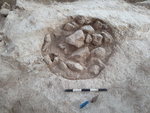
Pit 5. A round pit (diam 1.2 m), hewn in the soft limestone rock, was found full of dark brown earth and stones (L4; Fig. 3). It was not excavated since it was lay beyond the construction area.
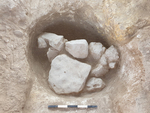
Pit 8. A round pit (diam. top c. 1.2 m, bottom c. 1.0 m, depth c. 0.7 m; Fig. 4), hewn in the soft limestone was uncovered. The pit’s straight walls narrowed slightly down to the pit bottom. An accumulation of small fieldstones (L18) was found in the pit, and a large flat smooth stone lay at its base; it was not clear whether these were collapsed stones or part of an installation.
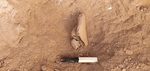
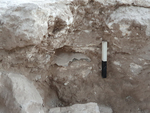
Pit 17. A round pit (diam. top c. 1.1 m, bottom c. 1.0 m, depth c. 0.9 m) hewn into soft limestone had straight sides, slightly narrowing down to the bottom. A layer of hard crushed gray earth, containing a few small burnt stones, and body sherds of a large storage jar, and sherds of a jar with a stamped handle, was uncovered at the bottom of the pit (Fig. 5; see Koch, below). About c. 0.3 m below the pit opening, a few burnt stones hugged the western side of the pit (Fig. 6); a burnt body sherd of a pottery vessel found amongst the stones was not identifiable. The gray earth layer was sealed by a brown crumbly earth accumulation, containing various-sized stones, including two roughly worked limestones.
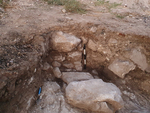
Walls 15 and 16. Two parallel walls extended beyond the excavation limits (Fig. 7). Wall 15 was constructed of a row of small stones and delineated two adjacent large roughly worked stones (L12, L14). North–south oriented W16, visible only in the southern section, was built of two rows of medium-sized stones with stone fill, and was preserved for three courses, only a single large flat stone extant in the top course. Since the wall was only partly excavated, its context is not clear. To the west of the walls, collapsed stones and earth (L10) found in a recess (L13), contained pottery sherds from the Late Bronze Age, and a few Iron Age sherds, dating the walls and installations to these periods.
Pottery
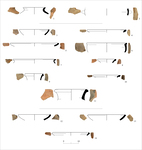
The pottery mostly comprised non-diagnostic body sherds. A few Late Bronze Age I–II and Iron Age I sherds were found in an earth and stone accumulation in the rock recesses (L13). Whilst their original location is not known, they may represent the settlement periods in this area. The Intermediate Bronze Age sherds were of jars (Fig. 8:1, 2); the Late Bronze Age sherds were of bowls (Fig. 8:3–5), deep bowls (Fig. 8:6, 7) and jars (Fig. 8:8–11), and the Iron Age I sherds were of bowls (Fig. 8:12–14).
Flint
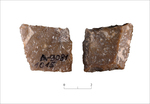
A single identified flint item is a sickle blade manufactured on a flake or a wide blade (length 35 mm, width 37 mm, max. thickness 6 mm; Fig. 9). Both ends are truncated and its outline and section are trapezoid. The blade has a semi-abrupt back, and it was formed by rough retouch. Similar sickle blades were common from the Middle Bronze to the Iron Ages, this sickle blade belonging to a trapezoid sub-type of the ‘large geometric’ blades, in use from the MB II until the beginning of Iron II (Rosen 1997:55–60).
Stamped Jar Handle
Ido Koch
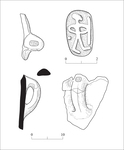
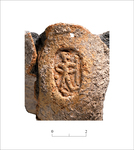
Sherds of a Late Bronze to Early Iron Age storage jar (Mazar 2015:15; Mullins and Yannai 2019:161–162), found within a burnt soil layer at the bottom of Pit 17, included a handle bearing an unframed oval seal impression (length 28 mm, width 16 mm; Figs. 10, 11). The imprint includes a schematic anthropomorphic figure, with arms bent to the sides, and hands placed on the torso. The figure faces right and one of its forearms touches a long vertical object; on the left side there is a small dot.
Similar figures are depicted on several stamped jar-handles from Tel Kinrot (Münger 2009: Nos. 4–9; 2013:612–617, Nos. 621–626), all including the figure, the vertical object and the dot, but in the Tel Kinrot impressions, the figure holds the long object in one hand and the other hand is raised in a menacing gesture. Based on Late Bronze Age depictions, predominantly from Egypt (Münger 2009:121–123), the Tel Kinrot figure’s posture identifies it as the deity Resheph.
The Kafr Kanna figure is similar in style but the different posture precludes associating it with this deity. The position of the figure’s arms resembles figures depicting the Egyptian king standing next to a cartouche depicting his name, with his hands placed on his chest, holding the royal attributes, the crook and flail (Wiese 1990: Type 4). This depiction is known on at least a dozen scarabs from the southern Levant, as, for example, a scarab from Tel Gezer Cave 10A (Keel 2013:440–441, No. 635). Already in the Late Bronze Age, figures in such a composition were sometimes rendered in the same posture, but without the royal attributes, as, for example, a scarab from Tell Jemmeh (Keel 2013:10–11, No. 20). The seal stamp on the Kafr Kanna handle may be related to this phenomenon, albeit the accompanying vertical element has parallels in early Iron Age scarabs, depicting anthropomorphic figures alongside a feather or reed signs (Keel 2010a:388–389, No. 318; 2010b:132–133, No. 242).
Conclusion
The hewn installations and remains of walls uncovered in the excavation were dated by the pottery to the Intermediate Bronze Age and Late Bronze Age and Early Iron Age, the jar with the stamped handle found in the sealed fill at the bottom of Pit 17, reinforcing this dating. Remains from the Late Bronze Age were not known in the area of Kafr Kanna prior to the present excavation. The remains from the excavation indicate an agricultural or industrial activity at the site. The Intermediate Bronze Age pottery seems to be ex situ, but indicate a site from the period in the vicinity.
References
Alexandre Y. 2009. Kafr Kanna. HA–ESI 121. https://doi.org/10.69704/jhaesi.116.2004.992
Alexandre Y. 2012. Kafr Kanna. HA–ESI 124. https://doi.org/10.69704/jhaesi.116.2004.1937
Be’eri R. 2015 Kafr Kanna. HA–ESI 127. https://doi.org/10.69704/jhaesi.116.2004.24885
Brink E.C.M. van den. 2019. Kafr Kanna. HA–ESI 131. https://doi.org/10.69704/jhaesi.116.2004.25524
Bron H. 2020. Kafr Kanna (South). HA–ESI 132. https://doi.org/10.69704/jhaesi.116.2004.25812
Covello-Paran K. 2013. Kafr Kanna. HA–ESI 125. https://doi.org/10.69704/jhaesi.116.2004.2211
Covello-Paran K. 2015a. Kafr Kanna (A). HA–ESI 127. https://doi.org/10.69704/jhaesi.116.2004.16744
Covello-Paran K. 2015b. Kafr Kanna (B). HA–ESI 127. https://doi.org/10.69704/jhaesi.116.2004.24866
Keel O. 2010a. Corpus der Stempelsiegel-Amulette aus Palästina/Israel: Von den Anfängen bis zur Perserzeit—Band II: Von Bahan bis Tel Eton (OBO.SA 29). Fribourg–Göttingen.
Keel O. 2010b. Corpus der Stempelsiegel-Amulette aus Palästina/Israel: Von den Anfängen bis zur Perserzeit III: Von Tell el-Far‘a-Nord bis Tell el-Fir (OBO.SA 31). Fribourg–Göttingen.
Keel O. 2013. Corpus der Stempelsiegel-Amulette aus Palästina/Israel: Von den Anfängen bis zur Perserzeit—Band IV: Von Tel Gamma bis Chirbet Husche (OBO.SA 33). Fribourg–Göttingen.
Mazar A. 2015. Iron Age I: Northern Coastal Plain, Galilee, Samaria, Jezreel Valley, Judea and Negev. In S. Gitin ed. The Ancient Pottery of Israel and Its Neighbors from the Iron Age through the Hellenistic Period 1. Jerusalem. Pp. 5–71.
Mullins R.A. and Yannai E. 2019. Late Bronze Age I–II. In S. Gitin ed. The Ancient Pottery of Israel and Its Neighbors from the Middle Bronze Age through the Late Bronze Age 3. Jerusalem. Pp. 151–259.
Münger S. 2009. “Handle with Care”—Notes on Stamp-Seal Impressions on Jar Handles and a Bulla from Early Iron Age Tell el-ʿOrēme/Tẹ̄l Kinrōt. ZDPV 2:116–138.
Münger S. 2013. Kinneret. In O. Keel ed. Corpus der Stempelsiegel-Amulette aus Palästina/Israel: Von den Anfängen bis zur Perserzeit—Band IV: Von Tel Gamma bis Chirbet Husche (OBO.SA 33). Fribourg–Göttingen. Pp. 602–617.
Rosen S.A. 1997. Lithics after the Stone Age: A Handbook of Stone Tools from the Levant. Walnut Creek–London–New Delhi.
Wiese A. 1990. Zum Bild des Königs auf ägyptischen Siegelamuletten (OBO.SA 96). Freiburg–Göttingen.
Keywords
Intermediate Bronze Age, Late Bronze Age, Iron Age I, hewn pits, installations, walls, flint find, seal impression on a jar handle, the god Reshef, agricultural activity, Stamped jar handle, deity Resheph
Publication Date
14/06/2026
Report Type
Final Report