
Noqedim (17-03-2021)
Permit/License Number
17-03-2021
Excavation Report
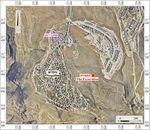
During September-October 2021, a salvage excavation was conducted in the eastern part of the settlement of Noqedim (Permit No. 17-03-2021; map ref. 223681/616979; Fig. 1), prior to the building of a new neighborhood. The excavation, on behalf of the Archaeological Staff Officer of Judea and Samaria and funded by the Gush Etzion Regional Council, was directed by O. Varoner (field photography and pottery), with the assistance of A. Miller (administration), Y. Fleitman (photogrammetry and aerial photography), O. Bejarano (plans), M. Manukian (pottery drawing), A. Harel (tables and figures), H. Shkolnik from the Judea District and workmen from Dhahiriya.
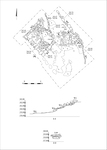
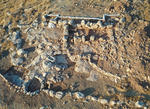
The excavation was conducted at the center of a moderate spur, sloping to east. Part of a structure was uncovered (Figs. 2, 3), probably a farmhouse, and was dated to the end of the Iron Age. Buildings dated to the Iron Age and the Persian period had been uncovered previously about half a kilometer northwest of the current excavation (Peleg 2004 [Fig. 1: 817-1998]).
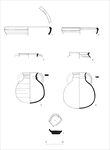
The structure that was uncovered was a rectangular building (7 × 13 m) with walls (W1–W4; max. width 1.5 m) built of one row of large, semi-hewn stones, laid over foundations of flat stones. The building probably extends farther southeast, but it was severely damaged by modern activity, and its complete plan cannot be reconstructed. The building comprises two stepped rooms, separated by a row of four monolithic columns. Wall 1 survived to a height of three courses (height 1.5 m), W3 survived to a height of two courses (height 1.2 m), while only the foundations survived of W2 and W4. The four columns at the center of the building are partly set on bedrock, and partly on a bedding of small stones and packed earth. Earth accumulations (L14, L15) were uncovered in the southwestern room, and below them a heap of large collapsed stones, that probably originated from the ceiling of the building, or the floor of a storey above that was not preserved. After this collapse-heap was removed, a packed-earthen floor was exposed in the western part of the room, and on it were found bowl fragments (Fig. 4:1, 2) and cooking pots (Fig. 4:3, 4), which are dated to the end of the seventh century and the beginning of the sixth century BCE. A heap of collapsed stones, which probably originated from W2, was found in the western part of the northeastern room. Accumulated earth (thickness 0.6 m) was exposed in the rest of the room, and once it had been removed, a packed earthen floor (L13) was uncovered, and on it were found two complete cooking pots (Fig. 4:5, 6) and the base of an oil-lamp (Fig. 4:7), which are also dated to the end of the seventh and to the beginning of the sixth centuries BCE.
On the external eastern side of the building was found an opening of a cistern (L11) with a stone trough next to it. The cistern was not excavated. A round sump (L10) that was built directly on the bedrock was found northeast of the cistern. A canal was found on the southwestern edge of the sump that leads to the cistern. Two constructed feeding canals (W6, W7) lead to the sump, of which only their southwestern sides are preserved, and it is therefore impossible to reconstruct their true dimensions. A probe was excavated in Canal 7 (L8; 2.× 4 m) and exposed an accumulation of soil (depth c. 0.15 m) and beneath it, part of the plastered canal floor.
It appears that the remains uncovered in the excavation are part of a farmhouse complex, with a water system, which was built in the seventh century BCE and existed until the beginning of the sixth century BCE. The structure was damaged and its original dimensions cannot be reconstructed, but the line of columns at its center and the extent of the collapses seem to indicate that the building had a second storey. The dating of the structure is similar to that of structures previously uncovered about 0.5 km northwest of the excavation (Peleg 2004), and therefore it appears that they existed and were abandoned at the same time. Other terraced structures from the Iron-Age are known from northwestern Jerusalem (Davidovich et al. 2006: building 32; Mizrahi et al. 2018: rectangular building in Area A), where they were interpreted as buildings associated with agriculture.
References
Davidovich U., Farhi Y., Kol-Ya‘akov S., Har-Peled M, Weinblatt-Krauz D. and Alon Y. 2006. Salvage Excavations at Ramot Forest and Ramat Bet-Hakerem: New Data Regarding Jerusalem’s Periphery during the First and Second Temple Periods. In E. Baruch, Z. Greenhut and A. Faust eds. New Studies on Jerusalem 11. Ramat Gan. Pp. 35–111 (Hebrew).
Mizrahi S., Freud L., Gellman D. and Gadot Y. 2018. What Kind of Village is This? Structures and Agricultural Activity in Northwestern Jerusalem in the Seventh Century BCE. In J. Uziel, Y. Gadot, O. Zelinger, O. Peleg–Barkat and O. Gutfeld eds. New Studies in the Archaeology of Jerusalem and its Region 12. Jerusalem. Pp. 191–213 (Hebrew).
Peleg Y. 2004. An Iron Age Site at Noqdim. In H. Hizmi and A. de Groot eds. Burial Caves and Sites in Judea and Samaria from the Bronze and Iron Ages (JSP 4). Jerusalem. Pp. 189–205.
Keywords
Farmhouse, Late Iron Age, Terraced Structure, seventh and sixth centuries BCE
Publication Date
14/06/2026
Report Type
Final Report