
Yafo, Ben Gamli’el Street (A-8559)
Permit/License Number
A-8559
Excavation Report
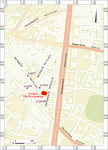
In July 2018, a salvage excavation was conducted at 10 Ben Gamli’el Street in Yafo (Permit No. A-8559; map ref. 177303–38/662219–46; Fig. 1), prior to creating a public garden. The excavation, on behalf of the Israel Antiquities Authority and funded by Shefa Department for Urban Improvement of the Tel Aviv Municipality, was directed by Y. Arbel (field photography), with the assistance of Y. Amrani (administration), A. Bouchenino and A. Reiss (site preparation), V. Essman (surveying and drafting), E. Delerson (plan), P. Gendelman, H. Törge, A. de Vincenz (pottery); E. Stern (pottery appendix); M. Shuiskaya (pottery drawing), Y. Gorin-Rosen (glass), A. Glick (canon ball), L. Rauchberger (tobacco pipes), I. Reznitsky (metal laboratory), R. Kool (numismatics), C. Amit, A. Gorzalczany and Y. Agmon (studio photography), and D. Abu Salah (IAA Tel Aviv District).
Extensive excavations have been conducted in the vicinity of the excavation in recent years. Meager Hellenistic-period building remains and a large refuse pit, as well as Byzantine-period pottery and two late Ottoman-period walls, were uncovered north of the site (Arbel 2020; Fig. 1: A-7213). A Hellenistic-period building complex (Mermelstein 2021 [Fig. 1: A-8477]) and remains of buildings and finds from the Persian, Hellenistic, Roman, Byzantine, Early Islamic and Crusader periods (Barkan and Bouchenino 2012 [Fig. 1: A-5455]) were found along Bet Eshel Street, west of the excavation site. Byzantine-period sherds and Late Ottoman and British Mandate refuse pits were found southeast of the site (Permit No. A-7071).
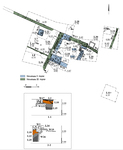
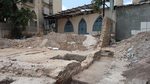
The present excavation comprised six squares (4 × 4 m; Fig. 2), five squares in the western part of the area, where building remains were identified in previous inspections, and the sixth square partly excavated at the center of the area, uncovering a tiled pavement. The excavation uncovered remains of two building phases dated to the Late Ottoman period (eighteenth–beginning of twentieth centuries CE).
Early Phase
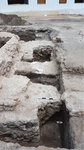
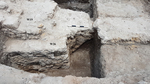
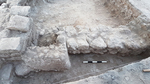
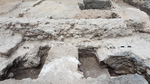
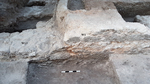
A small building comprising three adjoining walls (W13, W26, W31) was exposed. A wall (W5), an installation (L28) and a pillar (W29) were uncovered east of the building, and another pillar (W21) was found to its west. The arches, on which the three adjoining walls were built (Fig. 3), were characteristic of Ottoman-period building construction in Yafo (Arbel 2010; Re’em 2010; Jakoel and Marcus 2017:47–49; Arbel 2021a:33, 35, 38; Arbel 2026:15). The arches were built of hewn limestone and kurkar stones, with plaster as bonding material. It seems that the walls built on the arches were dismantled to reuse the stones for building the late phase. Part of one wall (W19), built of two rows of hewn kurkar stones with a core of small fieldstones, earth and lime, survived over the arch of W26 (Fig. 4). Late Ottoman pottery sherds and a few Byzantine-period sherds were retrieved in the earth accumulation layers (L23, L25) that abutted the foundations of W26, the deepest exposed building remains, and similar sherds were found in the earth accumulation layer (L15) abutting W13.
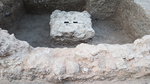
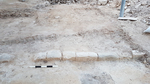
Wall 5 (Fig. 5), abutted by a packed-earth floor (L32), has a different construction method, not set on foundation arches, but on two foundation courses, built of medium-sized kurkar stones, some roughly hewn. Wall 5 was possibly, but not certainly, part of the early building, its association suggested based on its suitable location as a wall delineating the building on the east, and its depth lower than the walls of the later phase. Its construction technique also different from that of the later phase walls. A packed earth floor (L32) abutted W5, and the southern end of W5 extends beyond the excavation square, while its northern end abuts an installation (L28). The Installation (Fig. 5) is a stone-built rectangular structure. Its eastern part was not preserved and its function is unclear. The external face of the southern and western sides of the installation were plastered, and an earth fill inside the installation was rich in pottery finds, indicating that it served as a refuse pit in the late phase (see below). The pottery in the installation predominantly comprised saqiye antillia jar sherds, and small quantities of Ottoman-period jar, jug and bowl sherds. The saqiye jar sherds included a few local types, common in Yafo and other contemporary sites in Israel, and many fragments of an Egyptian type, found in Yafo for the first time (see below). The installation adjacent to the southern side of Pillar 29 was built of well-dressed stones, the largest stones found in the excavation (see Fig. 5). The architectural context of the pillar is unclear, and it seems that the walls of the associated building were dismantled when a wall of the late phase (W4, see below) was built. Pillar 21 (Fig. 6) was found below remains from the late phase, and its building materials and construction technique are similar to the remains of the early phase.
Late Phase
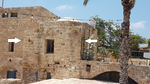
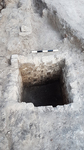
The walls of the early phase were dismantled, and new walls (W1, W2, W4, W6, W9, W17) were built, some founded on the earlier foundation arches. Wall 2 was set on the foundation arch of W31 (Fig. 7). The arch was wider than the wall, unlike the common Ottoman-period construction in Yafo, where the wall was usually the same width as the arch on which it was set. In addition, the line of the wall diverges slightly from that of the arch. The difference in the building technique of the two walls is also evident. In both phases, the walls were built of hewn kurkar stones with a core of stones, earth and plaster, but in the late phase, packed hamra soil was incorporated within the core. The incorporation of hamra soil in wall cores is familiar in nineteenth-century buildings in Yafo (Arbel and Rauchberger 2020a:259; 2020b:38), ensuring the solidity and endurance of the walls, even if they were narrow. Wall 1 (Fig. 8), only c. 0.4 m wide and extant to a height of at least 2 m in its western part (outside the excavation area), exemplifies these qualities, the wall constructed on shallow foundations, and not set on an early-phase arch. The difference in building techniques was also visible in the join between W1, consolidated with hamra soil, and W13 of the early phase, which does not incorporate such bonding material (Fig. 9). A robber trench (L34), found in the southern part of the area, removed stones from early-phase W26, probably to build W2 which sealed the robber trench. Walls 1 and 2 join at a right angle, creating a corner wider than the walls themselves. The corner apparently served as a foundation for a vault of a type still visible in standing Ottoman-period buildings in Yafo (Fig. 10). Wall 9, constructed of stones in secondary use, was built in the area between W1 and W2, and was abutted by a packed-earth floor (L33; Fig. 11). Wall 4 and 17 continued W1 to the east, and apparently cut through early-phase Pillar 29. The northern face of W4 was damaged and partly dismantled when an infrastructure shaft (L30; Fig. 12) was dug and lined with silicate bricks during the British Mandate or later. Wall 6, uncovered in the northeastern part of the area was badly preserved, with only a single surviving course, and its context is unclear. Wall 17 was built directly over early-phase W13. Ottoman-period pottery sherds were retrieved in this phase, as well as modern-day refuse and ash from the surface. This is unlike the earlier material that was uncovered next to W13 (see above). The two building phases are therefore identifiable also in the nature of the finds.
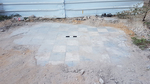
A segment of black-and-white tiled floor (L11; Fig. 13), part of a destroyed building, was exposed close to the surface in the southeastern part of the excavation area. This floor type was constructed in Yafo since the second half of the nineteenth century CE. These floor tiles were first imported, and local workshops began manufacturing them at the end of the nineteenth–beginning of the twentieth centuries, some such floors are still in use in many houses in Yafo, others exposed in archaeological excavations (Arbel 2026:16; Dayan 2018).
Pottery Finds
The pottery assemblage from the excavation is predominantly characteristic of the Late Ottoman period in Yafo and at many other sites throughout the country. Most of the vessels—storage, cooking, pouring, drinking and lighting vessels—were manufactured in local workshops, mostly comprising gray Gaza Ware. The small imported assemblage included sherds of bowls and glazed cups from Anatolia, and a few fragments of Marseille tiles (see below). The paucity of imports, unlike at other sites in Yafo, could probably be attributed to the location of the site in a rural-agricultural area until the British Mandate period, relatively distant from the Ottoman town center.
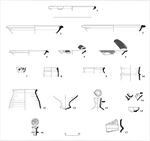
Some pre-Ottoman-period vessels include a Hellenistic amphora sherd (not illustrated), a Byzantine-period African Red Slip Ware bowl (Fig. 14:1) and a few Crusader-period sherds (Stern, Appendix). The Crusader-period pottery and a coin of Amauri I and his heirs (1163–1187 CE; IAA No. 178478) found in a Late Ottoman-period soil accumulation layer may be related to the eastward extension of the city in this period, at its peak reaching as far east as present-day Yehuda Me-Raguza Street (Arbel and Rauchberger 2020b:33–34). A decorated bowl sherd is a rare Early Ottoman-period find in Yafo, not settled in this period (Stern, Appendix).
Imported bowls. Two sherds of Drip-Painted Ware glazed bowls were found, one brown-yellow (Fig. 14:2), the other gray-green (Fig. 14:3). These bowls, common in Yafo, were manufactured in workshops at Didymoteicho and Çhanakkale.
Kraters. A few sherds of kraters were mostly Gaza Ware (Fig. 14:4–6). The kraters have a ledge rim, straight or leaning out, with a smoothed internal surface and a ring base. These kraters ‘ma‘ajna’ were mainly used for food preparation, as, for example, kneading dough, or washing and drying fruit and vegetables (Israel 2006:186–193). The larger kraters could be used for washing dishes and providing water for goats, once outlived their original function.
Imported cup. A sherd of a worn glazed coffee cup, made of imitation porcelain and decorated with vegetal patterns inside and out in characteristic black, green, red and blue colors, was found (Fig. 14:7), such cups manufactured in the Kütahya and Iznik workshops in western Anatolia. In this period, coffee cups—usually in true porcelain—were also imported from Europe, mainly from Meissen in Germany.
Jars. A jar ‘jara’ with two handles attached to the base of the neck was found (Fig. 14:8). These common Ottoman-period jars, some decorated with thumb imprints or wavy combing, were mostly used for carrying and storing water. Similar jars were also part of the Gaza Ware forms. A different type of jar—‘burniye’—had an oval body and a ledge rim with a groove to accommodate a lid (Fig. 14:9). Such jars, some with small loop handles, were found in various sizes, and were mostly used to store yoghurt and butter.
Local saqiye jars. These jars (antal or kadus) were incorporated in a chain of jars on a saqiye water wheel (Fig. 14:10). The upper part of the jars is cylindrical and the lower part conical, and their opening is wide to allow a quick collection of water. These jars are dated to the end of the eighteenth and the nineteenth centuries (Ayalon 2000:224–225). Once discarded, they were secondarily used in construction, as a substitute for the kizan, for storage and growing plants, and rarely for burying foetuses (Arbel 2021a:46).
Egyptian-type saqiye jars. These jars (kadus kabir) have a button base, a flaring rim and a flattened body (Fig. 14:11, 12), distinguishing them from the local saqiye jars (Israel 2006:75–76, Fig. 27, and references there to Henein 1997; for the manufacturing process, see Ménassa and Laferrière 1974:18–20). It is reasonable to assume that the vessels were produced by Egyptian potters who immigrated to Yafo in the reign of Ibrahim Pasha (1831–1840 CE), using local materials to manufacture jars they were familiar with in their homeland (Arbel 2021b:245–249), or by their descendants. This is the first archaeological evidence for the Egyptian immigration wave into Yafo and the establishment of settlements (sakanat) in its vicinity, as recorded in historical documents (Kark 1990:14). The present excavation is to date the only one in Yafo in which Egyptian-type saqiye jars were identified, apart from a single item found recently in an excavation in Shim‘on Ha-Zadiq Street (Permit No. A-8302). A similar vessel found in an excavation in Marzuk and ‘Azar Street (Rauchberger 2009: Fig. 10:4), was identified as a mid-Roman-period saqiye jar (second–third centuries CE; Ayalon 2000:221–222, Fig. 3.1).
Jugs. A jug ‘kuz’ with an oval body, a short neck widening to the pinched funnel rim, and a handle was discovered (Fig. 14:13). These jugs, some decorated, were used to carry and pour water. Another jug ‘ibriq’ has oval body, a long neck, a ring base and two handles extending from the base of the neck to the shoulder (Fig. 14:14); it has a pouring spout next to one handle. Such jugs were common in everyday use in the eighteenth to nineteenth centuries. They were described in nineteenth-century travelers’ records, and appear in historic illustrations and photos (Israel 2006:146–161).
Lamp. An open oil lamp ‘siraj’ sherd has a pinched rim to accommodate the wick (Fig. 14:15). These oil lamps, reminiscent of lamps from Bronze and Iron Age, were the main source of lighting in the fellahin houses. The wick was made of flax or cotton, and was lighted with olive oil. The lamps were manufactured without changes throughout the eighteenth and nineteenth centuries CE, and were found in various sites in Israel.
Nargile head. The nargilas first appeared in the first half of the seventeenth century CE, and their distribution gradually increased. The nargile heads were made of clay and decorated with a variety of motifs (Fig. 14:16). The nargile head from the present excavation is sparsely decorated, the pattern possibly worn. Nargile heads are commonly found at sites in Yafo, although much less common than the tobacco pipes chibouk (Rauchberger below). While pipe manufacture stopped when cigarettes became available, nargilas are still in use in the Levant and beyond.
Marseille tile (Fig. 14:17). The tile was manufactured in the Roux Brothers factory, in the village of St. Henri, today a suburb of Marseille, France. The factory began production in the mid-nineteenth century, and exported tiles and other construction materials to the Levant until the 1930s (Ayalon 2002). Tiles from this factory are commonly found in Late Ottoman-period pottery assemblages, and even today Roux tiles are extant in the roofs of some historical public and religious buildings in Israel.
Clay Tobacco Pipes
Lior Rauchberger
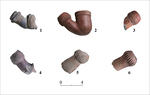
Six Ottoman-period clay tobacco pipes fragments were found in the excavation (chibouk; Fig. 15:1–6). Pipe No. 1 is of Type J-PIPE-18A, as classified in the Qishle excavations at Yafo, and dated to the eighteenth century (Vincenz 2021: Figs. 8.6.4–8.6.18) The pipe has a globular flower-shaped bowl whose petals were modelled with vertical rouletted lines, forming ribbing. The short shank is curved, terminating in a reinforcement ring framed by fine rouletted lines, with a simple end-ring above it. Pipe No. 2 has a complete profile, with a rounded, deep simple bowl with a rim decorated with two horizontal serrated rouletted lines. The bowl base is also decorated with two serrated rouletted lines forming a V marking the keel, and the shank is curved and simple, its end swollen and decorated with two horizontal rouletted lines forming a pattern of vertical lines. A similarly decorated swollen shank end also characterizes Pipes Nos. 3 and 4. The shank end of Pipe No. 5 is swollen and the rouletted decoration is slightly different, with projecting incisions at the top, rather than straight incisions. The upper part of the shank of Pipe No. 6 is swollen and decorated with incised vertical lines framed by a fine, serrated rouletted line. Pipes Nos. 2–6 belong to Groups 2 and 3 (Rauchberger 2017), these pipe types having rounded, angular or disc-shaped bowls with straight or widening rims, and rouletted or incised decoration and stamped impressions, and they are coated with earth-colored brown or red slip. These pipe types were common in Yafo and throughout the country in the second half of the nineteenth century.
Glass
The glass finds are meager, including mostly twentieth-century bottle fragments and a few earlier ones (not illustrated). The early vessels include a conical lamp and the hollow ring base of a Byzantine-period wine cup (fifth–seventh centuries CE). Additional twentieth-century fragments include a large blue-glass goblet, possibly machine-cast, and a twisted bracelet fragment with a round section.
Canon Ball
Alexander Glick
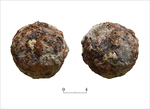
A common-shell cannon ball (diam. c. 75–76 mm, severe corrosion precluding exact measurement; Fig. 16) was found in an earth accumulation close to the surface. The ball is of the round shot type—a solid canon ball containing no explosive—that belonged to a light 3–4 lb canon (Dawson, Dawson and Summerfield 2007:125–126). Balls of this type were in use over a long period of time, from the second half of the fifteenth to the last third of the nineteenth centuries, precluding exact dating for the find. The ball was found opposite the main gate of Yafo, about 400 m from. It was likely shot by the city’s defenders on enemy forces observing the city from this strategic location.
Conclusion
The excavation contributed new information on the agricultural region of Yafo in the Ottoman period, and the process of urbanization at the end of the period and under the British Mandate. The early-phase buildings probably belong to the time when the area was still agricultural. According the local residents, there is a sealed well under one of the buildings adjacent to the excavation. If true, it probably dates to the time of the early-phase buildings. The Egyptian-type saqiye jars align with the historical evidence of the Egyptian fellahin settling in Yafo at that time. The archaeological evidence for the dismantling of the early-phase buildings, and the construction of a new complex over them, illustrates the urbanization process. Wall 1 joins the nearby Siksik Mosque. The late building complex may have been part of the mosque complex, although this cannot be proven as the mosque was since thoroughly renovated and the join with W1 was obscured by the new construction. No building remains predating the Ottoman period were found in the excavation, but as common at most of the excavated sites in Yafo, pottery from the Hellenistic, Byzantine and Crusader periods were found underneath the buildings.
References
Alexandre Y. 2012. The Pottery. In Y. Alexandre. Mary’s Well, Nazareth: The Late Hellenistic to the Ottoman Periods (IAA Reports 49). Jerusalem. Pp. 57–88. https://doi.org/10.2307/j.ctt1fzhd9z.8
Arbel Y. 2010. Yafo Ha-Zorfim Street. HA–ESI 122. https://doi.org/10.69704/jhaesi.116.2004.1474
Arbel Y. 2017. Excavations at the Armenian Compound in Jaffa, 2006–2007: Final Report. In A.A. Burke, K. Strange-Burke and M. Peilstöcker eds. The History and Archaeology of Jaffa 2 (The Jaffa Cultural Heritage Project Series 2; Monumenta archaeologica 41). Los Angeles. Pp. 327–338. https://doi.org/10.2307/j.ctvdmwwr7.27
Arbel Y. 2020. Building Remains from the Hellenistic, Byzantine and Late Ottoman Periods on Ben Gamliʼel Street, Yafo. ʻAtiqot 100:389–402. https://doi.org/10.70967/2948-040X.2115
Arbel Y. 2021a. Stratigraphy. In Y. Arbel ed. Excavations at the Ottoman Military Compound (Qishle) in Jaffa, 2007, 2009 (The Jaffa Cultural Heritage Project Series 4; Ägypten und Altes Testament 91). Münster. Pp. 15–58. https://doi.org/10.2307/jj.18654672.6
Arbel Y. 2021b. New Archaeological Indicators for Muslim Immigrants in Late Ottoman Jaffa. Aram 33:239–258. https://doi.org/10.5194/ica-proc-3-2-2021
Arbel Y. 2026. Reemergence of Street Planning in Yafo (Jaffa): The Late Ottoman Ha-Ẓorfim Compound. ‘Atiqot 120:1–20. https://doi.org/10.70967/2948-040X.2417
Arbel Y. 2021. New Archaeological Indicators for Muslim Immigrants in Late Ottoman Jaffa. ARAM 33(1 & 2):239–258.
Arbel Y. and Rauchberger L. 2020a. Remains from the Hellenistic through the Late Ottoman–British Mandate Periods in the Magen Avraham Compound, Yafo (Jaffa). ʻAtiqot 100:245–277. https://doi.org/10.70967/2948-040X.2104
Arbel Y. and Rauchberger L. 2020b. Remains from the Middle Bronze Age II and the Hellenistic, Roman, Byzantine, Crusader, Late Ottoman and British Mandate Periods on Rabbi Yehuda Me-Raguza Street, Yafo. ʻAtiqot 100:17–52. https://doi.org/10.70967/2948-040X.2083
Ayalon E. 2000. Typology and Chronology of Water-Wheel Pottery Pots from Israel. IEJ 50:215–226.
Ayalon E. 2002. Marseilles Roof Tiles and their Imitations in Israel. In. E. Ayalon and S. Sharif (Safadi). Hidden Palaces: Wall and Ceiling Paintings in Ottoman Palestine (1856–1917) (Eretz Israel Museum, Catalogue). Tel Aviv.
Barkan D. and Bouchenino A. 2012. Yafo. HA–ESI 124. https://doi.org/10.69704/jhaesi.116.2004.2161
Dawson A.L., Dawson P.L. and Summerfield S. 2007. Napoleonic Artillery. Ramsbury.
Dayan A. 2018. Yafo, Ha-Teʻuda Ha-Aduma Street. HA–ESI 130.
https://doi.org/10.69704/jhaesi.116.2004.25484
Gendelman P. and Dayan A. 2020. Pottery Vessels and Stone Artifacts from the Persian, Roman and Byzantine Periods at the French Hospital Compound, Yafo. ʻAtiqot 100:157–188. https://doi.org/10.70967/2948-040X.2094
Haddad E. and Rauchberger L. 2019. A Crusader-Period Moat and Other Remains from Yafo (Jaffa), Yehuda Ha-Yammit Street. ‘Atiqot 95:19*–42* (Hebrew, English summary, pp. 257–259). https://doi.org/10.70967/2948-040X.2069
Henein H. 1997. Poterie et potiers d’Al-Qasr. Oasis de Dakhla. Le Caire.
Israel Y. 2006. The Black Gaza Ware from the Ottoman Period. Ph.D. diss. Ben Gurion University of the Negev. Be’er Sheva‘ (Hebrew; English summary, pp. IV–XII).
Jakoel E. and Marcus J. 2017. The Northeastern Fringes of Yafo (Jaffa) in Light of the Excavations on Jerusalem Boulevard and its Vicinity. ‘Atiqot 88:43*–70* (Hebrew; English summary, pp. 157–158). https://doi.org/10.70967/2948-040X.1799
Kark R. 1990. Jaffa – City in Evolution, 1799–1917. Jerusalem.
Kletter R. 2004. Jaffa, Roslan Street. ʻAtiqot 47:193–207. https://doi.org/10.70967/2948-040X.2190
Ménassa L. and Laferrière P. 1974. La Sāquia; technique et vocabulaire de la roue à eau égyptienne. Cairo.
Mermelstein M. 2021. Yafo, Bet Eshel Street. HA–ESI 133. https://doi.org/10.69704/jhaesi.116.2004.25894
Rauchberger L. 2009. Yafo, Marzuk and ‘Azar Street. HA–ESI 121. https://doi.org/10.69704/jhaesi.116.2004.1075
Rauchberger L. 2017. Ottoman Clay Tobacco Pipes from the Seawall Excavations in Jaffa. In A.A. Burke, K. Strange-Burke and M. Peilstöcker eds. The History and Archaeology of Jaffa 2 (The Jaffa Cultural Heritage Project Series 2; Monumenta Archaeologica 41). Los Angeles. Pp. 249–269. https://doi.org/10.2307/j.ctvdmwwr7.21
Re’em A. 2010. Yafo, the French Hospital, 2007–2008. HA–ESI 122. https://doi.org/10.69704/jhaesi.116.2004.1566
Vincenz A. de. 2017. Ottoman Pottery and Glass Bracelets from Yafo, Jerusalem Boulevard and its Vicinity. ʻAtiqot 88:117–129. https://doi.org/10.70967/2948-040X.1800
Vincenz A. de. 2019a. The Ceramic Assemblage from Kefar Gabirol, el-Qubeibe. ʻAtiqot 96:171–198. https://doi.org/10.70967/2948-040X.2049
Vincenz A. de. 2019b. The Late Ottoman-Period Pottery from Kafr ʻAna, Or Yehuda. ʻAtiqot 95:219–227. https://doi.org/10.70967/2948-040X.2074
Vincenz A. de. 2020a. Byzantine- and Ottoman-Period Pottery Assemblages from Rabbi Yehuda Me-Raguza Street, Yafo. ʻAtiqot 100:75–119. https://doi.org/10.70967/2948-040X.2086
Vincenz A. de. 2020b. Ceramic and Porcelain Vessels of the Ottoman Period from the French School on Yefet Street, Yafo. ʻAtiqot 100:497–512. https://doi.org/10.70967/2948-040X.2123
Vincenz A. de. 2020c. Ottoman–Period Ceramic Artifacts from the Magen Avraham Compound, Yafo. ʻAtiqot 100:293–347. https://doi.org/10.70967/2948-040X.2107
Vincenz A. de. 2021. Porcelain and Ceramic Vessels of the Ottoman Period. In Y. Arbel ed. Excavations at the Ottoman Military Compound (Qishle) in Jaffa, 2007, 2009. The History and Archaeology of Jaffa 4. Münster. Pp. 127–304. https://doi.org/10.2307/jj.18654672.11
Keywords
Jaffa, Late Ottoman period; Refuse pit, Tile floor, Antilia jars, Urbanization process
Publication Date
02/06/2026
Report Type
Final Report
Supplemental Files
Tables for Figs. 14, 15.pdfAppendix 1 – Crusader-Period Pottery and Cypriot Glazed Bowl.pdf