
El-Majami‘ (B-498/2020, B-502/2021)
Permit/License Number
B-498/2020, B-502/2021
Excavation Report
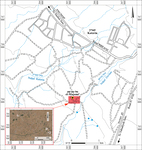
In August 2021, a salvage excavation was conducted along the eastern edge of the abandoned Syrian village of el-Majami‘, on the Golan Heights (Permit Nos. B-498/2020, B-502/2021; map ref. 265000/764100; Fig. 1), following damage to antiquities. The excavation, conducted by Dagesh Tourist Archaeology company on behalf of Ariel University, and funded by the Israel Nature and Parks Authority, was directed by A. Kohn-Tavor, with the assistance of H. Kohn-Tavor (administration), J. Rosenberg (plans), M. Osband, H. Bron and A. Shapiro (pottery consultation), K. Applebaum (pottery drawing), Y. Harari and D. Ben-Yosef (Israel Nature and Parks Authority) and workmen.
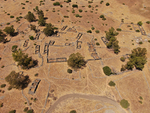
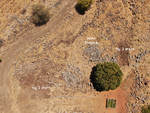
The remains of the el-Majami‘ village extend along the end of a low basalt spur sloping from east to west, north of Naḥal Zavitan (Fig. 2). A previous excavation in the surrounding area uncovered Chalcolithic-period buildings about one kilometer north of the remains of el-Majami‘ (Epstein 1998). An abandoned Syrian village built of fieldstones and hewn stones, as well as a few ashlars in secondary use, was identified in the Katzrin Map Survey, and to its east stood the remains of a large building constructed of fieldstones, perhaps a fort; pottery sherds from Early Bronze Age I, the Early Roman, Middle Roman and Mamluk periods were collected in the survey (Hartal and Ben Efraim 2012: Site 67). Architectural elements, perhaps from an Early Roman synagogue, were also found at the site (Osband, Ben David and Arubas 2020:413–414).
Three excavation squares were opened: Sq. 1 at the edge of the village, and Sqs. 2 and 3 in agricultural areas next to Naḥal Zavitan. Traces of agricultural activity and not in situ pottery from Early Bronze Age I, and the Early Roman (first–second centuries CE) and Ottoman periods were found in the fields at the edge of the site. The finds accord with previous surveys and excavations at the site, and attest that an Ottoman village was built over earlier remains.
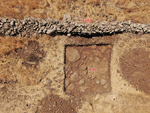
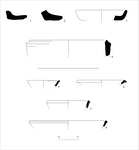
Square 1 (L101; Fig. 3) was opened next to a modern terrace wall (W104) to collect datable finds. A few worn pottery sherds, mostly dating to Early Bronze I, including flat-based bowls (Fig. 4:1–3) and a holemouth jar (Fig. 4:4), all characteristic Golan pottery, were found in a clayey soil fill layer (0.2–0.5 m thick) overlying the bedrock. Finds from the Roman period include Early Roman Kefar Hananya bowl Forms 1A, 4A, 4C (Fig. 4:5–7), and cooking pots (Fig. 4:8) dating to the Roman period. The absence of Kefar Hananya bowl Forms 1C, 1D and 1E, and the absence of the Galilean bowl, one of the most common types of the Late Roman period, indicate that the site did not extend into the third century CE.
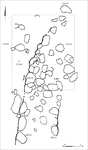
Square 2 (Figs. 5, 6) was opened on a stone-heap (L102) located on a low rock-step. Two rows of large stones were uncovered, perhaps terrace walls (W105), over which a few clearing stones were heaped. A tobacco pipe fragment, dated to the first half of the eighteenth century, was found at the edge of the stone pile (not illustrated).
Square 3 (Fig. 6) was opened over a damaged row of stones, which turned out to be natural and not man-made. No remains of agricultural terracing were found in the excavation boundaries.
A few large clearing-stone piles and a dolmen were found next to the excavation squares. One dolmen was covered by a pile of stones, the other was constructed of a circle (diam. 6 m) of medium-sized stones with a fill of smaller stones, covered with a large covering stone (1.5 × 1.9 m; Fig. 6).
References
Epstein C. 1998. The Chalcolithic Culture of the Golan. (IAA Reports 4). Jerusalem. https://doi.org/10.2307/j.ctt1fzhf0s
Hartal M. and Ben Efraim Y. 2012. Katzrin Map – 18/1 (The Archaeological Survey of Israel).
Osband M., Ben David C. and Arubas B. 2020. Roman-Period Synagogues of the Golan. JRA 33:401–416. https://doi.org/10.1017/S1047759420001087
Keywords
The Golan heights, Early Bronze Age 1, Early Roman period, Ottoman period
Publication Date
02/07/2026
Report Type
Final Report