
Beqo‘a, Areas H–J (A-8772)
Permit/License Number
A-8772
Excavation Report
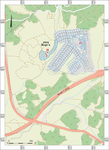
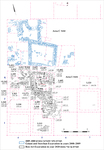
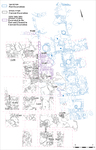
During July–September 2020, a trial excavation was conducted in Moshav Beqo‘a (Areas H–J; Permit No. A-8772; map ref. 192494–3264/637302–493; Fig. 1) after antiquities were discovered in test probes dug prior to construction in the western and northern expansions of the moshav. The excavation, on behalf of the Israel Antiquities Authority and funded by Moshav Beqo‘a, was directed by N. Ben-Ari (preliminary inspection, field photography and pottery), with the assistance of A. Kessler (area supervision), M. Krakovsky (area supervision, flint tools), N. Nehama and R. Abu Halaf (administration), S. Halevi (photogrammetry and aerial photography), O. Zakaim (drafting and plans), Y. Weingarten (supervision, stone tools), J. Tiano, H. Shliker and D. Benayoun (supervision) and O. Shalev (IAA outreach program). Further assistance was provided by T. Kanias, B. Storchan, Y. Zelinger and A. Shadman from the Jerusalem District and A. Golani from the Research and Specializations Department of the IAA. We thank E. Kogan-Zehavi for allowing us to present the plan of her previous excavation in Area J (Permit No. A-5412).
In the recently built western and northern expansions of the moshav, previous excavations uncovered remains from various periods.
In the moshav’s western expansion, settlement remains, including buildings and installations dated to the Chalcolithic period (Ghassulian culture) and the Early Bronze Age IB, were found (Ben Ari 2021; Golani, Storchan and Eirikh-Rose 2018). Burial caves dating to the Persian–Hellenistic and Roman periods and agricultural installations and rock cuttings of unknown date were also discovered (Golani 2011; Kogan-Zehavi 2016). In the northern expansion of the moshav, excavations revealed settlement remains dating to the Late Bronze Age (Kogan-Zhavi 2008) and a large burial cave from the same period that was damaged during the development work (S. Gendler, pers. comm.; Permit No. A-9937).
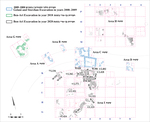
During the present excavation, two settlements located c. 800 m apart and dated to different periods were uncovered. Architectural remains and pits were found in the western expansion of the moshav (Areas H and I) and relate to the Chalcolithic (Ghassulian culture; Stratum 3) and Early Bronze Age IB (Strata 2 and 1) settlement discovered in earlier excavations. Muslim pit graves were dug into these remains, probably by the inhabitants of the now depopulated village of Deir el-Muḥaysin whose presumed location is inside Moshav Beqo‘a and to its east. In the northern expansion of the moshav (Area J), additional parts of the Bronze Age settlement that was previously excavated were found, with the remains belonging to two strata (1 and 2). Here the excavation uncovered building remains, smoothed working surfaces hewn into the bedrock and earth fills that were used to level the surface and contained sherds and flint tools from the Middle and Late Bronze Ages.
The Chalcolithic Period (Ghassulian Culture; Stratum 3; Fig. 2)
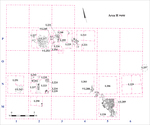
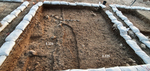
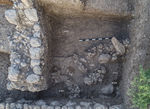
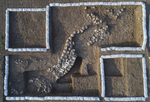
Area H (Fig. 3). A pit dug into the ground (L226; Fig. 4) and an adjacent habitation level (L225) were uncovered in Sq P3. Another pit (L257) was uncovered in a probe to the east of Sq O6; it was not excavated. In Pit 226, thousands of pieces of knapping debitage, representing the complete chaîne opératoire from the raw material to the fully prepared tool, were found. In nearly all the squares in which excavation of the fills and soil accumulations extended below the remains of Stratum 2 (Early Bronze Age 1B, see below), there were rich finds from the Ghassulian culture, including mainly assemblages of pottery, flint and stone tools. Red sterile soil was found in some locations.
Area I (Figs. 5, 6). Packed earth floors (L418, L422), stumps of walls (W419, W420), a pit/installation (L414) and a collapsed stone heap (L421) were found. The finds include rich assemblages of pottery, flint items and stone tools. A layer of pottery and flint items (L333) dated to the Chalcolithic period was found in the eastern part of the area in Sq K7, and below it there was sterile soil.
The Early Bronze Age IB (Strata 2, 1)
Area H (Fig. 3). A pit (L234) and two mudbrick walls (W233, W252; Fig. 7) were uncovered in Sq N2 and attributed to the early Stratum 2. A pit dug into the ground (L253) and a leveled surface of mudbrick material covered with clay (L245) were found in Sq P3. The later Stratum 1 was uncovered 0.1–1.0 m below the site surface, and its remains were found in nearly all the excavation squares and on the adjacent site surface outside the squares. The remains include wall stumps (W205, W211, W219), patches of stone bedding (L209, L217, L242) and a dug pit (L224).
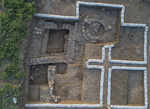
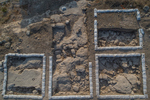
Area I (Figs. 5, 8). A square building (W356, W385, W394) with rounded corners was attributed to the earlier Stratum 2; the building’s foundations were laid directly over remnants of Stratum 3. The building was part of a complex that included another building and a granary that were built adjacent to it in the north and were previously uncovered in Area C (Golani, Storchan and Erikh-Rose 2018: Plan 2). The northern part of the building was below the remains of Stratum 1 and was not fully excavated. Another granary (L400), rounded and typical of the period, was uncovered next to the previously exposed southern corner of the building (Golani and Yannai 2016). West of the building, excavations uncovered a limited part of a small-stone surface (not in the plan), which was laid directly over remains from Stratum 3 and may have been part of the building’s courtyard. In the southern part of the area, in Stratum 2, several segments of a wide wall (W303; width c. 1.5 m; Figs. 2, 9) with a rounded outline were found. The wall was not evenly constructed, partly built into a sterile red soil layer and partly over it, as can be seen by its central segment. It was comprised of two rows of large stones with a dense fill of small and medium stones. Where the wall was dug into the red soil, pottery dated primarily to the Early Bronze Age IB, with some also dating to the Chalcolithic period, was found. The wall was damaged by later disturbances, including at least two of the recent pit graves (below).
At the time of Stratum 1, heaps of collapsed stones from the inner faces of W356 and W385 and the outer face of W385 (L389) were leveled to prepare the area for renewed construction, and the square building went out of use. In the previously excavated Area C, a similar phenomenon was previously observed in connection with the above mentioned building, whose collapsed heaps appear to have been leveled for renewed construction (Golani, Storchan and Eirikh-Rose 2018:18). Layers of small stones uncovered in nearly all the excavated squares were also attributed to Stratum 1. On the northern exposed edge of the Stratum 2 square building, next to the small-stone layers, there were the stumps of a wall (W386) and stone bedding of two floors (L367, L402), some constructed over the remains of the Stratum 2 building. A few of the remains were laid directly over a sterile red soil layer, attesting to the expansion of the settlement in this stratum beyond the boundaries of Stratum 2. It also seems that W303 from Stratum 2 remained in use during the time of Stratum 1.
The Late Bronze Age
Area J (Fig. 10). Three building phases (A–C) were identified. The early Phase C was exposed to a limited extent in three squares, revealing that it consisted of a dense fill of small stones and reddish-brown soil (e.g., L650) with only few finds; the latter included Middle and Late Bronze Age pottery sherds and stone tools. In several places, sterile terra-rossa soil was uncovered underneath the small-stone fill.
Remains attributed to Phase B include a stone bedding of a floor (L658; Fig. 11), a floor bedding (L654) that abutted a wall (W652) and a dense fills of fieldstones of various sizes used to level the area around the patches of smoothed bedrock, which served as work surfaces (Fig. 11). While only partially preserved, floors of packed earth (L601, L608, L609, L622, L634) appears to have been laid over this stone fills. In some places, earlier rock cuts and installations whose stratigraphic context is unclear went out of use when this fill was laid down. The finds from this phase comprise Middle and Late Bronze Age pottery sherds and flint tools, as well as basalt and beach-rock grinding tools and shells from the Mediterranean and Red Seas.
The remains from the later Phase A comprised a pit (L610), a few walls (W611, W626, W647; see Fig. 11) and fragments of ṭabuns. In addition, Middle and Late Bronze Age pottery sherds and flint tools, as well as many basalt and beach-rock stone tools, a single metal object, an awl or a needle and shells from the Mediterranean and Red Seas were found.
The Ottoman Period to Recent Time
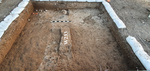
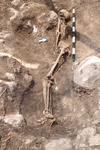
Area I. Eight pit graves (not in the plan), which intruded into the early remains, such as those penetrated to W303 (above), were uncovered. The deceased were interred as primary burials without grave goods. They were laid on their right side, feet to the east and head to the west and facing south (Fig. 12). The body orientation indicates that they were Muslim, perhaps from the Arab village of Deir el-Muḥaysin. Similar graves were uncovered in previous excavations at the site (Golani, Storchan and Eirikh-Rose 2018:19, Fig. 14).
Area J. Terrace and division walls (not illustrated), which were built on the mound's soil and over the early remains, were found. They may date to the time of the Arab village, Deir el-Muḥaysin, or even earlier. In addition to many finds from the Middle and Late Bronze Ages, a few primarily worn pottery sherds dating to the Roman–Byzantine and the Ottoman periods were found, as well as glass-vessel fragments dating to the British Mandate period (not illustrated).
The excavation uncovered additional parts of the ancient settlements previously discovered in Moshav Beqo‘a. Three strata of the rural settlement dating to the Chalcolithic period and the Early Bronze Age I were uncovered in the moshav’s western expansion. Part of another rural settlement dating to the Late Bronze Age was uncovered in the northern expansion. It is possible that the Middle Bronze Age pottery assemblage that was found in this part of the site was brought from a nearby settlement together with soil and numerous stones as part of extensive leveling work during the Late Bronze Age. The layer of mound soil that extends westward beyond the excavation boundaries, and formerly extended eastwards (in the previous excavations) as well, indicates that the excavation area was part of a multi-strata site. The remains and finds from the Late Bronze Age in Area J may have been part of an area of industrial activity. The combination of the many stone tools and smoothed bedrock surfaces indicates grinding and crushing activities, perhaps of agricultural produce. The fragments of Canaanite jars, found in all three constructional phases, combined with the basalt and beach-rock vessels and shells from the Mediterranean and Red Seas, point to the connection of the settlement economy to trade networks. Rural Late Bronze Age settlements in Israel are not as well researched as the well-known tell sites of large urban centers, emphasizing the importance of the present site.
References
Ben-Ari N. 2021. Beqo‘a. HA–ESI 133. https://doi.org/10.69704/jhaesi.116.2004.25898
Golani A. 2011. Beqo‘a. HA-ESI 123. https://doi.org/10.69704/jhaesi.116.2004.1783
Golani A. and Yannai E. 2016. Storage Structures of the Late Early Bronze Age I in the Southern Levant and the Urbanization Process. PEQ 148/1:8–41. https://doi.org/10.1080/00310328.2015.1096049
Golani A., Storchan B. and Eirikh-Rose A. 2018. The Chalcolithic and Early Bronze Age IB Site of Beqo‘a. ‘Atiqot 90:9–54. https://doi.org/10.70967/2948-040X.1825
Kogan-Zehavi E. 2008. A Rural Settlement from the Late Bronze Age II at Beqo‘a. In D. Amit and G.D. Steibel eds. New Studies in the Archaeology of Jerusalem and Its Region. Collected Papers II. Jerusalem. Pp. 116–121.
Kogan-Zehavi E. 2016. Khirbat el-Meisiya. 2016. HA-ESI 128. https://doi.org/10.69704/jhaesi.116.2004.24938
Keywords
Chalcolithic period, Ghassulian culture, Early Bronze Age IB, Middle Bronze Age, Late Bronze Age, Ottoman period, Muslim pit graves
Publication Date
02/07/2026
Report Type
Preliminary Report