
Khirbat Khushaibe (North) (A-9332)
Permit/License Number
A-9332
Excavation Report
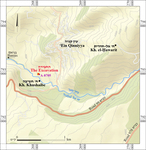
In August 2022, a salvage excavation was conducted north of Khirbat Khushaibe (Permit No. A-9332; map ref. 26810/79294; Fig. 1), prior to construction The excavation, on behalf of the Israel Antiquities Authority and funded by the ‘Ein Qinniyya Local Council was directed by T. Badichi (field photography), with the assistance of A. Kleiner (surveying and photogrammetry), E. Dalali-Amos (drafting), A. Shapiro (GIS), R. Be’eri (scientific consultation) and H. Tahan-Rosen (pottery drawing).
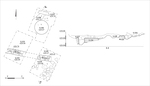
The excavation was located on an agricultural terrace on a hillslope north of the northern bank of Naḥal Sa‘ar, at the foot of the Druze village of ‘Ein Qinniyya on the southwest. A Roman-period wall and large hewn limestones were uncovered (Figs. 2, 3; 3D model).
Remains of a building, a water canal and an agricultural terrace retaining wall dated to the Roman period were uncovered in a previous excavation about 5 km east of the present excavation (Badichi and Shapiro 2024 [Fig. 1: A-8705]).
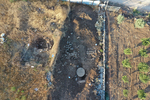
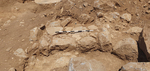
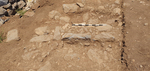
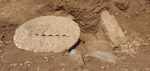
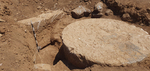
Two segments of an east–west oriented wall (W121; length exposed 6.8 m, width 0.65 m, height exposed 0.5 m; Figs. 4, 5), built of two rows of hewn basalt stones with a few limestones between them, were uncovered. The wall was not excavated down to its foundations. Earth accumulations and collapsed stone heaps (L122, L124, L125, L128) lay on both sides of the wall. A round, well-dressed but not smoothed limestone (L126, diam. 1.9 m, 0.8 m thick; Figs. 6, 7) with a shallow depression at its center, was found about three meters north of the wall, and adjacent to it on the north, a roughly dressed rectangular stone (0.5 × 1.8 m) was found, but not fully exposed.
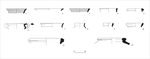
A few sherds of pottery vessels characteristic of Roman-period sites in the northern Golan were found, including a Terra Sigillata bowl, dated to the first–early second centuries CE (Fig. 8:1), a Banias-type bowl (Fig. 8:2), common local plain bowls (Fig. 8:3, 4), a mortarium (Fig. 8:5), a Kefar Ḥananya-type Form 3B cooking pot (Fig. 8:6), Ḥawarit-ware cooking pots (Fig. 8:7–9), a jar (Fig. 8:10) and pithoi (Fig. 8:11, 12).
The construction style of the wall exposed in the excavation is similar to that of the building previously found c. 5 km to its east, and it is dated by the pottery to the same period (second–third centuries CE). The wall and building may be associated with the same complex. The two hewn limestones are probably associated with another building whose relation to the wall was not clear. The round stone may possibly have served as a base for a large column or for another architectural element. Since the local bedrock in the area is basaltic and not calcareous, the limestones must have been intentionally brought to the site, perhaps for use in a public building. The present excavation and the one conducted to its east indicate that there were a few buildings here in the Roman period, perhaps associated with a public building complex.
References
Badichi T. and Shapiro A. 2024. Khirbat Khushaibe (North). HA–ESI 136. https://doi.org/10.69704/jhaesi.116.2004.26521
Hartal M. 2006. Land of the Ituraeans: Archaeology and History of the Northern Golan in the Hellenistic, Roman and Byzantine Periods (Golan Studies 2). Qazrin (Hebrew).
Libner U. 2018. Khirbet Wadi Hamam — A Roman-Period Village and Synagogue in the Lower Galilee. (Qedem Reports 13). Jerusalem.
Slane K.W. 1997. The Fine Wares. In S.C. Herbert ed. Tel Anafa II, i: The Hellenistic and Roman Pottery (JRA Suppl. S. 10). Ann Arbor.
Keywords
Ein Qinniyya, Roman period, Golan, public building, agricultural terraces, Terra Sigillata, Kefar Hananya
Publication Date
02/07/2026
Report Type
Final Report