
Ḥorbat Rosh (A-9331)
Permit/License Number
A-9331
Excavation Report
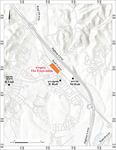
During June–August 2022, a salvage excavation was conducted northwest of Ḥorbat Rosh, next to the entrance to the settlement of Laqiya (Permit No. A-9331; map ref. 188099–440/581777–2210; Fig. 1) prior to expanding the settlement. The excavation, on behalf of the Israel Antiquities Authority and funded by the Authority for Development and Settlement of the Bedouin in the Negev, was directed by A. Peretz (field photography) and M. Margolis, with the assistance of F. Kobrin (grading), E. Aladjem (survey and photogrammetry), M. Kahan (surveying), Y. Alamor and R. Abu-Halaf (administration), A. Golani (consultancy and guidance), S. Talis (scientific guidance), Y. Nagar (physical anthropology), Y. Gorin-Rosen (glass), A. Montagu (plans) and workmen from the Hebron area.
The excavation was located c. 400 m northeast of Ḥorbat Rosh, an archaeological site upon which a large number of houses of the settlement Laqiya was built. In clearance works that had been conducted in the vicinity of Ḥorbat Rosh in 2001, a Byzantine-period cemetery was found, containing 60 cist tombs, some of them oriented east–west and some northwest–southeast (Sonntag 2005). Previous excavations on Tel Rosh, about 800 m southeast of the excavation area, uncovered remains of a farmhouse, a cistern, a columbarium and a winepress, which are probably associated with the agricultural hinterland of the settlement that was located at Ḥorbat Rosh, and attest to the industry practiced there (V. Nikolsky-Carmel, pers. comm.). Seven tombs dated to the Byzantine period had been previously uncovered at Ḥorbat Liqit, about c. 2 km southwest of the present excavation (Nagar and Sonntag 2008:81–83).
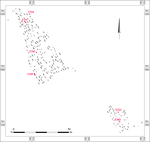
A cemetery with two sections (northern and southern) about 40 m apart was uncovered in the present excavation (Fig. 2). Two hundred and fifty-six pit tombs and cist tombs were discovered in this cemetery, dated to the fourth century CE, which is also known as the transition from the Late Roman to the Byzantine period. The tombs in both sections are oriented northwest–southeast and most of them were dug into the easy to dig young loess earth. It seems that the tomb-diggers tried to avoid digging tombs into the hard carbonaceous loess earth, and avoided quarrying the bedrock, or the dense stone layer above it. These conditions probably explain the narrowing of the northern part of the northern section, where the bedrock and carbonaceous loess earth are close to the surface. Two hundred and four tombs were exposed in this larger northern section (length c. 70 m, width 7.0–33.1 m). However, the northeastern boundary of the northern section is not clear, due to an active Bezeq line passing through it that prevents clearance and excavation. In the southern section fifty-two tombs were exposed (length c. 23.7 m, width c. 13.5 m). Unfortunately, the same Bezeq line that crosses the northern section also crosses through the center of the southern one, therefore a strip (width c. 2.5 m) along the line was only partially excavated. The Bezeq line damaged one tomb (T323), leaving only scattered scraps of bones. Clearance work and probes in the area between the two sections identified no additional tombs.
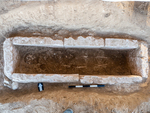
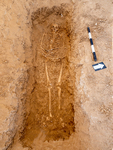
Most of the tombs in both sections are pit tombs, dug into the ground (length 0.48–2.3 m) and covered by chalk slabs hewn mostly on their inside face. The rest of the tombs are cist tombs that are dug into the ground and lined with stones (length 0.99–2.40 m; Fig. 3) and similarly covered. Crosses were engraved on five tombs—on the outer face of the covering stones of two, on the inside face of the covering stones of two others, and two crosses were engraved into the lining stones of one cist tomb, next to the head of the interred body.
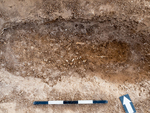
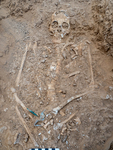
Infants, children and adults of both genders and of wide age-range (six months to 70 years at least) were buried in both sections—a typical distribution for the period. The bones were poorly preserved in most tombs, and in a few, mostly those of children, only scraps of bones or were found, or nothing at all (e.g., Tomb T302; Fig. 4). In most tombs there was found a single interred individual, but in some tombs there were more, especially in children’s tombs. The interred individuals were placed supine, most of them facing east. In some tombs the head rested on the side of the tomb, and in some a stone was placed under the head, or an earth ‘pillow’ was formed (e.g., Tomb T203; Fig. 5). In the rest of the tombs the head was found directly on the floor, either because this was its original placement, or because it dropped from the side once the soft tissues rotted. The arms were placed next to the body or on the belly, and the legs were laid close together.
The Material Culture. In most of the tombs, no finds were discovered at all, and in a minority of them, many finds or only a few items were discovered. The excavation uncovered a limited number of ceramic fragments alongside dozens of glass vessels, hundreds of beads and assorted metal, stone and bone implements.
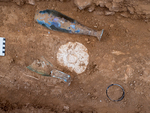
The glass vessels date the cemetery to the fourth century CE, also known as the transition between the Late Roman and Byzantine periods, however, some glass vessels may have remained in use until the beginning of the fifth century CE. The assemblage of glass vessels is interesting and important and includes vessels that are partly known from tombs excavated in the northern Negev or in other areas, and some are unique and not known at all from other excavations. Moreover, the vessels have characteristics that associate them with a particular workshop. All the glass vessels in the tombs are closed shapes: bottles, jugs, juglets, amphoriskoi (small jars), jars, and cosmetic vesselsMost were found broken, but a few were intact or complete. The jugs include several dozen vessels, from which one type of jug stands out, and appears in two or three sizes. Of that particular jug some were found without decoration and some with decoration in the form of a pattern of rotated vertical ribs. A rare intact version of this jug was found in one of the tombs (T141; Fig. 6). = A similar jug was found in a burial cave at Ḥeletz and was dated to the fourth century CE (Rahmani 1961:154). Other glass finds are kohl containers, some containing bronze cosmetic spatulas (see Fig. 5). Lastly, an unusual and rare vessel that was found was a decagon jar with two handles, which was blown into a mold in the shape of vertical ribs, and twisted to create diagonal ribs.
Approximately 300 beads of glass and other materials were found in the tombs whose dates are similar to the glass vessels Some of the beads were made using an intricate glass mosaic, while others are simply decorated. A wide variety of amber beads and a number of stone and coral beads were also found some of which are tiny (diam. less than 2 mm). The beads represent a very wide variety of simple and complex types that add another layer of information about burials and the buried.
The metal objects include many pieces of jewelry, including bracelets, earrings, rings, beaded necklaces, a few bib necklaces, as well as kohl sticks for applying cosmetics, hairpins and a number of pendants, one of them in the shape of a cross made of lead that was found in a child’s grave. Some of the metal objects retain remnants of textiles and threads, probably from shrouds or the clothes of the deceased, which were transferred to the Israel Antiquities Authority’s organic laboratory for treatment.
Three of the tombs contained mirrors made from chalk stone. Two of the mirrors are well preserved (see Fig. 6), but without the glass in the center, while the third was found in poor preservation with a few glass fragments.
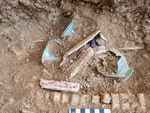
The bone artifacts include three bracelets, rings and some cosmetic utensils, probably made of ivory originating from a hippopotamus tooth; they are poorly preserved. In two tombs, once some of the ivory utensils were removed, traces of a purplish cosmetic material were found (Fig. 7—Tomb T254), samples of which were collected for composition analysis.
This excavation revealed a large cemetery with two sections, which served the settlement at Ḥorbat Rosh during the transition from the Late Roman to the Byzantine period. The remains and finds from this excavation, and the previous excavation that was conducted in the vicinity of Ḥorbat Rosh (Sonntag 2005), and especially the large number of tombs that were found, indicate a settlement that existed for a long period of time and had a number of cemeteries; they may have also served the settlement on nearby Tel Rosh. From the rich assemblage found in some of the tombs further suggests a well-established settlement. There is still a need for further analysis of the anthropological and material-culture finds in order to understand the size of the population and how well-established it was, particularly because Ḥorbat Rosh has never been excavated, while at Tel Rosh, only the east fringe of the site has been excavated. The plentiful glass finds, in particular the jugs, indicate that a possible glass workshop may have been active in one of the two nearby sites. Since the two sections of the cemetery are identical in burial features and in the material culture, it seems that this is a single cemetery that was divided into two sections because of the high level of carbonaceous loess. At the time of writing, it is unclear if the two sections were used at the same time or one after the other when one section was full.
References
Nagar Y. and Sonntag F. 2008. Byzantine Period Burials in the Negev: Anthropological Description and Summary. IEJ 58:79–93.
Rahmani L.Y. 1961. A Tomb from the Fourth Century A.C. in Ḥeletz. BIES 25:150–156 (Hebrew; English summary, p. III).
Sonntag F. 2005. Ḥorbat Rosh. HA–ESI 117. https://doi.org/10.69704/jhaesi.116.2004.110
Keywords
pit tombs, cist tombs, the transition between the Late Roman and Byzantine periods, the Byzantine period, glass vessels, beads, metal objects, stone, bone objects, mirrors made from chalk stone
Publication Date
02/07/2026
Report Type
Preliminary Report