
Jerusalem, Shemu’el Ha-Navi Street (A-9394)
Permit/License Number
A-9394
Excavation Report
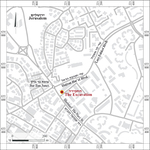
In September 2022, a salvage excavation was carried out in 66 Shemu’el Ha-Navi Street, Jerusalem, southeast of Bar Ilan junction (Permit No. A-9394; map ref. 220939–70/633627–67; Fig. 1), prior to the extension of a residential house. The excavation, on behalf of the Israel Antiquities Authority, was directed by I. Novoselesky, with the assistance of V. Essman and S. Halevi (surveying, field photography and photogrammetry), S. Baley (area supervision), O. Zakaim (plans), A. Gyerman-Levanon (digital documentation), Y. Zelinger (pottery consultation) and the contractor’s workers.
The excavation was located within the area of the northern necropolis of Late Second Temple-period Jerusalem (first century BCE–first century CE). Many excavations conducted throughout this area have uncovered many rock-hewn burial caves, some in an area of extensive stone quarries (Kloner and Zissu 2003:251–271).
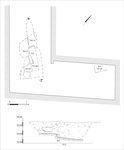
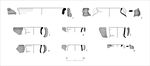
The present excavation (c. 25 sq m) exposed the remains of an ancient quarry (L2, L3; Fig. 2), at a depth of c. 1.5 m below the surface. Characteristic quarrying steps (height 0.2–0.4 m) were exposed, as well as severance channels indicating the quarrying of medium-sized stones (width 0.3–0.5 m). An unsevered stone (0.5 × 1.2 m) was uncovered in a probe dug in the eastern part of the excavation area. Dark brown soil mixed with pottery, including a bowl (Fig. 3:1), a cooking pot (Fig. 3:2), jars (Fig. 3:3–7) and a juglet (Fig. 3:8), all dating to the first century BCE–first century CE, accumulated above the quarry, the pottery and the location indicating that it was probably active in the Late Second Temple period.
References
Kloner A. and Zissu B. 2003. The Necropolis of Jerusalem in the Second Temple Period. Jerusalem (Hebrew).
Keywords
quarry, Second Temple-period, necropolis
Publication Date
02/07/2026
Report Type
Final Report