
Rummana (A-9404)
Permit/License Number
A-9404
Excavation Report
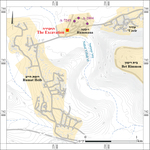
During September 2022, a trial excavation was conducted at the village of Rummana in the Lower Galilee (Permit No. A-9404; map ref. 229217–52/743596–629; Fig. 1), prior to construction work. The excavation, on behalf of the Israel Antiquities Authority, was directed by K. Hako (field photography), with the assistance of Y. Yaakobi and J. Zilpa (administration), A. Shichman (preliminary inspection), Y. Shmidov (field photography and photogrammetry), R. Be’eri (scientific guidance), R. Avrahm Yanuka (health and safety), O. Zingboym and H. Mamalya from the IAA Northern Region and workmen from the IAA.
The excavation was conducted in the western part of the village of Rummana, on the fringe of the Bet Rimmon Valley c. 1.5 km east of Ḥorbat Ruma. The village preserved the name of biblical Rimmon, which was located on the northern border of the territory of Zebulun, between Gat Ḥefer and Ḥanaton (Aharoni 1976). Two prior excavations that were conducted to the northeast of the present excavation exposed building remains and pit tombs dated to the Persian period, building remains dated to the Roman period and pottery fragments from the Early Bronze Age, Intermediate Bronze Age, Iron Age and Mamluk and Ottoman periods (Stepansky 2002 [Fig. 1: A-2804]; Feig 2016 [Fig. 1: A-7245]).
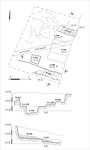
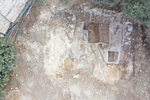
One excavation square was opened in the present excavation (Figs. 2, 3), and two quarried plastered pits (L103, L104), two plaster floors (L108, L109) and two walls (W106, W107) were uncovered.
Pit 103 (0.82 × 0.82 m, depth unknown) was coated with two plaster layers. Two steps (height 0.35 m) hewn into the partially exposed northern wall of Pit 104 (c. 1.7 × 2.0 m, depth unknown) led to its bottom. Body fragments of Roman-period pottery were found in and around a soil accumulation in Pit 104; therefore, it seems that the pit went out of use during or after the Roman period. Small fragments of limestone, chunks of plaster and large tesserae were also found in the soil accumulation. This may indicate that the pit was part of an industrial installation. The plastering in both pits indicates that they were associated with liquids and may have been part of a winepress.
Plaster Floors 108 and 109 flanked Pit 104. Each had at least three layers, indicating repairs and additions over the years. The floors abutted Wall 106 (length 2.5 m, width 0.6 m, height 0.3 m) and Wall 107 (length 1.4 m, width 0.55 m, height 0.66 m). Wall 106 was built of fieldstones and plastered on both faces, while Wall 107 was built of dressed fieldstones and plastered only on its southern face.
The remains found in the excavation appear to have been part of an installation, perhaps an industrial winepress, which went out of use during the Roman period or later. The excavation area may have been part of an industrial area on the southwestern boundary of the Roman settlement.
References
Aharoni Y. 1976. Rimon. Biblical Encyclopedia: A Treasury of Knowledge on the Bible and its Times 7. Jerusalem. P. 378 (Hebrew).
Feig N. 2016. Rumana. HA–ESI 128. https://doi.org/10.69704/jhaesi.116.2004.24905
Stepansky J. 2002. Salvage Excavations in Rumana. In Z. Gal ed. Eretz Zafon: Studies in Galilean Archaeology. Pp. 107–118. Jerusalem (Hebrew; English Summary, p. 180*).
Keywords
Bet Rimmon Valley, Roman period, industrial winepress
Publication Date
02/07/2026
Report Type
Final Report