
Jerusalem, Mount Zion – 2021, 2022 (G-50/2021, G-43/2022)
Permit/License Number
G-50/2021, G-43/2022
Excavation Report
In 2021 and 2022, two excavation seasons were conducted on the premises of Dormition Abbey on the summit of Mount Zion (License Nos. G-50/2021, G-43/2022; map ref. 221735–95/630940–65). The research excavation, undertaken on behalf of the German Protestant Institute of Archaeology (GPIA; Deutsches Evangelisches Institut für Altertumswissenschaft des Heiligen Landes) in collaboration with the Israel Antiquities Authority (IAA) and funded by the Gerda Henkel Stiftung (the survey: AZ 03/V/22) and the Düsseldorfer Wissenschaftsförderungsgesellschaft (the excavation: KH 22202410), was directed by D. Vieweger with the assistance of J. Zimni-Gitler, K. Soennecken and M. Chernin (area supervision), P. Leiverkus (IT support, measurements, photogrammetry) and H. Krummel, P. Leiverkus, C. Mischka, S. Möhring, K. Rassmann, R. Scholz and K. Winkelmann (geophysical survey, drilling and soil chemical analysis). Thanks are due to the staff of Dormition Abbey for their kind permission to excavate on their premises and their support of the expedition.
The first excavations on Mount Zion were conducted in 1898 when the modern Dormition Abbey was constructed (Renard 1900). The remains of ancient walls, cisterns and graves were discovered at the time by the architect P. Palmer (see Mommert 1898: Pl. 12). A review of the excavation findings and plan by L.-H. Vincent in 1922 revealed the existence of the important Byzantine-period church at the site, an identification which subsequently became widely accepted among scholars today (Vincent and Abel 1922: Pl. XLVIII; see also Küchler 2007: Fig. 342). It is now known that the Byzantine-period church on Mount Zion was constructed between 386 and 394 CE (Pringle 2007:265). The Crusaders must have seen the church in ruins in 1099, following severe damage to the building in 966 CE when Christian churches were ransacked (Saʿīd 1924:5, 18, 699–833), and again in 1009 CE when the Fatimid Caliph al-Hakim ordered another such destruction targeted at non-Islamic sites (Küchler 2007:447–448). The Crusaders rebuilt and enlarged the church of Sancta Maria in Monte Sion and added a fortified monastery at the same spot (Hiestand 1985), now outside of the city walls, as attested in the twelfth-century maps of Cambrai and Den Haag.
An excavation conducted on the premises of Dormition Abbey in 1983 revealed an Early Roman-period domestic quarter and a Crusader-period church (Eisenberg 1984). In the Armenian cemetery on Mount Zion, M. Broshi unearthed a Byzantine-period street and a 2.25-m-thick wall, which he interpreted as the boundary wall of a monastery (Broshi 1976:87).
The current excavations, continuing previous work on Mount Zion at the Anglican-Prussian Cemetery and the ‘Greek Garden’ (Areas I–III), took place in the garden of Dormition Abbey at the summit of Mount Zion, north of the abbey’s Bet Yosef dormitory. The previous excavations in the Anglican-Prussian Cemetery (Area I) revealed segments of the city walls from various periods—the late Hellenistic, Hasmonean, Herodian and Byzantine periods—as well as a city gate with three phases of use, assigned to the time of Herod, Hadrian and the Byzantine period, and part of an adjacent domestic quarter, dating from the Early Roman to the Umayyad periods (Schöpf et al. 2020:271–279; Zimni 2023:74–394). In the ‘Greek Garden’ (Area II), remains of a Byzantine-period villa with a well-preserved mosaic floor were found (Schöpf et al. 2020:280–284; Zimni 2023:264–268). Further exposure to the southeast of the ‘Greek Garden’, along the hewn edge of the bedrock (Area III), uncovered Early Roman-period domestic structures, which stood until the Roman conquest of 70 CE, and the remains of a tower and a fosse from the Ayyubid period (Schöpf et al. 2020:285–288; Vieweger and Würz 2021; Zimni 2023:150–154).
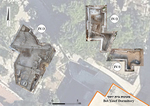
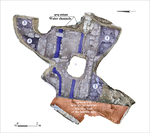
The present excavation opened two new areas (Area IV in 2021 and Area V in 2022); Area IV was divided into three subareas (VI/1, VI/2, VI/2; Fig. 1). The excavation unearthed additional remains from the time of the Byzantine- and Crusader-period churches and monastery, as well as from several other periods, in an area that presumably lay in the vicinity of the ancient churches. The excavation, in combination with surveys employing geophysical prospecting, drilling and soil analysis, aimed to reconstruct the layout of the ancient monastery and explore the connection between the church, the monastery compound and the residential neighborhoods exposed in excavation Areas I–III.
Area IV
Sub-Area IV/1
This sub-area, in the east of the Dormition Abbey garden and along a pathway leading to ‘King David’s Tomb’, yielded a modern-day horizon just below topsoil with canning packages and ammunition of an army outpost of the Israel Defense Forces from the 1950s and 1960s; below it was a layer with Ottoman-period Black Gaza Ware sherds, while further down was a dense fill layer of an unidentifiable nature, comprising small–medium-sized fieldstones.
Sub-Area IV/2 (Fig. 2)
This subarea, excavated down to bedrock, revealed several structures. Initially encountered was a layer of large collapsed stone blocks, probably remnants from the earthquakes of 747–749 CE. Below that layer were two fieldstone walls with their corresponding foundation trenches, one running northeast–southwest (W1), of which only the eastern face was exposed, and the other running east–west (W2), consisting of only two exposed stone blocks lying over bedrock. Also found was a plastered and covered water channel running northeast–southwest, dated to the late Byzantine or Umayyad period; it probably went out of use due to gradual infilling or destruction in the eighth century CE. The exposed part of W1 comprised three rows of fieldstones at its topmost course and three more courses of smaller fieldstones underneath it. The finds associated with W1 suggest a Byzantine-period date (fifth–seventh centuries CE), while those associated with W2 suggest a Late Hellenistic or Early Roman date. South of W2 were many pieces of wall plaster overlying bedrock. The bedrock revealed possible signs of quarrying activity.
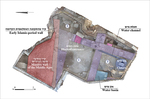
Sub-Area IV/3 (Fig. 3)
This subarea was covered with garden fill from the first half of the nineteenth century that contained a large quantity of Ottoman-period pottery. Underneath it was a chalk fill layer that sealed Byzantine- and Umayyad-period residential structures; earlier Iron Age pottery was also found in association with these structures. The building remains consisted of a central room (Room 1) and two other adjoining rooms (Rooms 2 and 3), as well as another room that may have been a cellar at one time. The building’s layout and construction resemble the typical Byzantine-period residential buildings found in Area I (Schöpf et al. 2020:271–279; Zimni 2023:316–379). It is presumed that the structure was built over after the Umayyad period.
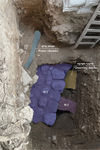
Room 1. This rectangular room (3 × 4 m) has a floor made of thick white plaster; a small pit in the floor was exposed in the room’s southeastern corner. Connected to the floor was a channel that exited from an installation with an integrated water pipe in the eastern wall (Fig. 4) that may have led to a water reservoir at a lower elevation, possibly on a lower story of the building, or to a cistern exposed in Room 3 (below).
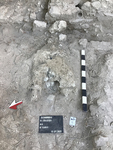
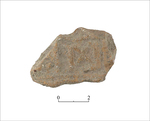
The fill of the room consisted of huge amounts of crushed limestone, mortar, small charcoal particles, limestone chunks that had melted together and rooftiles, which might be the remains of a destructive event, possibly the earthquakes in 747–749 CE (see also the 14C date of Context 10959: 95.4% — 666–774 CE). Based on the pottery and the stamping of the rooftiles (Fig. 5), it is possible to date the exposed rooms, and likely the entire building, to the Byzantine period.
In a later phase, the northern side of Room 1 was overbuilt by a wall (Fig. 3) made of irregularly formed ashlar blocks, running from east-northeast to west-southwest. The substructure of the wall consisted of a very compact layer containing abundant mortar and numerous rooftiles; an Umayyad-period coin found in this layer indicates the date that the new structure was built over the Byzantine-period building.
Still later, a massive wall (3.2 m wide) running west to east cut parts of the wall between Rooms 1 and 2. The massive wall is partly cut out of bedrock and partly built of large ashlar blocks. Its original height may be estimated at 6–8 m. The course of this wall runs roughly parallel to the longitudinal axis of the Byzantine- and Crusader-period church in the compound and the course of the suggested boundary wall of the Crusader-period monastery of Saint Mary exposed by M. Broshi (1976:88); the Ayyubid/Crusader pottery found near this wall generally points to a date in the Middle Ages.
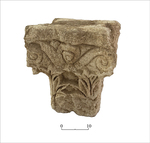
Room 2. This partly exposed room (length 4 m) revealed no traces of destruction. A rock-cut floor with one in situ broken tile was exposed. The floor had been cut by a trench that may have been the foundation trench of the Umayyad-period wall built later along an east–west axis in the north of Room 1. Above the floor was a fill layer of pebbles and mortar, within which were a capital (Fig. 6) and a column base, which blocked the entrance to Room 1 in its late phase (Fig. 3).
Room 3. The excavation of this room, south of Room 1, exposed only a part of it (c. 3.5 × 3.5 m), revealing its bedrock floor. The fill of the room, which yielded debris from a dismantled mosaic floor, overlaid a plastered floor. A cistern exposed near the southern excavation baulk was covered with an olive-press stone in secondary use (Fig. 3). At the top of the fill of the cistern, beginning at a depth of 4 m below its mouth, was a Byzantine-period coin (Maurice 583/4 CE); the fill was not excavated, and therefore, the cistern’s volume remains unknown. A channel (0.2 m wide, 0.15 m deep), exiting from the cistern and extending along the room’s eastern wall, appears to have led water into the cistern and continued the channel exposed in Room 1. A water basin exposed to the west of the cistern and channel may have had a function in connection with those features.
A hoard of 17 coins was found next to the eastern wall of Room 3. All of the coins date to the Byzantine period, the earliest dating to the time of Anastasius I (512–518 CE) and the latest to the time of Phocas (606/607 CE); the hoard may have been stashed here at the time of the Sassanid conquest of the Holy Land in 614 CE.
Area V
Area V, opened in 2022, was located in the upper part of the Dormition Abbey garden, west of Area IV, on the other side of the pathway leading to ‘King David’s Tomb’. Initially, the modern garden soil was removed, exposing a layer that included pottery dating to the Roman–Byzantine, Abbasid and Ottoman periods and the present day, as well as tesserae.
Below this layer was an ash layer sealing and leveling architectural remains: a street (6 m exposed length, 3.5 m wide; Fig. 7) with two water channels running below it; two structures, one on each side of the street, each comprising two rooms (1–4; see below); and part of a wall belonging to a later phase that cut the street on its southern end and Room 2 and was erected atop a chalk leveling fill; while the wall dimensions could not be ascertained due to its partial exposure, it undoubtedly continued the massive wall exposed in Sub-Area IV/3. Pottery of the Middle Ages was found in association with the Area IV segment of the massive wall; the construction date is reinforced by Carbon 14 dating of samples taken from the Area V segment.
The street and the architectural remains are interpreted to have been part of a Byzantine–Umayyad-period domestic area dating to the sixth–eighth centuries CE. The north–south street, which led directly to the highest point of Mount Zion, consisted of a stone pavement overlying a packed earth surface with bedding of lime or chalk (5–10 cm thick). The western of the two water channels below the street (0.6 m deep), sloping north, was plastered at its bottom, and its sides (0.5 m wide) were constructed of two rows of fieldstones; the channel curved to the east on its southern end, narrowing the street. The eastern water channel, also plastered at the bottom, was narrower (0.3 m wide); it also sloped down to the north and its sides were built of two rows of worked stones, of which the width was indiscernible. The space between the eastern channel and the wall of the structure to its east was filled with fieldstones and plaster to protect the structure from the water flow. The inside of this channel revealed late Byzantine–Umayyad-period pottery.
The exposed bedrock in this area revealed quarrying activity and Early Roman-period pottery.
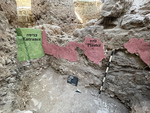
Room 1, east of the street, was enclosed on the west by a wall bearing plaster with a herringbone pattern (Fig. 8). The small, exposed segment of the room’s southern wall consisted of one massive, plastered ashlar, possibly a doorpost of an entrance that was later blocked. The fill of Room 1 consisted of a mixture of ash, pieces of plaster and pottery dating from the Early Roman till the Abbasid period. The floor of the room below the fill consisted of hard brownish soil with mixed pottery dating from the Iron Age to the Early Islamic period. The floor was built directly on bedrock, which showed signs of quarrying.
Room 2, bordering Room 1 to the north, had its walls and floor similarly constructed. The blocked doorway in the wall separating the two rooms was also exposed here. The fill within the room consisted of a pile of large boulders with abundant crushed chalk material and light brown soil in-between them. This debris was once sealed with a chalk layer, which appears to have leveled the area to accommodate the massive wall to the south of Room 2.
Rooms 3 and 4. The rooms on the western side of the street are separated by an east–west wall (0.7 m wide, 4 preserved courses), which abuts the wall parallel to the street. The fills within the rooms revealed pottery generally dating from the Iron Age to the Umayyad period, but mostly including Roman–Byzantine-period sherds; pieces of plaster were also found in the fills. In Room 4, a chalk floor was exposed that abutted the lower part of the walls. Underneath the walls of the two rooms, built directly on bedrock, was a wall of a slightly different orientation—northwest–southeast—comprising four stones (each 0.2 × 0.2 m). A floor associated with this wall consisted of hard, ashy soil mixed with abundant chalk. The bedrock exposed by removing a part of the floor revealed traces of quarrying activity.
References
Broshi M. 1976. Excavation on Mount Zion, 1971–1972: Preliminary Report. IEJ 20/2–3:81–88.
Eisenberg E. 1984. Jerusalem, Church of the Dormition. ESI 3:47.
Hiestand R. ed. 1985. Papsturkunden für Kirchen im Heiligen Lande (Abhandlungen der Akademie der Wissenschaften in Göttingen, Philologisch-Historische 3, 136; Vorarbeiten zum Oriens Pontificius 3). Göttingen. Pp. 280–287.
Küchler M. 2007. Jerusalem: ein handbuch und studienreiseführer zur heiligen stadt (Orte und Landschaften der Bibel 4, 2). Göttingen.
Mommert C. 1898. Die Dormitio und das deutsche grundstück auf dem traditionellen Zion. ZDPV 21:149–183.
Pringle D. 2007. The Churches of the Crusader Kingdom of Jerusalem; A Corpus 3: The City of Jerusalem. Cambridge.
Renard H. 1900. Die Marienkirche auf dem Berge Sion in ihrem zusammenhang mit dem Abendmahlssaale. Das Heilige Land 44:3–23.
Schöpf F., Vieweger D., Würz M. and Zimni J. 2020. DEI Excavations on the Southwestern Slope on Mount Zion (2015–2019). Archäologischer Anzeiger 1/20:268–292.
Vieweger D. and Würz M. 2012. Ausgrabungen in Jerusalem. Ayyubidische und frührömische funde an der oberen Terrasse des Anglikanisch-Preußischen Friedhofs (Areal III) im Jahr 2019. ZDPV 137:97–101.
Vincent L.H. and Abel F.M. 1922. Jérusalem: Recherches de topographie, d’archéologie et d’histoire II: Jérusalem nouvel. Paris.
Yahyâ ibn Sa’id. 1924. Histoire de Yahyâ ibn Sa‘îd d’Antioche. Kratchkovsky I. and Vasiliev A. eds. and transls. (Patrologia Orientalis 18; 23). Paris.
Zimni J. 2023. Urbanism in Jerusalem from the Iron Age to the Medieval Period at the Example of the DEI Excavations on Mount Zion. Ph.D. diss. Wuppertal University. Wuppertal.
Keywords
Old City of Jerusalem, Mount Zion, Abbey of the Dormition, Byzantine period, Crusader period
Publication Date
19/05/2026
Report Type
Preliminary Report