
Tel Yavne, Area U – 2024 (A-8999)
Excavation Report
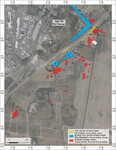
During 2024, an excavation was conducted in Area U, about 120 m east of Tel Yavne (Permit No. A-8999; map ref. 176464/641377; Fig. 1). The excavation, on behalf of the Israel Antiquities Authority and financed by the Israel Land Administration, was directed by P. Betzer and D. Varga, with the assistance of R. Golding-Meir (area supervision), I. Kelman, A. Notraius, R. Bick, R. Moshe and D. Jamchi (assistance in area supervision) Z. Lotan (administration), G. Tal (preliminary probe), A. Peretz and I. Jonish (field photography), Y. Shmidov and M. Kahan (surveying and drafting), N. Leitner (drafting and plans), Y. Gorin-Rosen (glass), Y. Nagar, H. May and Y. Makovichuk (physical anthropology), L. Perry-Gal (zooarchaeology) and N. Wieler (geomorphology).
Numerous surveys and excavations were conducted at Tel Yavne and its surrounding area (Yannai 2014; Haddad et al. 2021, and see further references there; Golding-Meir, Betzer and Varga 2024, and see there for details and further references), and remains from many periods were exposed. Since 2021, additional excavations have been conducted in extensive areas to the east and south of the tel (Kelman, Betzer and Varga 2025, and see further references there).
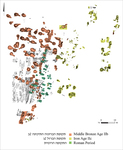
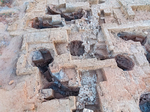
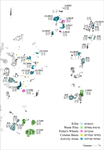
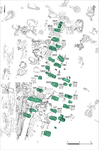
Area U was opened next to the Naḥal Soreq streambed and its alluvial plain, extending along the eastern side of a kurkar ridge that traverses the site from north to south. The soils in this area are characterized by young Pleistocene–Holocene sediments that accumulated in the valleys between the kurkar ridges. Repeated runoff episodes resulted in soils, including ḥamra, accumulating at the site. In an excavation in Area U in 2023 (Golding-Meir, Betzer and Varga 2024), 78 squares were opened, and an area of pottery production and a Middle Bronze IIB cemetery were found, as well as donkey burials in Middle Bronze IIB kilns, and a Roman-period cemetery. In the present excavation, 137 squares were opened (Fig. 2), and additional areas of the Middle Bronze IIB pottery-production area and the cemetery containing a range of burial types were discovered, as well as a Middle Bronze IIB fortification wall, an Iron Age IIC pottery production area, and additional parts of the Roman-period cemetery.
Middle Bronze Age IIB (Fig. 3)
Pottery Production Area
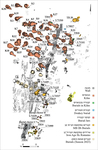
Fourteen pottery kilns were uncovered (K26–K39), joining the 25 kilns discovered in the 2023 season and classified into five main types (Types 1–5; Golding-Meir, Betzer and Varga 2024). Most of the kilns belong to Type 1—Teardrop-shaped kilns—the most common type in Area U, and two kilns belonging to Types 2 and 3. In addition, a single small and shallow drop-shaped kiln (K37) was discovered, unique at the site, constitutes a distinct type.
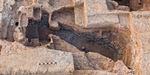
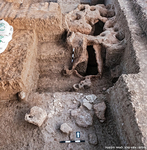
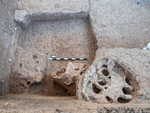
Type 1 Kilns (K26–K29, K31–K38) are large and deep teardrop-shaped kilns. The combustion chamber, stoking channel and two to four protrusions—vertical projections on the upper part of the combustion chamber wall supporting the firing chamber floor—were preserved in most of them. The protrusions may also have had a role in facilitating the air flow in the kiln (Rhodes 1968:16; Alizadeh 1985:48). In three kilns (K27, K33, K35), the protrusions were supported by an internal step, reducing the volume of the combustion chamber. The combustion chambers of Kilns 35 and 36 shared a stoking channel (Fig. 4), and in Kilns 27 and 36, the firing chamber floors were partly preserved. The floor of Kiln 27 (3–5 cm thick; Fig. 5) was made of fired clay, and two segments survived in situ on the western and eastern protrusions, whilst other parts of the floor that collapsed into the combustion chamber presented perforations (diam. c. 7 cm) meant to facilitate the flow of hot air into the firing chamber. A circular firing chamber (preserved height 0.4 m), built of a thin clay layer ( c. 5 cm thick) attached to the kurkar ridge and supported by it, was found in the southwestern part of the kiln. In Kiln 36, a narrow rectangular segment in situ, attached to the upper part of the combustion chamber, and a segment of the center of the floor that partly collapsed into the combustion chamber, constitute the remains of the firing-chamber floor.
Kiln Type 2 (K30) has a circular combustion chamber and a rectangular stoking channel. In contrast to the Kiln 8, a Type 2 kiln uncovered in the 2023 season (Golding-Meir, Betzer and Varga 2024), neither an internal step narrowing its width, nor protrusions supported by a step, were found in Kiln 30.
Kiln Type 3 (K39) is small and shallow, and it presents a rectangular combustion chamber with firing-chamber floor made of rectangular fired bricks. The firing chamber (diam. c. 2 m, preserved height c. 0.2–0.3 m) is slightly wider than the underlying combustion chamber. The firing-chamber floor did not survive.
A small drop-shaped kiln (K37). This is a small, shallow kiln (1.08 × 1.88 m, preserved height 0.5 m), and its combustion chamber was dug into the ḥamra soil and lined with clay. Four medium-sized fieldstones were placed at the end of its stoking channel, as they were in other Type 1 kilns (Golding-Meir, Betzer and Varga 2024). The kiln may have been used to fire small vessels; no wasters were discovered inside it or in its surroundings.
Cemetery
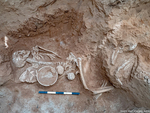
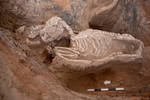
Burial Cave (TB9). The cave was excavated in the 2021 season, and four burial stages (IV–I) were identified (Golding-Meir, Betzer and Varga 2024). In the early Stage IV, a single articulated burial was uncovered, and in Stages III–I secondary burials and partly articulated burials were exposed. Mud bricks that were identified as an anteroom, were uncovered in the eastern part of the cave. In the 2024 season, the northern part of the cave was exposed, and the mud bricks in the eastern part of the cave turned out to be the foundations of a fortification wall (see below) that damaged the two late burial stages. Poorly preserved scattered human bones and a jar (L71623) were discovered in Stage IV. The remains of two individuals in primary burial (L71621; Fig. 6) were uncovered in Stage III. The southern poorly preserved, interred was placed on its left side with its head to the west, facing north. The northern interred was placed supine, with its head to the west, facing southeast. Northwest of the interred, adjacent to the kurkar wall of the cave, secondary burials were uncovered (L71609), including four skulls and many limb-bones; next to them were several burial offerings including pottery and jewelry.
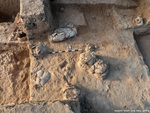
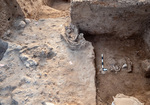
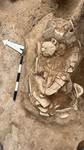
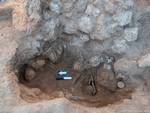
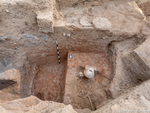
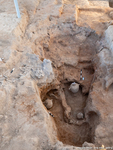
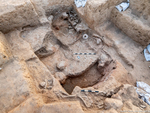
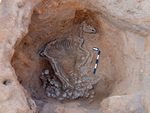
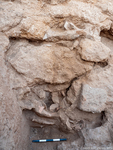
Clusters of Infant and Child Burials. Three clusters of infant jar-burials (A–C) were found on the kurkar ridge slope, and underneath or next to them, hewn tombs or pit tombs containing children, and sometimes also adults were also uncovered. In the 2023 season, three shallow tombs hewn in the kurkar rock and three piles of pottery sherds with infant burials were found in Cluster A (Golding-Meir, Betzer and Varga 2024). In the present excavation, five additional infant jar-burials and one hewn tomb (TB30; Fig. 7) were uncovered in this cluster. Tomb 30 is adjacent to one of the hewn tombs uncovered in the 2023 season (TB19), its western part was hewn into the kurkar ridge, and its eastern part was dug into the ground and lined with fieldstones and mud bricks. Remains of two children and one adult were found in the tomb. Nine infant jar-burials were discovered in Cluster B, mostly containing remains of skulls and scattered small bones. Remains of an articulated infant skeleton were found in one jar (L71630; Fig. 8). Cylindrical and dipper juglets were discovered inside the jars or adjacent to them. Three pit tombs were uncovered under the jars, containing two child burials (TB32, TB33) and one adult burial (TB31). Seven infant burial-jars were uncovered in Cluster C (Fig. 9), most of them containing a few bones and a juglet. Remains of an infant skeleton in articulation were found in one jar (L71000; Figs. 10, 11), with a juglet placed above its shoulder. Many burial offerings, including jugs, juglets and scarabs, were discovered at the level of the jar burials. A rectangular pit tomb (TB34; Fig. 11), whose western side was lined with fragments of gray mud bricks, was uncovered below the jars; it seems that similar mud-brick fragments were also used to cover the tomb. A child skeleton I supine position, of whom only the upper part of the skeleton survived, was found in the tomb, its left hand resting on the pelvis, on which lay a quartz scarab.
Pit Tombs (TB35, TB36). Two tombs containing skeletons of adult individuals were exposed in the southern part of Cluster C. A single skeleton in partial articulation, and secondary burials that included four skulls, were found in Tomb 35 (Fig. 12, see Fig. 11). Above the eastern side of the tomb, a north–south oriented wall (W71595; length 1.3 m, height 0.7 m), built of fieldstones, of which four–five courses survived, was exposed; it may have functioned as tomb marker. In Tomb 36, three poorly preserved adult skeletons were uncovered: the northern interred was laid supine and only the torso bones were preserved; the southern interred was placed on its left side, legs to the east, and only the lower limbs are preserved; and the interred at the center was supine and the skeleton is fully preserved, head to the south.
Kiln-Shaped Tombs (TB37, TB38). Two kiln-shaped tombs were uncovered. Tomb 37 was hewn in the bedrock, and the burials were predominantly secondary, collected in two clusters (L71125, L71537). Tomb 38 was dug into the ḥamra soil at the northern end of the pottery-production area. Three child burials were placed next to the tomb wall, together with jars and jugs; the bones were poorly preserved.
Shaft Tombs (TB39, TB47). Two newly-found tombs join the eight shaft tombs exposed in the 2023 season (Golding-Meir, Betzer and Varga 2024). The tombs had hewn vertical shafts that were not preserved, leading at their base into a burial chamber. Tomb 39 burial chamber was hewn into the kurkar rock and was blocked with jars. A few poorly preserved bones were found in the chamber, and three skulls were uncovered outside the chamber. The shaft was probably damaged during the quarrying of a kiln in the Iron Age (KI3, below). The burial chamber of Tomb 47 (Fig. 13) was dug into the ḥamra soil and eventually collapsed over the interred bones. Two skeletons, an adult and a juvenile, were uncovered in the tomb. The adult, whose bones were well preserved, lay supine, head to the north and facing east, with its legs flexed to west; the juvenile, whose bones were poorly preserved, was placed by the adult’s feet.
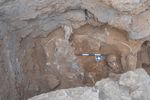
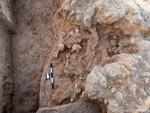
Burial in Kilns. Seven tombs were uncovered in five kilns (TB40 in K26; TB41 and TB42 in K35 and K36; TB43 in K28; TB44–TB46 in K27). In most cases the deceased were interred beside the stoking channels or in the combustion chambers. The interred were covered with the fill material of the kiln, making it impossible in most cases the identification of the tomb contour. The deceased in TB40 at the center of K26 combustion chamber (Fig. 14) lay supine, arms along the sides of the body, head to the north and feet to the south, with a jug next to the head. TB41 was adjacent to the northern wall of K36 combustion chamber, and contained an adult with a scarab ring on one finger, and poorly preserved bones. TB42 was found adjacent to the shared stoking channel of kilns K35 and K36, being its burial chamber (0.3 × 0.8 m) dug in the ḥamra soil. There was a child burial in the chamber, with its head to the west and feet to the east, and burial offerings beside it including a bowl, a juglet, and stone and bone beads; the tomb was sealed by two jars and a jug. TB43 was found in the stoking channel of K28 (Fig. 15). The tomb contained three clusters of secondary burials and adjacent pottery vessels, including jars, jugs and juglets. TB44–TB46 were uncovered next to the wall of K27 (Fig. 16). TB44 was uncovered outside the rounded wall of the kiln’s firing chamber, and contained a supine interment preserved in articulation, its head to the east and its feet to the west. TB45 was discovered outside the kiln’s stoking channel, with four interments preserved in articulation. The tomb contained two burial levels, with a thin layer (c. 0.1 m) of soil between them. Two adults and a child were buried in the lower level (L71230), the adults’ heads placed to the north. The eastern adult was lying supine, hand next to the head, holding a jug, and the western adult was placed on its side, knees flexed and facing the eastern burial; between the two were bowls, a juglet and lamps. The child was buried next to them on the south, its partially preserved bones included the spine, ribs and fragments of skull. In the upper burial level (L71161), above the adult burials, another adult was placed supine, head to the south and feet to the north. Tomb 46 was exposed above the western wall of the kiln, and contained an infant jar-burial, placed directly over a pile of human bones in secondary burial.
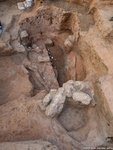
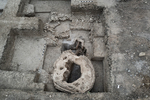
Donkey Burials. Seven donkey-burials were uncovered in the pottery-production area, and two donkeys were found next to the fortification wall (see below). Donkey-burials in kilns were previously found in the 2023 season in Kilns 12 and 25 (Golding-Meir, Betzer and Varga 2024), as well as in Area H at the foot of the tel (Golding-Meir et al. 2023). Two donkeys were interred in the upper part of the combustion chamber of K32, one above the other and adjacent to the wall (L71178): the head of the top donkey to northwest, the head of the lower one missing, and its rear side also to northwest. Two donkeys were also interred in K34 (L71318; Fig. 17) adjacent to the combustion chamber wall. They were placed one above the other, their heads to the north and facing each other. The west-facing head of the upper donkey was placed below the lower jaw of the east-facing donkey underneath it. The rear part (pelvis and back limbs) of a donkey (L71366) was found at the center of the shared stoking channel of K35 and K36. At the base of K31 combustion chamber, adjacent to the wall, a foal (L71573) was interred. Another donkey was buried outside the stoking channel of K28 on the kurkar ridge, its head turned towards the juncture between the stoking channel and the kiln combustion chamber (L70820; see Fig. 15). A similar donkey-burial, adjacent to the kiln on the outside, was uncovered in the 2023 season near K25. Two donkey-burials were found about 1 m away from the eastern face of the fortification wall (see below), one at the wall’s foundation level, containing the poorly preserved skeleton of a young donkey (L70827) placed on its side with its head to the west. The second burial (L71643; Fig. 18), exposed next to the southern part of the wall below burial Cluster C, comprised a circular pit (diam. 1.8 m) quarried into the kurkar ridge. The donkey was placed on its side, head to the north, front legs slightly flexed, rear ones straight. Fieldstones, pottery sherds and two pigs’ jaws were found underneath its legs. Small bones, perhaps of an unborn donkey, were found in the area of its belly, and this area seems to have been burnt. The tomb was covered with gray earth mixed with a few pottery sherds, and two additional pigs’ jaws were placed in its upper part.
Fortification Wall
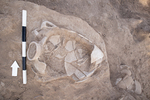
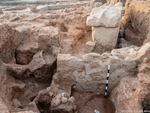
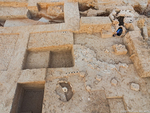
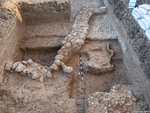
Eleven segments of a wide mud-brick fortification wall (L70133, L70997, L71259, L71429, L71448, L71449, L71467, L71484, L71548, L71565, L71567; Fig. 19), oriented northeast–southwest, were exposed along c. 73 m at the center of the area; in most cases only the wall foundations were preserved. The foundation trench (L71484: max. preserved width 1.8 m; L71565: max. depth 0.98 m; Fig. 20), which had an upside-down trapezoid section, was hewn on the slope of the kurkar ridge. Three to six courses of rectangular mud bricks (average size 0.08 × 0.20 × 0.30 m) were laid in the trench. At the center of the trench the bricks were placed on their broad side, and near the sides of the trench they were sometimes laid on their narrow side. A wider wall (max. width 3.06 m) was built above the foundations, from mud bricks identical to those of the foundations, preserved for a maximum of two courses (L71259, L71467). A cluster of Middle Bronze IIB pottery vessels, discovered in the wall foundations in the southwestern part adjacent to the kurkar ridge (L71670; Fig. 21), included bowls, jars and juglets that were probably foundation offerings. The wall cuts two kilns (K29, K31) and traverses the production area from north to south; 33 kilns (K1–K25, K32–K39) were found to its west, and four kilns (K26–K28, K30) to its east. The three burial Clusters A–C, and two of the donkey-burials (see above) lay next to and east of the wall.
Iron Age IIC (Fig. 22)
Remains of a pottery-production area, in which there were nine kilns and several activity areas, including floors, three potter’s wheels and debris piles, were uncovered in the eastern part of Area U. Additionally, building remains and one pit grave were found. These finds join the four Iron Age pottery kilns previously uncovered in Area M2, c. 40 m north of Area U (Ein Mor, Varga and Betzer 2024).
Kilns
The kilns comprised a combustion chamber, stoking channel and firing chamber. The combustion chamber was dug at a lower level than the working surface, while the firing chamber was built above it, at surface level. The stoking channel adjoining the combustion chamber was dug below the working surface. When the kilns functioned, hot air was sucked up from below the firing chamber floor to an opening in the upper part of the kiln (updraft kiln). Two types of kilns (A, B) were found in the pottery-production area.
Type A Kilns (KI1, KI2, KI4, KI5) were large kilns, with a deep rectangular combustion chamber (1.0–1.3 × 2.2 m, depth 1.6–1.8 m), and a square firing chamber with rounded corners. Two of the kilns exposed previously in Area M2 were also of this type. At the base of each combustion chamber was a layer of packed earth mixed with large quantities of ash. The high temperature resulted in vitrification of the combustion chamber walls, except for in KI4, where two courses of narrow mud bricks (0.05 × 0.35 × 0.45 m) lining the chamber were identified. Three arches supporting the firing chamber’s floor were built springing from the center of the long side of the combustion chambers of KI1 and KI4. The combustion chamber of these kilns also had three rectangular rafters of fired clay that supported the firing floor, connecting one of the arches to the wall in the narrow side of the combustion chamber. In the combustion chambers of KI2 and KI5, pillars and rafters were built to support the firing-chamber floor. In KI2, two pillars extended from the northern side of the combustion chamber, and two from the southern side, the four pillars connected by rectangular clay rafters. Three more rafters connected the pillars to the western side of the combustion chamber.
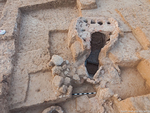
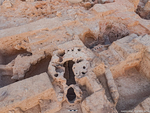
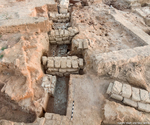
All the stoking channels adjoined the narrow side of the combustion chamber, but their direction and characteristics differed. The channel of KI1 was long and deep (length 1.7 m, width 1.4 m, depth 0.7 m; Fig. 23), and it joined the northern part of the combustion chamber, a funnel at its end was found blocked with fired brick material. The channel of KI2 (length 1.55 m, width 1 m, depth 0.8 m; Fig. 24) joined the eastern part of the combustion chamber, and its opening was blocked with a fired mud brick (0.37 × 0.65 × 0.80 m). The channel of KI4 was short and rectangular (length 1.1 m, width 0.9 m, depth 0.8 m; Fig. 25), and it joined the southern part of the combustion chamber. In KI2 and KI4, the vaulted roofing that overlay and connected the stoking channel to the combustion chamber was preserved, the top of the vault at the level of the firing-chamber base. The channel of KI5 (length 1.53 m, width 1.2 m, depth 0.7 m) joined the eastern part of the combustion chamber, and there was a step at its center. A rectangular fired mud brick placed at the end of the channel to narrow the opening, may have served as an opening for bellows.
The floor and the lower part of the firing chamber walls was preserved in all the kilns to a height of 5–10 cm, apart from in KI4, where the southern part of the chamber wall survived to a height of 35 cm (wall 3–5 cm thick), and was slightly domed, perhaps indicating that the chamber had a dome ceiling. The firing-chamber floors (2.2–3.0 × 2.2–3.0 m, 0.15–0.30 m thick) were constructed above the combustion chambers, and were wider, the thickness of the floor differing according to its position above the supports. In the floors there were three rows of four–five pierced holes (diam. 0.20–0.25 m), to transfer the hot air from the combustion chamber into the firing chamber. The holes overlying the combustion chamber were vertical, while the ones outside its boundaries sloped down. Small segments of a thin clay layer that was smeared on the floor (2–3 cm thick) were preserved. In KI5, this layer was well-preserved, and it seems to have covered the wide floor holes, while the smaller holes were pierced through it (diam. 5–10 cm). A built opening was uncovered on the wall above the floor of KI4, perhaps to regulate the heat during the firing (see Fig. 25).
Type B Kilns (KI3, KI6–KI9) were small, shallow pear-shaped kilns. They were poorly preserved, and only the combustion chambers survived, apart from KI6 (Fig. 27), in which all components of the kiln were preserved. The remains of KI6 include the circular firing-chamber floor (diam. c. 1 m), with seven large pierced holes (diam. 0.15–0.20 m) and two small ones (diam. 4–6 cm), the firing chamber (preserved height 0.1 m), whose walls (4 cm thick) were made of clay, and the stoking channel, which had a vaulted cover with four airing holes. In the combustion chamber of KI3 (max. width c. 1 m, depth 0.5 m), the remains of an arch that probably supported the firing-chamber floor were preserved.
Activity Areas
Activity levels. Fieldstone and pebble floors laid over packed earth (L28185, L28247, L70176, L70931, L71339) were found, as well as fired-brick floors (L71162, L71177) and packed kurkar layers (L28111, L28121, L70984, L71225). Grinding stones and other implements used by the potters for the production of ceramic vessels, were uncovered in these activity levels. Square flat kurkar stones, which served as pillar bases (Fig. 28) were found next to the activity levels.
Potter’s wheels. Round foundation pits of three potter’s wheels (L28142, L28238, L71583; diam. 1.2–1.5 m, depth c. 0.2 m; see Fig. 28), dug below the surface, were uncovered. The pits were mostly lined with fieldstones, and occasionally incorporated slag and pottery sherds. A large limestone with a deep smoothed depression at its center (diam 0.12 m, depth 0.8 m; see Fig. 28), uncovered at the center of Potter’s Wheel 71583, was probably the shaft of the wheel itself; the stone was stabilized with pebbles and pottery sherds placed around and below it. North of Wheel 28142, activity level 28111 with numerous pottery vessels, mostly holemouth jars, was uncovered.
Production Debris Piles. Large clusters of pottery vessels (L28091, L71351, L71365, L71402), including distorted wasters, slag and kiln fragments mixed with much ash, were discovered.
Building Remains. Next to KI5 and to its east, a north–south wall (W28264; length 3.28 m, width 0.4–0.5 m, preserved height 0.3 m; see Fig. 26), built of various-sized fieldstones was uncovered. Adjacent to the wall on its east, a debris pile (L28091), mostly containing jars, was uncovered. The wall may have served as a partition between the operation area of the kiln and the area where the kiln waster debris was discarded.
Adjacent to KI8 on its west, the single foundation course of the corner of a building built of fieldstones (W70150, W70158; Fig. 29) was extant. Activity level 70176 to the west of the building, sealed the stoking channel of KI8. The relation between this activity level and the building was not clear, since no adjoining remains were found between them, but it may be assumed that the building postdates the kiln, since its foundations were slightly above the level of the surface that sealed the channel.
Two wall segments (W71007, W71008), with two extant courses of various-sized fieldstones, and oriented northwest–southeast, were found in the southern part of the area; these may be the walls’ foundations. Adjacent to and south of the top level of the walls, a layer of Iron IIC pottery sherds (L71529) was uncovered. North of the walls, a pit (L70953, L71507) containing many sherds of cooking jars and jugs, and some stone grinding utensils, was found.
Pit grave. At the northeastern end of the production area, a pit grave (L28252) with unclear boundaries was uncovered. The grave included an individual laying supine, its head to southeast and its feet to northwest, with a juglet placed next to the head on the south, and an iron object on the north.
Roman Period (Fig. 30)
During the 2023 season, a Roman-period cemetery was discovered in the southern part of the area, with 34 tombs, including 10 infant jar-burials, 24 cist tombs and one sarcophagus (Golding-Meir, Betzer and Varga 2024). In the present excavation it become apparent that 13 of the Roman-period tombs (TR1, TR3, TR5, TR7–TR10, TR12–TR14, TR20, TR39, TR40) were dug into the foundations of the Middle Bronze II mud-brick fortification wall that was uncovered this season (Fig. 31). The exposure of three cist tombs (TR2, TR19, TR21) was completed in this season, and five other cist tombs (TR38, TR40–TR43) and one sarcophagus (TR39) were uncovered.
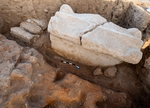
TB2 and TB21 were small cist tombs probably used for children burial. TB2 (1.10 × 1.36 m) had a gable cover, and TB21 (0.87 × 1.38 m) a flat one. The dimensions of TB19 (1.25 × 2.43 m) were similar to most of the cist tombs uncovered here, and its cover was flat. TB37–TB41 had flat covers, TB42 had a flat cover on its western part and a gable cover on its eastern one. The sarcophagus (length 2.13 m, width 0.8 m, height 1.27 m) was placed in a northeast–southwest orientation, different from all the other tombs (except some of the jar burials). The sarcophagus lid (0.87 × 2.26 m) was larger than the sarcophagus itself, and was formed as a gable roof with acroteria in its four corners. The lid broke crosswise into two halves, and the break was filled with small fieldstones. Many animal bones were found above the sarcophagus lid and on its sides, as well as around TB37 and TB42.
Conclusion
The excavation in Area U uncovered an extensive pottery production area dated to Middle Bronze Age IIB. Most of the kilns were types that manufactured storage and holemouth jars. In this period, a mud-brick fortification wall was built in its eastern part. The complete extent of the wall has not been exposed, but it seems to cross the area from north to south along the eastern slope of the kurkar ridge. Most of the kilns are located west of the wall, and some seem to have remained in use after the construction of the wall, indicating that at some point the production area was restricted to the west. When pottery production ceased, the kilns were used for the burial of humans and donkeys. Burial in kilns was previously known only at Bet Yeraḥ (Greenberg and Eisenberg 2006:164–167). Donkey burials are known from the Early Bronze Age in Egypt, Mesopotamia and the Levant, and were found in Israel at Tel Ẓafit (Greenfield et al. 2012). At Tell ed-Dab‘a, donkey bones were found in a Middle Bronze Age industrial installation (Prell 2021:30). The donkey burials found next to the fortification wall may have been foundation offerings, as the donkey burial uncovered in the fortifications of ‘Akko (Be’eri et al. 2020). In addition to the kiln burials, the Middle Bronze IIB cemetery contained several tomb-types that are known from other contemporary sites (Hallote 1995).
Similarly to the Middle Bronze Age IIB, an area of pottery production with kilns, potter’s wheels, activity levels and production debris, dating to Iron Age IIC was also exposed in Area U.
The Roman-period tombs exposed in this area were part of a strip of cemeteries found at the site. In the 2023 and 2024 excavation seasons, 42 tombs were found in this cemetery, of which 30 were cist tombs, two sarcophagi and 10 infant burial-jars, adult burials found next to child and infant burials. The different burial types may indicate different social status. Most of the Roman-period tombs were not opened.
References
Alizadeh A. 1985. A Protoliterate Pottery Kiln from Chogha Mish. Iran 23:39–50. https://doi.org/10.2307/4299752
Be’eri R., Motro H., Gerstel-Raban N. and Artzy M. 2020. Burials of Domesticated Animals in the Middle Bronze Age Rampart at Tel ‘Akko in Light of Archaeological Finds in the Levant and Ceremonies from the Ancient Near East. In A. Gilboa and A. Yasur-Landau eds. Nomads of the Mediterranean: Trade and Contact in the Bronze and Iron Ages (Culture and History of the Ancient Near East 112). Leiden–Boston. Pp. 54–68. https://doi.org/10.1163/9789004430112_006
Ein Mor D., Varga D. and Betzer P. 2024. Tel Yavne, Area M2. HA–ESI 136.https://doi.org/10.69704/jhaesi.116.2004.26437
Golding-Meir R., Betzer P. and Varga D. 2024. Tel Yavne, Area U—2023. HA–ESI 136. https://doi.org/10.69704/jhaesi.116.2004.26548
Golding-Meir R., Neumeier-Potashnic B., Lehmann G., Betzer P. and Varga D. 2023. Tel Yavne, Area H, Bronze Age Remains. HA–ESI 135. https://doi.org/10.69704/jhaesi.116.2004.26262
Greenberg R. and Eisenberg E. 2006. Area BS: The Bar-Adon Excavations, Southeast, 1951–1953. Bet Yerah: The Early Bronze Age Mound I (IAA Reports 30). Pp:117–235. https://doi.org/10.2307/j.ctt1fzhdbg.9
Greenfield H.J., Shai I. and Maeir A. 2012. Being an ‘Ass’: an Early Bronze Age burial of a Donkey from Tell es-Safi/Gath, Israel. Bioarchaeology of the Near East 6:21–52.
Haddad E., Nadav-Ziv L., Elisha Y., Tal G., Rauchberger L. and Sandhous D. 2021. Tel Yavne, Area A. HA–ESI 133.https://doi.org/10.69704/jhaesi.116.2004.25883
Hallote R.S. 1995. Mortuary Archaeology and the Middle Bronze Age Southern Levant. JMA 8/1:93–122. https://doi.org/10.1558/jmea.v8i1.93
Kelman I., Betzer P. and Varga D. 2025. Tel Yavne, Area Q. HA–ESI 137. https://doi.org/10.69704/jhaesi.116.2004.27727
Prell S. 2021. The Enigma of the Hyksos III: Ausländische Bestattungssitten im Ostdelta Ägyptens – eine Spurensuche (Contributions to the Archaeology of Egypt, Nubia and the Levant 11). Wiesbaden. https://doi.org/10.13173/9783447117067
Rhodes D. 1968. Kilns: Design, Construction and Operation. Philadelphia.
Yannai E. 2014. Yavne. HA–ESI 126. https://doi.org/10.69704/jhaesi.116.2004.13677
Keywords
Yavne Tel, Middle Bronze Age IIB, Iron Age IIC, Roman Period, Pottery Kilns, Ceramic Production, Cemetery, Donkey Burials, Mudbrick Wall
Publication Date
02/08/2026
Report Type
Preliminary Report