
Naḥal Qomem (A-9804)
Permit/License Number
A-9804
Excavation Report
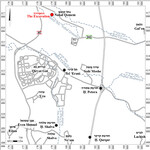
During June–September 2024, a trial excavation was conducted in Naḥal Qomem in northern Qiryat Gat (Permit No. A-9804; map ref. 177770–9015/616800–7727; Fig. 1), prior to establishing a new neighborhood. The excavation, on behalf of the Israel Antiquities Authority and funded by the Israel Land Administration, was directed by M. Pasternak and S. Bloch-Lifshitz, with the assistance of M. Margulis, S. Gonter, R. Prokofiev and M. Bitton (area supervision and field photography), L. Einan (assistant area supervisor), Y. Alamor (administration), D. Eisenberg-Degen (scientific guidance, field photography and 3D model), A. Montagu and E. Aladjem (photography and 3D model), I. Azoulay (plans), Y. Vidker (GIS), Y. Paz, Y. Dagan and P. Fabian (consultancy), N. Ben-Ari (pottery), D. Biton and J. Vardi (flint), Y. Abadi-Reiss (stone tools), Y. Nagar (physical anthropology), L. Perry-Gal (archaeozoology), N. Wieler (geomorphology) and R. Semama (analytical laboratory). Assistance was also rendered by A. Rasiuk, A. Dobrinin, S. Talis, S. Gal and N. Dagan. Workmen from Rahat, Kuseifa, Laqiya, the Palestinian Authority, India and Bengal took part in the excavation.
The site of Naḥal Qomem is located next to the streambed, south of Road 353 and east of Road 40. The site, which was originally named Gat-Govrin, was discovered in the late 1950s by members of Kibbutz Gat during plowing, which exposed pottery fragments from the Chalcolithic period and the Early Bronze Age I in an area of c. 35 dunam (Itaie 1959; Khalaily and Hermon 2013:1). The first excavation at the site was conducted as part of Jean Perrot’s research of Chalcolithic-period sites in the northern Negev (Perrot 1961). Subsequent excavations exposed settlement remains from the Chalcolithic period and Early Bronze Age I, including numerous pits (Khalaily 2002 [Fig. 2: A-2968]; Fabian 2012b [Fig. 2: A-4432]; Khalaily and Hermon 2013). Early Bronze Age sites were found in the vicinity (see Fig. 1) at Tel Erani (Yevin 1961; Milevski et al. 2016), Ḥorbat Petora (Milevski and Baumgarten 2008), Naḥal Shalva (Israel Aladjem and Milevski 2014; Aledjem and Abadi-Reiss 2024) and Ḥorbat Qarqar (Fabian 2012a).
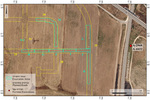
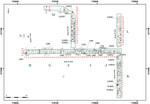
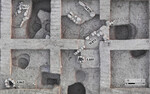
Probes that were conducted before the excavation identified remains from the Chalcolithic period and the Early Bronze Age IA2. Consequently, nine excavation areas were opened (F–N; see Figs. 2, 3) along the planned route of local roads, and settlement remains from the Late Chalcolithic period (the Ghassulian period; 4500–3900 BCE) and the Early Bronze Age IA2 (3500–3350 BCE) were exposed: pits, building remains, habitation levels, installations, refuse compounds, human and animal burials, pottery sherds and flint items. In addition, pottery sherds from the Early Bronze Age IB1 (3350–3200 BCE) were found in nearly all the excavation areas. The remains are poorly preserved in some of the excavation areas, particularly in Areas F–J, where they were damaged by modern agricultural activity and development that preceded the excavation. Building remains and finds from the Roman and Byzantine periods were also found in the excavation and will be published separately.
The Late Chalcolithic Period
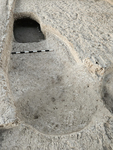
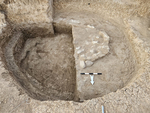
Pits. In all excavation areas, pits were found. Most of them are bell-shaped pits (diam. 0.7–1.0 m) that are well-known from this period. In Areas F–K, the upper portion of some pits was not preserved due to modern disturbances. A brown/grayish soil was found in the pits, mixed with finds from the Chalcolithic period, which include pottery sherds, flint items, stone vessels, grinding stones, weights, mortars and animal bones. Most of the pits also contained pottery sherds from the Early Bronze Age IA2, which probably originated from a later disturbance or a secondary use of the pits during this period. In Area K (Sqs R56–S56 and U57–W57, for example L10314), excavations uncovered bell-shaped pits with a shallow circular or oval depression dug at their opening (max. diam. c. 2 m), creating a slope towards the pit (Fig. 4).
Habitation Levels. Thin habitation levels (thickness c. 5 cm) with light-brown tamped soil mixed with ash were found in Area J (e.g. L10073); the tamped soil was uncovered directly over virgin soil. A considerable quantity of Chalcolithic-period pottery, flint tools and stone vessels was uncovered in the habitation levels, as well as animal bones.
Refuse Compound. In Area L (Sqs AO56-57–AT56-57; L10542), a large refuse pit (c. 240 sq m) was dug into the ground and filled with gray and brown soil. It contained pottery sherds and flint items from the Chalcolithic period and animal bones. Additional pottery and flint items show that the pit was used until the Early Bronze Age IA2 (see below).
Early Bronze Age IA2
Pits. Two hundred and fifty-two pits in a range of sizes (diam. 0.2–0.5 m) dug into loess soil were discovered. Their outline is circular, ovular, bell-shaped or irregular, and their sides are concave or straight. Most are circular with concave sides. Particularly large ovular pits (diam. c. 9 m, depth 1.8 m) were found in Area M (Sqs AJ32-33–AN32-33). Excluding shallow pits (max. diam 1 m, max. depth c. 0.4 m) and those lined with mud bricks (see below), most pits featured steps cut directly into the soil to ease the descent and provide convenient access.
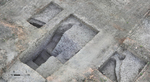
Seven circular pits (diam. 3–5 m) lined with unfired rectangular mud bricks were found; the lining survived to a height of four to nine courses. At the bottom of the pits, tamped earth was uncovered. It was overlain by a layer of fine white soil (e.g. Area G, L648), whose composition will be analyzed in future. Two pits were found in Area F. One is large and lined with mud bricks (L246; diam. c. 4 m; Fig. 5) preserved to a maximum height of five courses. The other is small, unlined and filled with mostly burnt pebbles (L269; diam. c. 2.5 m). A similar pair of pits that contained a human burial (Fabian 2012b [Fig. 2: A-4432]) was discovered previously about 200 m east of the excavation. Circular installations built from mud brick material were found in some of the lined pits. A few small to medium-sized pebbles were found in one of the installations in Area F (L649; Fig. 6). All the lined pits were filled with gray-brown soil containing pottery sherds, flint items, animal bones and heaps of collapsed mud bricks that probably originated from the upper courses of the lining. Human and dog burials were exposed in one pit (see below). It seems that many of the pits were used for storage or caching since they contained finds such as flint cores that were not exhausted and unfinished primary Canaanite blades. The particularly small pits (max. diam. c. 0.3 m) may have supported columns. Pottery sherds and charred bones were found in the small and lined pits, perhaps indicating fire-related activity. At a later stage, the pits were reused as refuse pits.
Building Remains. Meager building remains were found, including segments of walls and part of a building (Building 1). A few walls of fieldstones and river pebbles were uncovered in Area J (Sqs AB55–56); small–medium-sized river pebbles were incorporated in all walls but one (W10372), which used large pebbles. A wall (W10411) that was built over a pit that was no longer in use (L10428) was uncovered in Area M. In Area I, excavations exposed Building 1, composed of two walls (W870, W875; Fig. 7) built from a single row of semi-hewn limestone stones and preserved to a height of one course, and a tamped-earth floor. A stone socket marking an entranceway was found in W870. A circular installation (L855) was found next to W875, and another circular installation (L862) was found about 15 m west of it. The installations (diam. c. 0.6 m) were built of medium–large-sized fieldstones, and inside were accumulations of brown soil, pottery sherds, flint items and several animal bones.
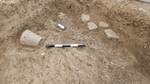
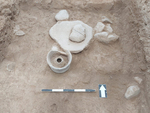
Habitation Levels. Habitation levels of tamped earth over virgin soil were found, with concentrations of pottery, flint and stone. A large quantity of grinding stones and basalt bowls, among them a bowl with in-relief knobs below the rim, was uncovered in a habitation level in Area M (L10728; Fig. 8). Some of the habitation levels abut pits and installations (e.g. in Area J, Sq AC50). Sunken and shallow habitation levels (max. depth 0.5 m) that were dug into virgin soil were also found. Some of the small pits that were described above were dug into these levels. An example is a sunken habitation level (L895; diam. c. 25 m, depth c. 0.5m) with three pits (diam. c. 0.8 m) that was found in Area I about 8 m west of Building 1. Rich assemblages of stone vessels and animal bones were found in the pits. In the sunken habitation level, a limestone lower grinding stone with an upper grinding stone on top was uncovered alongside a basalt bowl with a small jar inside (Fig. 9). A few small stone vessels and pottery sherds were found in a sunken habitation level in Area K (L10379; 40 sq m, depth c. 0.4 m).
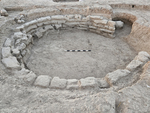
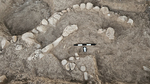
Installations. In addition to the two installations that were exposed in Building 1 and its vicinity (see above), a few other built installations were uncovered. An unusual installation (L10732; diam 4.1 m; Fig. 10) with a round or oval outline was partially uncovered in Area M; its southern part is outside the excavation boundaries. The installation was built of two rows of stones, with the rows being approximately 0.4 m apart. The external row (length 4 m) was constructed of medium-sized fieldstones and river pebbles, while the internal row (length 3.9 m) was built of upright limestones (stele?). At the center of the installation, a cluster of pottery and stone vessels and a mother of pearl shell (Chambardia) were discovered.
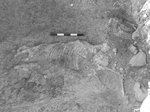
Burials. Human and animal burials were uncovered in some of the pits. In Area F, a donkey burial (L192; Fig. 11) was found in a bell-shaped pit (diam. c. 2.5 m) that was dug during the Chalcolithic period and was probably used for storage; in the Early Bronze Age IA2, the eastern part of the pit was widened to accommodate the donkey burial. The donkey’s bones were fully articulated, the head to the south and the legs flexed. The donkey was laid on flat stones, including some grinding stones. Adjacent to its western side, body fragments of pottery vessels, a flint blade and a shell were found.
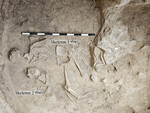
Two phases of human and animal burials were found in Area K in a pit (L10396; diam. c. 4 m) with straight sides. In the early phase, the pit was lined with four courses of narrow mud bricks (W10933). Two human skeletons in articulation (Skeletons 1 and 2; Fig. 12) were found in it, placed side by side, with a partially articulated dog and a few bones of sheep next to them. At the southeastern part of the pit, Skeleton 1 was supine, with its head adjacent to the mud bricks, facing east with its left arm flexed by the body. Skeleton 2 was placed adjacent to the right arm and calf of Skeleton 1. The individual was buried on its right side, with its head facing east and laying on the right arm of Skeleton 1. The right arm was flexed, touching the body, and the right hand was placed next to the shoulder and chin. The left arm was also flexed, resting on the chest. The legs were turned toward the northwest, with the knees slightly flexed. Fragments of two jars with a ledge handle, a type known from the Early Bronze Age IA2, were also found in the early burial phase. In the late burial phase, a layer of small dense stones was found c. 5 cm above the skeletons from the early phase. The pit was lined with mud bricks (W10931) that preserved to a maximum height of six courses. The lining used in the late phase is thicker than in the early phase. Three articulated dog skeletons were found on the stone layer (Fig. 13).
Some pits contained a few human bones not in articulation. We do not have enough data to determine whether the small number of bones and their distribution indicate secondary burials or a later disturbance and reuse of the pits.
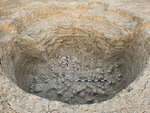
Refuse compounds. In addition to the refuse compound that was found in Area L (L10542, above) and was used from the Chalcolithic period to the Early Bronze Age IA2, an extensive refuse compound, which was dug into the ground, was exposed in Area H (L402; diam. c. 15 m, exposed depth c. 4.5 m; Fig. 14). The compound was filled with gray soil (burnt?) mixed with mud-brick material and pottery and flint items dated to the Early Bronze Age IA2. In addition, numerous animal bones were found. In the eastern part of the compound, there is a sloping deposit of small river pebbles next to the compound wall; it is not clear whether this is the result of intentional dumping or natural alluvium.
The Early Bronze Age IB1
A few pottery sherds from the Early Bronze Age IB1, mostly of the Erani C Type (see below), which are known from this period, were found in a few pits and in Refuse Compound 10542, mixed with finds from the Early Bronze Age IA2.
Finds
Finds from the Chalcolithic Period. The pottery includes bowls, among them V-shaped bowls and bell-shaped bowls, kraters, holemouth jars, large jars and cornets. The flint items include blades, bladelets, cores and flakes. Stone vessels and a violin figurine were also found.
Finds from the Early Bronze Age I. The pottery assemblage is comprised of open vessels, including bowls and kraters, and closed vessels, such as holemouth jars, jars, small jars and juglets. Numerous Early Erani C Type pottery vessels were also found, among them bowls and small jars, as well as a few Middle Erani C Type pottery vessels (Yekutieli 2006; Pasternak 2024).
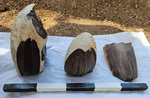
The flint items include tools, flakes and debitage. A few cores of Canaanite blades were discovered in loci dated to the Early Bronze Age IA2 (Fig. 15), some exhausted and others not; some of the cores were found in situ. The Canaanite blades, most of them retouched, were cached in the pits. The stone tools include limestone and basalt bowls, grinding stones and hammerstones.
Conclusion
The excavation of Naḥal Qomem exposed occupation remains from the Chalcolithic period and the Early Bronze Age IA2 and IB1. Many pits and a few habitation levels were found dating to the Chalcolithic period, like in previous excavations of the site. The Chalcolithic therefore seems to be the earliest occupation. The site reached its zenith during the Early Bronze Age IA2, as is evidenced by the building remains, the habitation levels, the installations and the pits. The human, donkey and dog burials are the only ones found so far from the Early Bronze Age I in this area. A few pottery sherds from the Early Bronze Age IB1 indicate that the site continued to be occupied during this period, albeit in a more limited scope. The Canaanite blades are among the most important finds that were found, and they are part of an industry that is characteristic of the Early Bronze Age. Naḥal Qomem is so far the only site in which all the stages of Canaanite blades manufacture were found, including in situ Canaanite cores. During the Early Bronze Age 1A the site of Naḥal Qomem was a center of production for Canaanite blades, and the products were distributed to nearby sites, such as Ḥorbat Petora and Tel Erani, both dated, among other periods, to the Early Bronze Age IA.
References
Aladjem E. and Abadi-Reiss Y. 2024. Nahal Shalva. HA-ESI 136. https://doi.org/10.69704/jhaesi.116.2004.26558
Fabian P. 2012a. Horbat Qarqar. HA-ESI 124. https://doi.org/10.69704/jhaesi.116.2004.1982
Fabian P. 2012b. Nahal Qomem. HA-ESI 124. https://doi.org/10.69704/jhaesi.116.2004.1928
Israel Y., Aladjem E. and Mileski I. 2014. Nahal Shalva. HA-ESI 126. https://doi.org/10.69704/jhaesi.116.2004.12656
Itaie J. 1959. Chalcolithic Settlement in the Fields of Gat. Hedim, Quarterly of Hakibbutz Haartzi Hashomer Hatsair 62:99–104 (Hebrew).
Khalaily H. 2002. Nahal Qomem. HA-ESI 114:103.
Khalaily H. and Hermon S. 2013. Gat-Govrin (Nahal Qomem): A Late Chalcolithic Site in the Northern Negev. ‘Atiqot 75:1–25. https://doi.org/10.70967/2948-040X.1636
Milevski I. and Baumgarten I. 2008. Between Lachish and Tel Erani: Horvat Ptora, a New Late Prehistoric site in the Southern Levant. In J.M. Cordoba, M. Molist, M.C. Perez, I. Rubio and S. Martinez eds. Proceeding of the 5th International Congress on the Archaeology of the Ancient Near East. Madrid. Pp. 608–626.
Milevski I., Yegorov D., Aladjem E. and Pasternak M.D. 2016. Salvage Excavation at Tel Erani, Areas P to U. Preliminary Report. In K.M. Cialowicz, Y. Yekutieli and M. Czarnowicz eds. Tel Erani I: Preliminary Report of the 2013–2015 Excavations. Krakow. Pp. 45–57.
Pasternak M.D. 2024. The Socio-Cultural Landscape of Southwestern Canaan in the Early Bronze Age 1B1 (Erani C Horizon). Ph.D. diss Ben-Gurion University of the Negev. Be’er Sheva‘ (Hebrew).
Perrot J. 1961. Gat-Govrin. IEJ 11:76. https://doi.org/10.3406/annor.1961.6758
Yeivin S. 1961. First Preliminary Report of the Excavations at Tel “Gat” (Tell Sheykh ’Ahmed el-‘Areyny), Seasons 1956–1958. Jerusalem (Hebrew).
Yekutieli Y. 2006. The Ceramics of Tel ‘Erani, Layer C. Journal of the Serbian Archaeological Society 22:225–242.
Keywords
Qiryat Gat, Late Chalcolithic Period, Ghassulian Culture, Early Bronze Age, Bell-Shaped Pits, Canaanite Blades, Animal Burials, Flint Industry
Publication Date
03/08/2026
Report Type
Preliminary Report