
Sulam (A-9342)
Permit/License Number
A-9342
Excavation Report
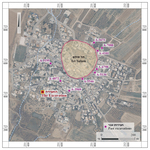
During July 2022, a trial excavation was conducted in Sulam (Permit No. A-9342; map ref. 231703/723676; Fig. 1), prior to construction work. The excavation, on behalf of the Israel Antiquities Authority and funded by Khaled Zoabi, was directed by A. Levi-Hevroni, with the assistance of Y. Ya‘aqobi (administration), A. Elghani Ibrahim (survey), E. Dalali-Amos (plans), A. Shapiro (map), B. Tzin (pottery), Y. Gorin-Rosen (glass), R. Be’eri (scientific guidance), H. Butrus from the Lower Galilee District and workmen from Kafr Manda.
In the center of the village of Sulam, there is a tel that is associated with Biblical Shunem, which was located on the Sea Road between Megiddo, the Sea of Galilee and the eastern valleys (Roll 2002); today the tel functions as a cemetery. Numerous excavations were conducted in the village (see Fig. 1), and settlement remains from the Early Bronze Age to modern times were uncovered (for background and further references see Covello-Paran and Arie 2010; Abu Zedan 2019).
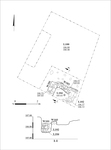
The present excavation (Fig. 2) was conducted in the southwestern part of the village, southwest of the tel and next to Naḥal Shunem, which crosses the settlement. Remains of a building from the Umayyad period were discovered.
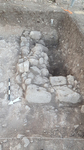
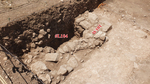
Excavations revealed two walls (W101, W103; Figs. 3, 4), which form the northern corner of a building that was founded on a layer of white calcareous alluvial soil. The building seems to continue south. Wall 101 was constructed of two rows of well-hewn medium-sized limestone blocks, while Wall 103 was constructed of two rows of smaller, partially hewn limestone blocks; both survived to a height of three or four courses. In the building, a floor of packed-earth (L104), mixed with crushed lime, small fieldstones and a few Byzantine and Early Islamic-period pottery fragments, was found. On the floor, there was a collapsed stone heap (L102), containing Early Islamic-period jar body fragments (not illustrated), a fragment of an Umayyad glass vessel (not illustrated) and small fragments of animal bones. The pottery and glass fragments date the building to the Umayyad period.
References
Abu Zedan F. 2019. Sulam. HA–ESI 131. https://doi.org/10.69704/jhaesi.116.2004.25650
Covello-Paran K. and Arie E. 2010. Sulam, Tel Shunem. HA–ESI 122. https://doi.org/10.69704/jhaesi.116.2004.1471
Roll I. 2002. Crossing the Rift Valley: The Connecting Arteries between the Road Networks of Judaea/Palaestina and Arabia. In P. Freeman, J. Bennett, Z.T. Fiema and B. Hoffmann eds. Limes XVIII (Proceedings of the XVIIIth International Congress of Roman Frontier Studies Held in Amman, Jordan, September 2000) I (BAR Int. S. 1084). Oxford. Pp. 215–230.
Keywords
Shunem, sea road, building remains, Umayyad period
Publication Date
03/08/2026
Report Type
Final Report