
Ḥorbat ‘Ashshe (A-7408)
Permit/License Number
A-7408
Excavation Report
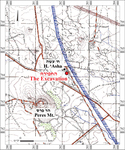
During May–June 2015, a salvage excavation was conducted at Ḥorbat ‘Ashshe in the Golan Heights (Permit No. A-7408; map ref. 28212/76418; Fig. 1), following damage to antiquities. The excavation, on behalf of the Israel Antiquities Authority and funded by the Ministry of Defense, was directed by E. Bron and O. Zingboym, with the assistance of Y. Ya‘aqobi (administration), K. Covello-Paran (scientific guidance), M. Osband, L. Liran and R. Mishayev (survey and drafting), H. Ben David and S. Fridman (pottery), Y. Gorin-Rosen (glass), H. Tahan-Rosen (pottery and glass drawing), A. Shapiro (map), A. Ecker (inscription on pottery) and A. Karasik (inscription photograph).
The site was first documented in the late nineteenth century CE (Schumacher 1888:124), and since 1967, it was the subject of numerous surveys (Hartal and Ben Efraim 2012: Site 8, and see extensive review of the site in the Hebrew version). Chalcolithic pottery was found in a survey, and an excavation was carried out in 2013 (Zingboym 2015), identifying five strata (1–5) containing Early Bronze Age II pottery (Stratum 5), settlement remains from the Hellenistic and until the Abbasid period (Strata 4–2) and a modern building (Stratum 1).
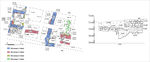
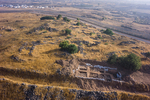
Eight excavation squares were opened in the present excavation (Figs. 2–4) northeast of Mount Peres, on the Israel–Syria border. Remains from five strata, dated to the Early Bronze Age II (Stratum 7) and the Late Hellenistic (Stratum 6), Roman (Stratum 5), Late Roman (Stratum 4) and Byzantine (Stratum 3) periods, were found. Strata 2 and 1, which are dated to the Abbasid period and present day, were only found in the 2013 excavation.
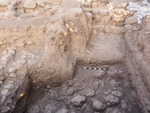
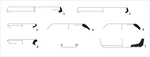
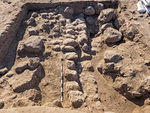
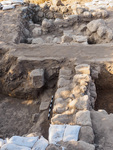
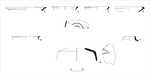
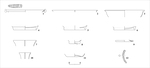
Stratum 7—The Early Bronze Age II (end of second millennium BCE). A thick layer of dark soil and ash (L131, L133; Fig. 5) was uncovered above the bedrock; the ash may indicate that there was a fire and violent destruction. In the stratum above the bedrock, a range of Early Bronze Age II pottery was recovered: platters (Fig. 6:1–3), holemouth jars (Fig. 6:4, 5), a jar (Fig. 6:6) and a base of a jar or pithos (Fig. 6:7).
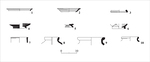
Stratum 6—The Late Hellenistic Period (beginning of second century–first century BCE). After a long period of abandonment, the site was reoccupied during the Hellenistic period. Remains of walls (W6, W9, W13) built from large fieldstones and dark brown soil, perhaps crumbled mudbricks, were found. The foundations of a wall below W2 of Stratum 3 were also found (see below). Most of the walls were dismantled, and the stones were reused in Stratum 5. Therefore, the size and function of the building are unclear. Eastern Sigillata imports, including bowls (Fig. 7:1–6) and jars (Fig. 7:7–10), were found.
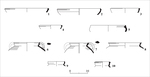
Stratum 5—The Roman Period (first–third centuries CE). Pottery fragments from this period were found in the excavation, including bowls (Fig. 8:1–5), cooking pots (Fig. 8:6–8) and jugs or small jars (Fig. 8:9, 10). Some of the bowls and cooking wares are similar to types known from the Kefar Ḥananya workshop (Adan-Bayewitz 1993; 2003; Ben David 2014), while others, judging by their fabric, were manufactured in the Golan (Osband 2014:198–208). A considerable proportion of the fragments was found next to W5 from Stratum 4 (L122, see below), which may indicate that the wall was built in Stratum 5.
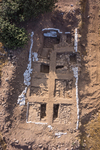
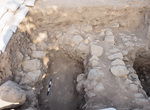
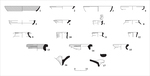
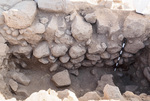
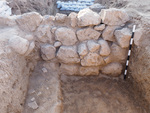
Stratum 4—The Late Roman Period (third–fourth century CE). Remains of a large building, oriented east–west, with walls (W5, W7, W10–12, W14; width c. 0.6–0.9 m; Fig. 9) built of fieldstones of various sizes, were found. Wall 6 of Stratum 6 was also part of this building, delineating a room with Walls 5 and 12. Walls 7 and 10 delineated another room (Fig. 10), in which a floor of small stones (L130) abuts Wall 10. Another floor (L125), made of medium and small basalt fieldstones, seals the layer of soil and ash (L133) of Stratum 7 and abuts W7 from the north. Pottery fragments were discovered. This includes: African Red Slip bowls (Fig. 11:1–3; Kingsley 1999; Hayes 2008:76–77, Pl. 5:1–3); bowls (Fig 11:4–7), a cooking pot (Fig. 11:8) and jars (Fig. 11:9–12) similar to Ḥawarit ware from the northern Golan (Hartal, Hudson and Berlin 2008) but manufactured from clay likely from east of the site; jars (Fig. 11:13–15); and fragments of Ituraean-type pithoi, among them a base with spiral paring (Fig. 11:16) and a handle with three grooves (Fig. 11:17). This site is the southernmost location where finds support an Ituraean settlement, which is typically characteristic of the northern Golan. Two jar or amphora body sherds with a Greek inscription (L122, B1050, B1052; A. Ecker, below) were also found.
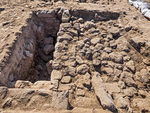
Stratum 3—The Byzantine Period (fourth–fifth centuries CE). Over the Stratum 4 building, a larger building was constructed with wide fieldstone walls (W1–W4, W8; Figs. 12–14). Wall 6, initially part of Stratum 6, remained in use, as did the western room it delineated. Wall 1 delineated the full length of the building on the south. A room (L115), with a fieldstone floor laid over L122 of Stratum 4, was added to the building. In the southwestern part of the excavation, another floor (L116, Fig. 15) of medium- and large-sized fieldstones abuts Walls 3 and 4. The floors of this stratum seal most of the walls and floors from the previous stratum.
Fragments of table and storage plain wares were found. These include bowls (Fig. 16:1–4), one of which is an African Red Slip bowl with light fabric and red slip (Fig. 16:5), a casserole (Fig. 16:6), a jar (Fig. 16:7) and a body fragment of a jar with geometric combed decoration (Fig. 16:8).
The Glass
Yael Gorin-Rosen
Nineteen fragments of glass vessels (Fig. 17:1–11), mostly dated to the Roman period and representing well known types in Israel, were found in the excavation.
Bowl rim No. 1 is the earliest fragment found in the excavation. It is decorated with an applied glass trail. The type is known as ‘bowls with crimped trails’ and is dated to the end of the first century and the first half of the second century CE. The type serves as a fossile directeur for the Bar-Kokhba Revolt, since large quantities were discovered in the refuge caves. These bowls were also found in Jerusalem and its surrounding area in assemblages dated to between the Great Revolt and the Bar-Kokhba Revolt (Katsnelson 2009). In the northern Golan, rims of this type were found in the excavation of Bab el-Hawa (Hartal 2005:225, Fig. 159:3–4) and at Banias (Gorin-Rosen and Jackson-Tal 2008:82, Fig. 5.1:2–3, and see there further references to sites around the Kinneret, e.g., a tomb at Kefar Naḥum and Bet Ẓeida).
Vessel No. 2 is a small greenish blue fragment of a bowl with a fine everted rim that was rounded by fire. The fragment is too small to reconstruct the shape of the bowl.
Vessel No. 3 is a clear greenish blue bowl with a thickened everted rim, rounded by fire. The diameter of the bowl indicates that it is typical of the Galilee during the Late Roman period. These bowls usually have a pushed-in hollow ring-base. A rim of a similar bowl was found at Ḥammat Gader and compared with finds from Jalame dated to the fourth century CE (Cohen 1997:401, Pl. 2:4).
Vessels Nos. 4–6 are ‘pad bases’ that were made by coiling a strip of glass around the lower part of a vessel and shaping it as a base. Their glass is highly transparent bluish green, with a few bubbles, and they are covered with a slight sandy weathering. Base No. 4 was smashed into many fragments and has a flat bottom; marks of the trail coiling are visible on the base. The underside of base No. 6 is thickened and slightly sagging; there is no trace of a pontil. The three bases are very similar and were probably made by the same craftsman in the Late Roman period. Such bases are very common, for example, at Ḥammat Gader, where they were compared to bases from Egypt and Jalame (Cohen 1997:402, Pl. 2:9–10, 12).
Vessel No. 7 is an everted rim of a beaker, rounded by fire and made of yellowish green glass of relatively good quality. This rim could belong to a beaker with a solid base such as No. 8 or with a tooled-out hollow ring-base like vessel No. 9 (below). Vessel No. 8 is the base of a solid beaker, a type that is characteristic of the end of the Roman period and is very common in the Galilee and other areas. The base is made of a greenish blue glass coated with sand deposits. On its underside, there is a coarse pontil scar. Vessel No. 9 is another base of a beaker or juglet. It is a greenish blue base, pushed in with a tooled-out hollow ring-base. Fragments of rims and bases similar to Nos. 7–9 were found at Ḥammat Gader and dated based on typology to the fourth century CE (Cohen 1997:409–410, Pl. 3:9, 12–19).
Vessels 10 and 11 are bottle fragments. Vessel No. 10 has an everted rim rounded by fire, made of greenish glass covered with sandy weathering. Vessel No. 11 is greenish blue, with a low convex base with no scar.
Another find is a blue-glass bracelet, twisted to form a pattern of diagonal ribbing (Fig. 17:12). Bracelets of this type first appeared during the Late Roman period, and they remained in use until the Ottoman period.
The glass vessels represent types that are common and well-known in Israel during the Roman period. They were all manufactured in local workshops, with bases 5–7 being a typical example of such a regional workshop.
Pottery Fragments Bearing an Inscription
Avner Ecker
The Greek inscription (Fig. 18) contains two lines incised on two refitted body sherds (part of the shoulder?) of a storage jar or amphora; it was incised after the firing of the vessel. The inscription can be read as follows:
[--]ΕΙ LCΔ
ΑΡΙCΤѠ[--]
It may be reconstructed and translated as follows:
[μηνί...ἔικοσ?]ει (ἔτους) σδ' — 20th of the month…? year 104
Ἀρίστω[νος] — (Property of?) Ariston
The reading of the letters is rather clear. The first two letters preserved in the first line are a ligature of EI, succeeded by an L-shaped symbol, followed by a sigma in subscript attached to its leg and a delta. The L-shaped symbol was primarily used to designate the year, which indicates that the first line may be a date formula. In this case, the two letters preceding the year are taken to be a number, 20, meaning the day in a certain month.
The second line, which clearly contains a personal name, cannot then be syntactically connected with the date formula. Also, since the inscription was written on a storage jar or amphora, it is possible that it was a commercial notation and not necessarily part of an ostracon. Hence, the name Ariston is read in the genitive, indicating the name of a producer or an owner.
The era most likely used in ‘Ashshe is that of Paneas, beginning in 2 BCE (Di Segni 2022:17), making the year inscribed on the sherd 102 CE. This date, however, is earlier than the date assigned to the archaeological stratum in which the sherd was discovered. Either the sherd was part of the refuse by this time, or the inscription was written elsewhere and employed a later era, such as that of the Province of Arabia, beginning in 106 CE. The descending order of digits, from hundreds to units, fits the notation of this latter era (Di Segni 2022:19), and may date the sherd to 209 CE.
Conclusion
In the excavation, remains of a well-constructed building, probably from the end of the Hellenistic period, were uncovered, and the building remained in use until the Abbasid period. After about 1200 years, a simple building, which was part of the Ashshe village, was built over its remains. Finds from surveys and excavations suggest that the site was occupied nearly continuously from the Early Bronze Age onward due to its favorable habitation conditions: proximity to an eastward road, fertile soil, runoff water, springs and bedrock suitable for construction. It is also possible that the proximity to Mount Peres, the highest mountain in the region, encouraged occupation at this place.
The excavation is outstanding in its location, the easternmost point of the Golan Heights, on the border with Syria. The pottery assemblage includes vessels from the Late Roman–beginning of the Byzantine period, which probably originated in the area to the east of the excavation, perhaps in the territory of the Syrian city of Nawa. Historical evidence for Jewish settlement in this region and ties with the Jewish community in the Galilee can be found in the Jerusalem Talmud. In the tracate Berakhot (JT Berakhot, Chapter 5, Halacha 2), it is written that when rain fell during the month of Nissan, in which there was no fasting, the Jewish congregation of Nawa turned to Rabbi Yehuda Ha-Nasi, who lived in the Galilee, to ask if fasting was allowed. Further evidence can be found in the Baraita di-Teḥumin, in which the Jewish towns prohibited within the territory of Nawa are noted (Tosefta, Shevi‘it, Chapter 4, Halacha 5; Tosefta, Demai, Chapter 1, Halacha 4; JT Shevi‘it, Chapter 6, Halacha 1; JT Demai, Chapter 2, Halacha 1). The date of the Baraita is not clear, but it may reflect the time of the Mishna sages (second–third centuries CE; Klein 1925:43; and see discussion in Sussman 1973). The same Baraita is mentioned also in the Reḥov inscription (Klein 1925: Sussman 1973:121–125; 1975:123–128; Safrai 1978:16–18; 28–34; Ma‘oz 1986:79–84). In addition, during a survey of the site in 1995, a boundary stone dated to the reign of Diocletian (end of the third century CE) was found, and among the settlements mentioned was Agrippina, which was probably located on the southern border of Syria Phoenice (Hartal and Ben Efraim 2012: Site 8); this name may preserve the name Gripina, mentioned in the Rabbinic literature as one of the stations in which torches were lit to declare the new month. It is possible that the torches were lit on the nearby Mount Peres. If this is the case, it may suggest a Jewish population at the site that was associated with the city of Nawa to the east (Rosenfeld 1999).
During the Early Islamic period, the population at the site declined, perhaps due earthquakes, famine and more events that occurred in the area from the mid-seventh to the mid-eighth century CE. Later the settlement was renewed at a slightly different location, in the northern part of the site, next to the main road.
References
Adan-Bayewitz D. 1993. Common Pottery in Roman Galilee: A Study of Local Trade. Ramat Gan.
Adan-Bayewitz D. 2003. On the Chronology of the Common Pottery of Northern Roman Judaea/Palestine. In G.C. Bottini, L. Di Segni and L.D. Chrupcała eds. One Land—Many Cultures: Archaeological Studies in Honour of Stanislao Loffreda OFM (SBF Collectio Maior 41). Jerusalem. Pp. 5–32.
Ariel Y. 1979. The Land of the Jordan, the Heights of Hermon: Transjordan and the Golan in the Halacha. Ḥaspin.
Ariel Y. 1996 The Land of the Jordan, the Heights of Hermon. Ḥaspin.
Ben David C. 2014. Distribution of Kefar Hananya Type Kitchenware in Roman Period Golan: The Data from the Surveys. Tel Aviv 41(2):238–254. https://doi.org/10.1179/0334435514Z.00000000040
Büchler A. 1964. The Galilean Am-Ha'ares (I. Eldad Transl.). Jerusalem (Hebrew).
Cohen E. 1997. Roman, Byzantine and Umayyad Glass. In Y. Hirschfeld ed. The Roman Baths of Hammat Gader: Final Report. Jerusalem. Pp. 396–431.
Di Segni L. 2022. An Introduction to Late Antique Epigraphy in the Holy Land (SBF Collectio Maior 46). Milan.
Gorin-Rosen Y. and Jackson-Tal R.E. 2008. Area B: The Glass Vessels. In V. Tzaferis and S. Israeli eds. Paneas I: The Roman to Early Islamic Periods; Excavations in Areas A, B, E, F, G and H (IAA Reports 37). Jerusalem. Pp. 81–89. https://doi.org/10.2307/j.ctt1fzhfcg.9
Hartal M. 2005. Land of the Ituraeans: Archaeology and History of Northern Golan in the Hellenistic, Roman and Byzantine Periods (Golan Studies 2). Qaẓrin (Hebrew; English summary, pp. 1*–7*).
Hartal M. and Ben Efraim Y. Har Peres—18/3 (The Archaeological Survey of Israel).
Hartal M., Hudson N. and Berlin A.M. 2008. Khirbat el-Ḥawarit: A Ceramic Workshop on the Mount Ḥermon Slopes. ‘Atiqot 59:131–155. https://doi.org/10.70967/2948-040X.1419
Hayes J.W. 2008. Roman Pottery: Fine-Ware Imports (Athenian Agora XXXII). Princeton.
Katsnelson N. 2009. Early Roman Glass Vessels from Judea—Locally Produced Glass? A Preliminary Report. In Annales du 17e Congrès de l’AIHV (Anvers, 2006). Brussels. Pp. 163–169.
Kingsley S.A. 1999. The Sumaqa Pottery Assemblage: Classification and Quantification. In S. Dar ed. Sumaqa: A Roman and Byzantine Jewish Village on Mount Carmel, Israel (BAR Int. S. 815). Oxford. Pp. 263–329.
Klein S. 1925. Jewish Transjordan: From the Time of the Second Temple until the Last Century of the Middle Ages. Vienna.
Ma‘oz Z.U. 1986. The Golan in Antiquity. Qazrin (Hebrew).
Osband M. 2014. Ceramic Ecology of the Golan in the Roman and Early Byzantine Periods. Ph.D. diss., Bar-Ilan University. Ramat Gan.
Rosenfeld, B.Z. 1999. Nawa—the Capital of the Bashan from Herod to the Muslim Conquest Al Atar 4–5:83–94.
Safrai Z. 1966. The Practical Implementation of the Sabbatical Year after the Destruction of the Second Temple. Tarbiz 35/4:304–308 (Hebrew; English summary pp. I–III)
Safrai Z. 1978. The Jewish Settlement in the Golan after the Destruction of the Second Temple. Qeshet Yonatan (Hebrew).
Schumacher G. 1888. The Jaulân. London.
Sussman Y. 1973. A Halakhic Inscription from the Beth-Shean Valley. Tarbiz 43:88–158 (Hebrew; English summary, pp. V–VII).
Sussman Y. 1975. The Inscription in the Synagogue at Rehob. Qadmoniot 4(32):123–128 (Hebrew).
Zingboym O. 2015. Ḥorbat ‘Ashshe. HA-ESI 127. https://doi.org/10.69704/jhaesi.116.2004.24848
Keywords
Golan Heights, Early Bronze Age II, Late Hellenistic period, Roman period, Byzantine period, Abbasid period, Greek inscription, Itureans, Rural settlement
Publication Date
04/08/2026
Report Type
Final Report