
Ḥorbat Kefar ‘Otnay (A-9615)
Permit/License Number
A-9615
Excavation Report
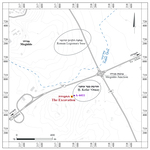
During July 2022, a salvage excavation was conducted in Ḥorbat Kefar ‘Otnay inside Megiddo Prison, near Megiddo Junction (Permit No. A-9615; map ref. 217948/719565; Fig. 1), prior to building a water tank. The excavation, on behalf of the Israel Antiquities Authority and funded by the Ministry of Defense, was directed by N. Benenstein (field photography) with the assistance of J. Zilpa (administration), A. Efron (field photography and photogrammetry), E. Dalali-Amos (plan and sections), A. Shapiro (location map) and B. Hana and R. Be’eri (scientific guidance).
The excavation area was on a spur south of Naḥal Qeni in an area that was identified as Kefar ‘Otnay. During the Roman period, the area was named Legio after the permanent garrison of the Sixth Legion (Ferrata), which was located on a hill south of Tel Megiddo. Remains of a settlement dating to the Roman and Byzantine periods, including a Christian prayer hall, were found in an excavation that was conducted in 2005 in the western part of the jail, about 25 m east of the current excavation (Tepper 2006 [Fig. 1: A-4411]).
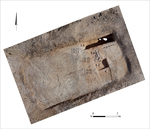
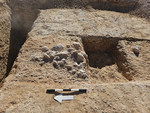
A cluster of small and medium-sized fieldstones (L4) with dark soil between them was exposed in the excavation (Figs. 2, 3). These were probably the remains of an installation. Underneath this cluster and in the northern part of the excavation area, two layers of dark brown soil (L3, L5 respectively) were found over the chalk bedrock. Numerous Roman-period pottery sherds were found in all loci.
References
Tepper Y. 2006. Legio, Kefar ‘Otnay. HA–ESI 118. https://doi.org/10.69704/jhaesi.116.2004.363
Keywords
Legio, installation, Roman period, Byzantine period
Publication Date
04/08/2026
Report Type
Final Report