
Yavne-Yam (A-9115)
Permit/License Number
A-9115
Excavation Report
During October 2021, a trial excavation was conducted in the Palmaḥim Beach National Park, within the site of Yavne-Yam (Permit No. A-9115; map ref. 171495/648159), following the identification of graves and human bones in probes carried out by M. Mermelstein, prior to building a kiosk. The excavation was directed by S. Dan-Goor, on behalf of the Israel Antiquities Authority and financed by the Israel Nature and Parks Authority, with the assistance of Y. Amrani (administration), A. Dagot (GIS), I. Jonish (surveying), M. Abu (drafting), A. Peretz (field photography), A. Tamir (metal detector), Y. Nagar (physical anthropology), D. Golan (assistance in dating pottery), I. Ktalav (mollusks), D. Aladjem (digital documentation), I. Naor (metal laboratory), D. Gazit (studio photography) and excavation workmen.
During the late 1960s, Y. Kaplan conducted excavations in the vicinity near a rampart (see Itach et al. 2024: Fig. 1), which was attributed to a Bronze Age settlement (Kaplan 1969; 1971). These excavations primarily yielded burials from the Middle and Late Bronze Ages. Excavations conducted in the 1980s near an Iron Age fortress south of the current excavation uncovered dozens of burials dating from the Chalcolithic to the Byzantine period (Ayalon 2005a). Additionally, the excavations revealed a well that was used from the Hellenistic period onwards and a Byzantine structure with a mosaic floor (Ayalon 2005b). Ten excavation seasons conducted since 1992 near the fortress and to its north identified settlement remains from the Late Bronze Age to the Early Islamic period (Fischer 2005). In an excavation conducted in 2007 south of Kibbutz Palmaḥim and c. 700 m north of the Yavne-Yam fortress, several Late Bronze Age pit and cist graves were exposed (Ajami and ‘Ad 2009). In 2022, an impressive Late Bronze Age burial cave (License No. Z-35/2022) was discovered adjacent to the current excavation.
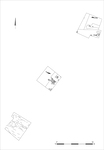
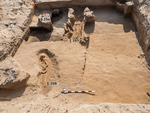
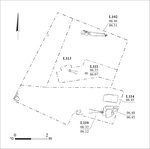
In the current excavation, three squares were opened on a north–south axis (Fig. 1). Pit and cist graves dating to the Late Bronze Age were found.
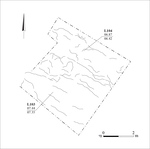
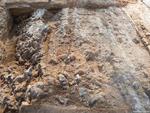
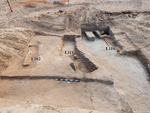
The Southern Square. Bedrock slanting northward (Figs. 2, 3; 3D model) was uncovered. No archaeological remains were found in this square.
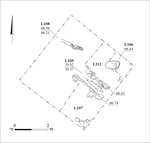
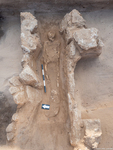
The Middle Square. Three graves with primary burials (L105, L106, L108; Figs. 4, 5; 3D model) were found. Grave 105 is a cist grave dug into the ground and lined with kurkar stones (Fig. 6). The grave contained a supine individual, oriented approximately northwest–southeast, with the head to the east and arms resting alongside the body. Although the bones were poorly preserved, the dimensions of skeleton fragments indicate the individual was over ten years old. Similar cist graves, dated to the Late Bronze Age, were uncovered in a nearby excavation (Permit No. A-7372).
Grave 106 is a pit grave dug into the ground (Fig. 7), which was damaged by infrastructure works. It contained small bone fragments and the cranial vault of an infant less than one year old.
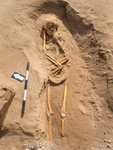
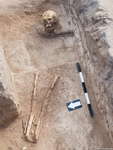
Tomb 108 is also a pit grave dug into the ground (Fig. 8). The interred individual was laid supine in an approximately southeast–northwest orientation, with the head to the southeast, arms flexed and hands crossed over the abdomen. The skull features a medium-sized glabella and a developed mastoid process, morphologically typical of a male (Bass 2005:82). In both the maxilla and mandible, the third molar had erupted; the upper central incisors were worn down to the dentine cup. This is characteristic of a 30–40 years old individual (Hillson 1986:176–201).
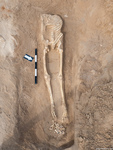
The Northern Square. Four graves with primary burials (L102, L110, L111, L114; Figs. 9, 10; 3D model) were uncovered. Grave 102 is a pit grave, dug into the ground (Fig. 11). The interred individual was supine and oriented approximately east–west, with the head to the west. The left arm was slightly flexed with the hand resting on the abdomen, and the right arm rested along the body. The skull was damaged during modern construction. The epiphyses of the long bones, the vertebrae and the pelvis are fused; this is typical of individuals over 18 years old (Johnston and Zimmer 1989). The age was further refined based on the cranial vault; the bones comprising the cranial vault are separated along the sutures, a condition characteristic of an individual over 35 years old (Hershkovitz et al. 1997). The horizontal diameter of the proximal end of the femur is c. 39 mm, a measurement typical of females (Bass 2005:230).
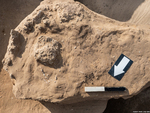
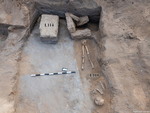
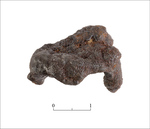
Grave 110 is another pit grave dug into the ground (Fig. 12), containing a supine individual oriented approximately east–west, with the head to the west. The epiphyses of the long bones are fused, typical of an individual over 18 years old (Johnston and Zimmer 1989). Two teeth from the mandible were found: a second molar with the dentine exposed on one cusp and an erupted third molar with a closed root. Based on dental wear, the individual’s age is estimated to be around 20–30 years old (Hillson 1986:176–201). The sex of the individual is unclear. A poorly preserved metal object, which may be a ring, was found on the skeleton (Fig. 13).
East of and adjacent to the legs of the individual in Grave 110, hewn stones were uncovered. These likely belong to another grave that was not excavated because most of it is within the excavation balk.
Grave 111 is a pit grave dug into the ground (Fig. 14). It contained a supine individual, oriented approximately southeast–northwest, with the head to the southeast. Although the ends of the long bones were crumbled, the deceased was determined to be over 15 years old.
Grave 114 is a cist grave (Fig. 12), of which only a single cover slab was preserved in situ. There were no finds below this stone slab. North of this grave, another cover slab was found, which may belong to the same grave.
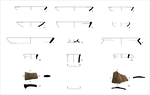
The Pottery Finds. Pottery sherds characteristic of the Late Bronze Age were found in all three squares. These include bowls (Fig. 15:1–7), a ring base of Cypriot bowl (Base Ring; Fig. 15:8), cooking pots (Fig. 15:9), jars (Fig. 15:10, 11), jugs (Fig. 15:12), the handle of a Cypriot Base-Ring jug (Fig. 15:13) and a body sherd of a Cypriot Base-Ring jug with plastic decoration (Fig. 15:14). A few Byzantine-period pottery sherds (not illustrated) were also found.
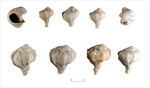
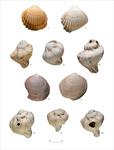
Mollusks. Clusters of Mediterranean mollusks were found in the middle and northern squares; these were collected on the shore and not processed by humans. They were not suitable for eating or producing dye, so they were probably collected for another unclear purpose. North of Grave 105, nine Bolinus brandaris shells (L112; Fig. 16) were found. Ten shells from various species were found in an earthen fill next to the cover slab of Grave 114, including two Acanthocardia tuberculata shells (Fig. 17:1, 2), three Hexaplex trunculus shells (Fig. 17:3–5), two Glycymeris nummaria shells (Fig. 17:6, 7) and three Bolinus brandaris shells (Fig. 17:8–10).
The present excavation exposed an additional part of a Late Bronze Age cemetery known from previous excavations near Yavne-Yam. Cist and pit graves, all oriented approximately east–west, were found. In the southern part of the excavation where the bedrock is higher, no quarrying marks or burials were found. The area could not be used for burials because, as is characteristic of this site, graves were dug exclusively into the ground.
References
Ajami M. and ‘Ad U. 2009. Yavne-Yam (North). HA–ESI 121. https://doi.org/10.69704/jhaesi.116.2004.1263
Ayalon E. 2005a. Tombs from the Roman Period at Yavneh-Yam. In M. Fischer ed. Yavne, Yavne-Yam and their Neighborhood. Tel Aviv. Pp. 217–221 (Hebrew).
Ayalon E. 2005b. An Irrigation System from Byzantine Yavneh-Yam. In M. Fischer ed. Yavne, Yavne-Yam and their Neighborhood. Tel Aviv. Pp. 229–252 (Hebrew).
Bass W.M. 2005. Human Osteology. A Laboratory and Field Manual (5th edition). Columbia, MI.
Fischer M. 2005. The Archaeology and History of Yavneh-Yam. In M. Fischer ed. Yavne, Yavne-Yam and their Neighborhood. Tel Aviv. Pp. 178–208 (Hebrew)
Hershkovitz I., Latimer B., Dutour O., Jellema L.M., Wish-Baratz S., Rothschild C. and Rothschild B.M. 1997. Why do We Fail in Aging the Skull from the Sagittal Suture? American Journal of Physical Anthropology 103:393–400. https://doi.org/10.1002/(SICI)1096-8644(199707)103:33.0.CO;2-R
Hillson S. 1986. Teeth. Cambridge, UK.
Itach G., Yasur-Landau A., Ben-Dor Evian S. and Edrey M. 2024. Yavne-Yam. HA–ESI 136. https://doi.org/10.69704/jhaesi.116.2004.26593
Johnston F.E. and Zimmer L.O. 1989. Assessment of Growth and Age in the Immature Skeleton. In M.Y. Iscan and A.R. Kenneth eds. Reconstruction of Life from the Skeleton. New York. Pp. 11–22.
Kaplan J. 1969. Yavne-Yam – 1968. HA 30:16–17 (Hebrew).
Kaplan J. 1971. Yavne-Yam – 1969. HA 38:24–25 (Hebrew).
Keywords
pit graves, cist graves, Late Bronze Age, cemetery, primary burial, Mollusks
Publication Date
06/09/2026
Link to Excavation Repository
Report Type
Final Report