
Ḥorbat Qasṭra (South) (A-9554)
Permit/License Number
A-9554
Excavation Report
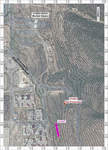
During April 2023, a salvage excavation was conducted south of Ḥorbat Qasṭra (Castra), Haifa (Permit No. A-9554; map ref. 197672–7/743562–70; Fig. 1), in preparation for construction. The excavation, on behalf of the Israel Antiquities Authority and financed by Yefe Nof Transportation and Infrastructures Ltd., was directed by A. Gabay, with the assistance of A. Oshri (preliminary inspection), Y. Amrani and Z. Lotan (administration), S. Emmanuilov (photogrammetry, surveying, field photography and plans), D. Kirzner (metal detector), Y. Tepper (scientific guidance), K. Sa‘id, N. Shachar and other employees from the IAA Haifa District and workmen from the village of Deir Sharaf near Nablus.
The excavation was located on the western slope of the Carmel Ridge, north of Naḥal Aḥuzza and c. 350 m south of Ḥorbat Qasṭra, where remains of a large settlement from the Roman–Early Islamic periods and Ottoman period were exposed. Some scholars associate Qasṭra with a city of the same name mentioned in Jewish and Christian sources that flourished during the Byzantine period (Oren 2014; Oren 2021). Surveys conducted in the vicinity of the excavation area documented a lime kiln and a cistern (Olami, Ronen and Romano 2003: Sites 76, 77). A previous excavation in the area uncovered caves and installations from the Hellenistic–Byzantine periods (Permit No. A-9337). A hewn installation and a stone heap were uncovered in the present excavation.
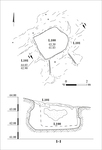
A poorly preserved square installation hewn into bedrock (L100; 2.5 × 2.5 m, depth 1.5 m; Fig. 2; 3D model) was found. Remnants of plaster were discovered on the sides of the installation, and the corners of the floor were rounded inwards, suggesting that the installation was plastered. On the surrounding bedrock, three channels connected to the installation (L101) were hewn. The southern two transported liquid to the installation, while the northern one transported liquid from the installation northward. A hewn cupmark (diam. and depth c. 0.1 m) was exposed between the two southern channels, and four hewn cupmarks (diam. and depth c. 0.1 m) were uncovered next to the northern channel.
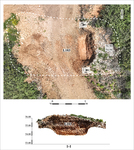
Approximately 100 m west of the hewn installation, excavations revealed a large stone heap (L103; 9 × 14 m, height 1.3 m; Fig. 3; 3D model) composed mostly of small fieldstones laid directly on the bedrock slope. The stone heap may be related to industrial or agricultural activity in the vicinity of the site.
Despite the installation’s poor state of preservation, it is possible to suggest that it served as a collecting vat for a winepress that did not preserve. Three similar Byzantine-period winepresses were uncovered in Moshav Ha-Bonim, c. 17 km south of the excavation (‘Ad 2011); the shapes and sizes of their collection vats are similar to the one uncovered in this excavation, but in these examples, mosaic-paved steps led to the collecting vat. If the installation uncovered in this excavation is indeed part of a winepress, it contributes information about the agricultural hinterland of Ḥorbat Qasṭra during the Byzantine period.
References
‘Ad U. 2011. Ha-Bonim (South). HA–ESI 123. https://doi.org/10.69704/jhaesi.116.2004.1687
Olami Y., Ronen A. and Romano A. 2003. Map of Haifa—West (22) (Archaeological Survey of Israel). Jerusalem
Oren E. 2014. H̲orbat Castra. HA–ESI 126. https://doi.org/10.69704/jhaesi.116.2004.8534
Oren E. 2021. H̲orbat Qastra. HA–ESI 133. https://doi.org/10.69704/jhaesi.116.2004.25997
Keywords
Naḥal Aḥuzza, hewn installation, stone heap, winepresses, Moshav Ha-Bonim
Publication Date
06/09/2026
Link to Excavation Repository
Report Type
Final Report