
Ha-Bonim (A-9699)
Permit/License Number
A-9699
Excavation Report
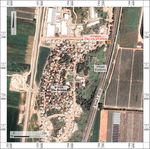
During November 2023, a salvage excavation was conducted in Moshav Ha-Bonim (Permit No. A-9699; map ref. 194189–215/727123–41; Fig. 1), prior to widening the Moshav’s access road. The excavation, on behalf of the Israel Antiquities Authority and financed by Moshav Ha-Bonim, was directed by A. Gabay, with the assistance of Y. Amrani and Z. Lotan (administration), D. Kirzner (preliminary probes and metal detector), A. Khalatov (photogrammetry, surveying and drafting and plans), P. Gendelman (pottery), M. Shuiskaya (pottery scanning) and Y. Tepper (scientific guidance). Help was also rendered by K. Sa‘id and N. Shachar from the Haifa District and workmen from Umm el-Fahm and Kafr Qari‘.
Moshav Ha-Bonim was built during the Ottoman period over the remains of an ancient settlement known as Kafr Lamm. The village was documented in historical sources like the writings of the Arab geographer Yaqut al-Hamawi (1178–1229 CE; ‘Ad 2017:9–10), and the name was probably a distortion of the Crusader name, Kafer Lia. E. von Mülinen was the first to document the ancient remains at the site (Geva-Kleinberger and Ben-Artzy 2013:323–330). Surveys and excavations in the surrounding area uncovered burial caves and quarries from the Persian, Hellenistic and Roman periods, remains of a flourishing Byzantine-period settlement and a Crusader-period fortress that remained in use until the Ottoman period (‘Ad 2017).
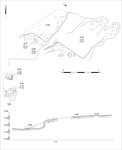
The excavation (Fig. 2) was located at the foot of the slope north of the fortress. It uncovered a quarry (L14) and, to the southeast, remains of a circular installation (L15), with an adjacent plaster floor (L16). Pottery dating from the Persian to the Mamluk period was also found.
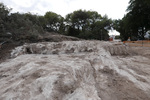
In Quarry 14 (0.6 × 8.5 m; Fig. 3; 3D model), two quarrying levels separated by a slanting rock exposure, were discovered, one 0.7 m higher than the other. The floor of the quarry is flat, and its sides are upright and straight. In some spots, the walls retained remnants of mortar mixed with shell-fragments, which were probably part of an installation cast of mortar. Two hewn pits (L17, L18) were found next to the quarry. These may have been used to anchor poles that supported awnings (Porath, ‘Ad and Sa‘id 2023:165) or crane-like implements used to move quarried blocks (Safrai and Sasson 2001:43–45).
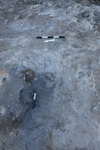
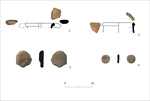
Installation 15 (0.2 × 0.3 m; Fig. 4; 3D model) was built of mortar; when it was dismantled, the recovered pottery (not illustrated) indicates that it was built during the Byzantine period or later. Adjacent to the installation, there was Floor 16 (0.5 × 0.5 m), which was made of plaster. Pottery sherds of a fourth–second centuries BCE jug (Fig. 5:2; Basket 125/1), first–third centuries CE amphora (Fig. 5:1; Basket 125/2) and two clay stoppers of unknown date (Fig. 5:3, 4; Baskets 125/3, 125/4) were found in the floor’s bedding. These indicate that the floor was built during the Roman period or later.
The excavation contributes to our understanding of the site during the Roman and Byzantine periods, the area surrounding the fortress and the nearby quarries. Despite the large size of the pottery assemblage, containing hundreds of sherds, Ottoman-period pottery is remarkably absent. This may indicate that the settlement did not extend north of the fortress during this period.
References
‘Ad U. 2017. A Church and Agricultural Installations South of Moshav Ha-Bonim. ‘Atiqot 88:9*–42* (Hebrew; English summary, pp. 155–156). https://doi.org/10.70967/2948-040X.1795
Geva-Kleinberger A. and Ben-Artzy Y. 2013. Mount Carmel of Graf Von Mülinen. Jerusalem (Hebrew).
Porath Y., ‘Ad U. and Sa‘id A.S. 2023. The Naḥal Tanninim Dam and Its Vicinity: Final Report of the 2000–2005 Excavation Seasons (IAA Reports 71). Jerusalem. https://doi.org/10.2307/jj.3452813
Safrai Z. and Sasson A. 2001. Quarrying and Quarries in the Land of Israel in the Period of the Mishnah and Talmud. Elkana (Hebrew; English summary, pp. 115–117).
Keywords
Kafr Lam, quarry, installations, fortress, Persian period, Hellenistic period, Roman period, Byzantine period, Mamluk period
Publication Date
06/09/2026
Link to Excavation Repository
Report Type
Final Report