
Abu Ghosh, ‘Abd el-‘Aziz Street (A-8975)
Permit/License Number
A-8975
Excavation Report
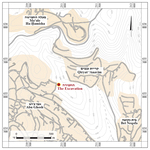
In March 2021, a salvage excavation was conducted east of Khirbat Deir esh-Sheikh, next to ‘Abd el-‘Aziz Street, Abu Ghosh (Permit No. A-8975; map ref. 210924/635154; Fig. 1), after an installation was discovered in probes undertaken prior to development. The excavation, on behalf of the Israel Antiquities Authority and funded by the land-owner ‘Imad Jaber, was directed by H. Shliker, with the assistance of D. Ben-Ayoun (probes), S. Halevi (photogrammetry), O. Zakaim (plan) and the landowner’s workers.
Field walls, cultivation terraces, agricultural installations, paths, burial caves and scattered flint items, dating to several periods, were found during a survey conducted in the vicinity of the excavation, and specifically at Khirbat Deir esh-Sheikh (Greenwald and Barda 2012).
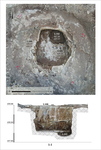
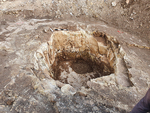
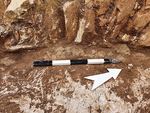
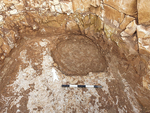
The excavation focused on the installation (L101; 1.8 × 2.1 m, depth 1.3 m; Figs 2, 3) and its surroundings. The installation was a poorly preserved, square pit quarried into the bedrock, and only its northwestern corner was clearly discernible. Remains of gray hydraulic plaster with white inclusions were extant on the installation floor and minimally on its sides (Fig. 4). An oval plastered basin (L102; 0.75 × 0.85 m, depth 0.15 m; Fig. 5) was quarried into the floor of the installation. Since no treading floor or drainage channel were found near the installation, it was probably a free-standing installation rather than a winepress collecting vat, although the possibility that it was an element of the wine or olive oil production industry—common in the area over a long period—cannot be ruled out. The installation could not be dated as no datable finds were found.
References
Greenwald R. and Barda L. 2012. Abu Ghosh (North), Survey. HA–ESI 124. https://doi.org/10.69704/jhaesi.116.2004.1973
Keywords
Hewn installation, Plastered installation, Agricultural industry
Publication Date
20/05/2026
Report Type
Final Report