
Yehud, Marvad Ha-Qesamim Street (A-9633)
Permit/License Number
A-9633
Excavation Report
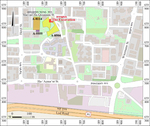
During August 2023, a trial excavation was conducted within the boundaries of Tel Yehud, on the southern side of Marvad Ha-Qesamim Street in Yehud (Permit No. A-9633; map ref. 189489–509/659828–38; Fig. 1), prior to extending the municipal library building. The excavation, on behalf of the Israel Antiquities Authority and financed by the Yehud Economic Development Company Ltd., was directed by V. Eshed, with the assistance of D. Masarwa (preliminary inspection), Y. Amrani and Z. Lotan (administration), I. Jonish (surveying, drafting and field photography), A. Dagot (GPS), A. Bouchenino (pottery), M. Shuiskaya (pottery drawing), R. Lewis-Bloom and Y. Gorin-Rosen (glass; Appendix 1), I. Lidsky-Reznikov (glass drawing), D. Gazit (glass and metal artifacts photography), I. Reznitsky (metallurgy laboratory), I. Naor (treatment and conservation of finds), R. Kool (numismatics) and Y. Tepper (scientific guidance).
The excavation was located south of the municipal library and north of the purported tomb of the biblical patriarch Yehuda Ben Ya‘aqov (Fig. 1). Settlement remains dating from the Chalcolithic period to the British Mandate era were found in prior excavations conducted in the site’s vicinity (e.g., Jakoel and van den Brink 2014; Korenfeld and Bar-Natan 2014; Zwiebel 2019; Elisha and Jakoel 2023). The exposed findings include many tombs evincing Muslim burial practices. Characteristic features of the tombs include the use of limestone coverings of various sizes, east–west orientation of the graves, placement of the deceased on the right side and positioning the head at the western end facing south (Gorzalczany 2009; Zwiebel 2019; Elisha and Jakoel 2023).
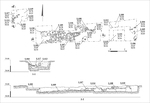
In the present excavation, four squares (Fig. 2; 3D model) were opened, three south of the library building and one to the west. A stone floor and finds from the end of the Byzantine–beginning of the Early Islamic period were uncovered, as well as seven poorly preserved graves, among them pit graves, a cist grave and an infant jar burial. The graves were not excavated, so their date remains unclear. One, however, damaged the stone floor, so the graves may post-date it.
Architectural Remains and Finds from the End of the Byzantine–Beginning of the Early Islamic Period
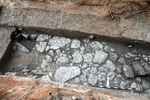
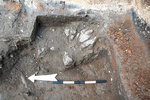
A floor (L109; Fig. 3) of flat fieldstones (0.5 × 1.0 m) was exposed. To date the floor, two pavers were removed from its northwestern part (L120). The pottery fragments (not illustrated) found beneath were dated to the end of the Byzantine–beginning of the Early Islamic period. Soil accumulations (L100, L103, L111) containing pottery fragments (below, Figs. 10, 11), glass vessels (Appendix 1) and coins (below) dating to the end of the Byzantine and beginning of the Early Islamic periods were found in the upper part of the excavation area.
Graves
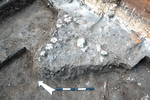
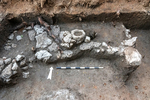
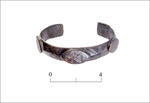
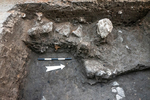
Pit Graves (L104, L105, L108, L110, L113; Fig. 4). Five shallow pit graves dug into dark alluvial soil were uncovered. Most were oriented east–west and covered by fieldstones of various sizes. The graves were used for single burials. One of the cover stones of Grave 110 was a grinding basin in secondary use (Fig. 5). In addition, two stone clusters (L115, L117) were found, and each may originate from the cover of a pit grave that did not survive. Near Stone Cluster 115, there was a metal bracelet (Fig. 6) that perhaps belonged to the deceased from this grave. Underneath Grave 113 and the adjacent Stone Cluster 117 was a thick burnt layer (L119; thickness c. 0.5 m; Fig. 7).
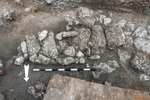
Cist Grave (L107; Fig. 8). A cist grave was built on an east–west axis of fieldstones in a range of sizes and covered with flat stone slabs. The grave damaged the eastern part of Floor 109, and therefore the grave may post-date the floor.
Infant Jar Burial (L106; Fig. 9). Remains of a jar were found in the southeastern part of the excavation area. It contains remnants of bones and may represent an infant burial.
The Pottery
Aviva Bouchenino
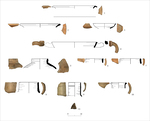
A single imported bowl and a range of local vessels dated to the end of the Byzantine–beginning of the Early Islamic period were found in the excavation. A small fragment of a panel from a magical clay mirror (Fig. 10:11) that was dated to the Byzantine period was also found. A similar fragment dated to the Byzantine period was found in an excavation in Usha, and the excavators also considered it to be part of a magical mirror.
Imported Bowl (Fig. 10:1). A Type C10 LRC bowl, dated to the second half of the seventh century CE, was found. The vessel has a thickened square rim and a widening, out-leaning wall.
Bowls (Fig. 10:2, 3). Two FBW bowls were found. Bowl No. 2 is of Magness’ Type C2 and has a ledge rim and diagonal walls; it is dated between the second half of the seventh century and the ninth–tenth centuries CE. Bowl No. 3 is of Magness’ Type C1. It is shallow and has a simple rim, carinated body and shallow ring base. The bowl is dated to the end of the seventh–mid-eighth century CE.
Casserole (Fig. 10:4). An open shallow casserole with a flat rim designed to accommodate a lid and horizontal handles with a double twist, was found. The type is common at sites in Israel, and it is dated to the fourth–ninth centuries CE.
Coastal Bag-Shaped Jars (Fig. 10:5–7). These jars are common in the excavation. They were manufactured along the coastal plain and are dated to the fifth–ninth centuries CE. They appear in a range of shapes and have a rounded rim leaning or folded out, a short, sometimes swollen neck, a barrel-shaped body and ribbed wall, two vertical loop handles and a rounded or sometimes flat base. Jar No. 5 has a rounded rim leaning slightly out, a short bulbous neck and dense ribbing on the shoulder. Jar No. 6 has an in-turned rim and a short neck. Jar No. 7 has a rounded, out-folded rim and a short neck.
Zir Jar (Fig. 10:8). The jar has a thickened in-turned rim and a straight long neck. It is Magness’ Type 6A and is dated to the end of the sixth–eighth centuries CE.
Juglets (Fig. 10:9, 10). Juglet No. 9 is common to the Abbasid period. The vessel has a fine rim leaning slightly out and a tall neck decorated with straight combed lines just below the rim. Juglet No. 10 has a triangular out-leaning rim and a funnel-shaped neck widening towards the rim. It is dated to the mid-sixth–beginning of eighth centuries CE.
Coins
Three identifiable coins were found: (1) a Roman coin minted in Aelia Capitolina and dated to 100–160 CE (L101; IAA No. 189173); (2) a Late Roman coin dated to 324–497 CE (L100; IAA No. 189172); (3) an Umayyad coin (fals) minted in Damascus and dated to 697–750 CE (L101; IAA No. 189174).
Conclusion
A stone floor uncovered in this excavation was dated according to pottery, glass and coin finds to the end of the Byzantine–beginning of the Early Islamic period. The pit and cist graves that were found during the excavation were oriented east–west and covered with a single course of fieldstones in a range of sizes, like graves found in the vicinity of the site in previous excavations. Based on their characteristics, the graves likely belong to a Muslim population. Since the cist tomb damaged the stone floor, that tomb, and by extension the other exposed graves, likely post-date the floor.
References
Avissar M. 1996. The Medieval Pottery. In A. Ben-Tor, M. Avissar and Y. Portugali. Yoqne‘am I: The Late Periods (Qedem Reports 3). Jerusalem. Pp. 75–172.
Elisha Y. and Jakoel E. 2023. Tel Yehud. HA-ESI 135. https://doi.org/10.69704/jhaesi.116.2004.26326
Gendelmann P. 2012. The Pottery from Ḥorbat Biẓ‘a. ‘Atiqot 70:33*–47*. https://doi.org/10.70967/2948-040X.1534
Gendelman P. and Sa‘id K. 2021. Pottery of the Persian, Hellenistic, Roman and Byzantine Periods at Kerem Maharal. ‘Atiqot 105:23–47. https://doi.org/10.70967/2948-040X.1898
Gorzalczany A. 2009. An Early Islamic Site and a Late Islamic Cemetery in Arab Kefar Sava. ‘Atiqot 61: 83*–96* (Hebrew; English Summary, pp. 139–140). https://doi.org/10.70967/2948-040X.1491
Hayes J.W. 1972. Late Roman Pottery. London.
Jakoel E. 2021. Remains from the Chalcolithic, Roman, Byzantine and Ottoman Periods at Yehud, Ashkenazi Market. ‘Atiqot 105:1*–42* (Hebrew; English summary, pp. 163–164). https://doi.org/10.70967/2948-040X.1893
Jakoel E. and van den Brink E.C.M. 2014. Tel Yehud, Lugano Project. HA-ESI 126. https://doi.org/10.69704/jhaesi.116.2004.13708
Korenfeld I. and Bar-Nathan R. 2014. Yehud. HA-ESI 126. https://doi.org/10.69704/jhaesi.116.2004.10581
Magness J. 1993. Jerusalem Ceramic Chronology: Circa 200–800 CE (JSOT/ASOR Monograph Series 9). Sheffield.
Zwiebel E. 2019. Tel Yehud. HA-ESI 131. https://doi.org/10.69704/jhaesi.116.2004.25553
Keywords
Tel Yehud, stone floor, late Byzantine period, early Islamic period, pit graves, cist grave, infant jar burial, Muslim burial, glassware, coins
Publication Date
06/09/2026
Link to Excavation Repository
Report Type
Final Report